
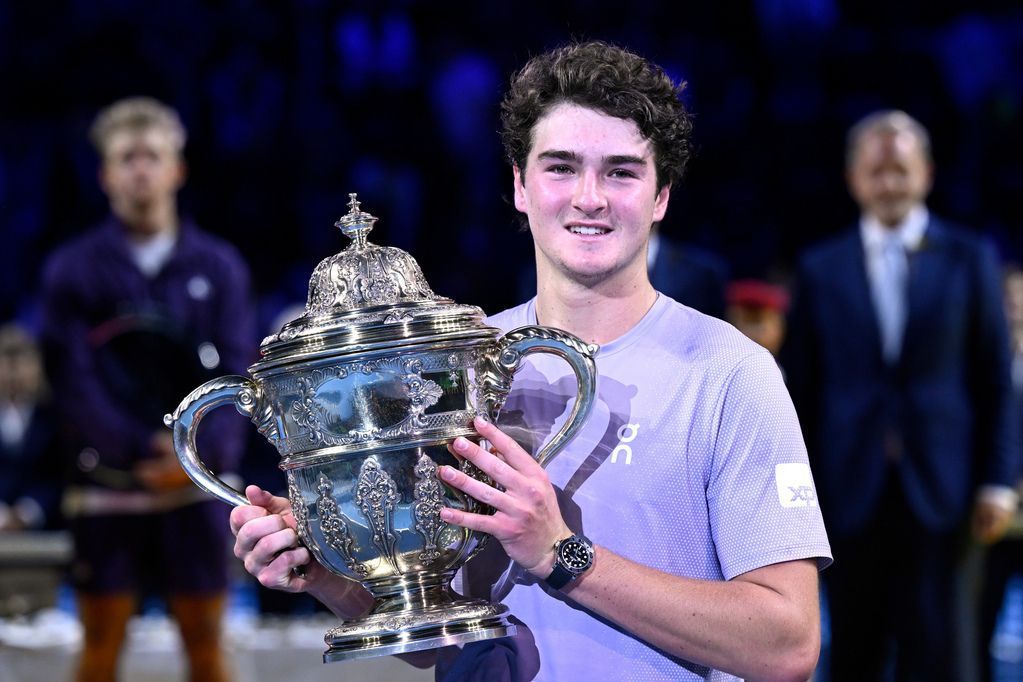
Joao Fonseca‘s Swiss Indoors triumph: A Rising Star’s breakthrough Moment
Basel, Switzerland – october 26, 2025, 22:44:21 ET – The St. Jakob Hall in Basel witnessed the coronation of a new champion this Sunday as 19-year-old Brazilian sensation Joao Fonseca secured his maiden ATP 500 title at the Swiss Indoors. Fonseca’s commanding 6-3,6-4 victory over spain’s alejandro Davidovich Fokina not only marks a career milestone but also signals a notable ascent in the world of professional tennis,propelling him to a projected career-high ranking of No. 28 on Monday, October 27th. This win isn’t just about a trophy; it’s a testament to dedication, strategic gameplay, and the powerful influence of family support.
Did You Know? Fonseca is the youngest Brazilian to win an ATP 500 title since Gustavo Kuerten in 1997, highlighting the resurgence of Brazilian tennis talent.
The Path to Victory: Fonseca’s Performance Analysis
The final against Davidovich Fokina was a masterclass in controlled aggression. Fonseca, known for his powerful serve and increasingly refined groundstrokes, consistently pressured his opponent. according to data from the ATP Tour, Fonseca landed 78% of his first serves, a crucial factor in dictating the pace of the match. He also demonstrated remarkable efficiency on return, converting 40% of break point opportunities.
This performance builds on a strong showing throughout the tournament, where Fonseca overcame challenging opponents, including veteran players and rising stars. His ability to maintain composure under pressure,a trait often lacking in younger players,was particularly evident in the crucial moments of the final. Recent analysis by Tennis insights (October 2025) points to Fonseca’s improved net game as a key differentiator, allowing him to finish points decisively.
Pro tip: Young players aspiring to emulate Fonseca’s success should focus on developing a consistent first serve and improving their net play. These are often overlooked areas that can provide a significant competitive advantage.
A Family Affair: The Emotional Core of Fonseca’s Success
The victory was made even more poignant by the timely arrival of Fonseca’s family. Just hours before the final, his parents, originally scheduled to travel to the Paris Masters, rerouted their flights to Basel, accompanied by his uncles. “My parents have just arrived from Brazil. They were going to Paris [for the Paris Masters], but they changed their flights and arrived an hour before the match with my uncles,” Fonseca shared in a post-match interview. “It’s unbelievable to have them here for the most vital title of my career.”
This anecdote underscores the vital role of family support in the demanding world of professional sports. The presence of loved ones provides not only emotional encouragement but also a grounding influence, helping athletes navigate the pressures of competition. Consider the story of Carlos Alcaraz, whose family’s unwavering support has been consistently cited as a key factor in his rapid rise to the top of the tennis world. The emotional impact of having family present during such a pivotal moment is undeniable, and Fonseca’s story is a powerful illustration of this.
The Swiss Indoors, a tournament steeped in history and tradition, has consistently served as a launchpad for future stars. From Roger Federer to Novak Djokovic, many of the game’s greats have honed their skills on the indoor courts of Basel. Fonseca’s victory adds his name to this illustrious list, suggesting a bright future for the young Brazilian.
The Broader context: Brazilian Tennis on the Rise
Fonseca’s triumph isn’t an isolated event; it’s part of a broader resurgence of Brazilian tennis. Historically a powerhouse in the sport, Brazil experienced a period of decline in the early 2000s. However, recent investments in grassroots development programs and the emergence of talented young players like Fonseca and Thiago Seyboth Wild are signaling a return to prominence.
According to the Brazilian Tennis Confederation (CBT) data released in September 2025, participation in junior tennis programs has increased by 35% in the last three years. This surge in participation, coupled with improved coaching and facilities, is creating a fertile ground for future champions. the success





