
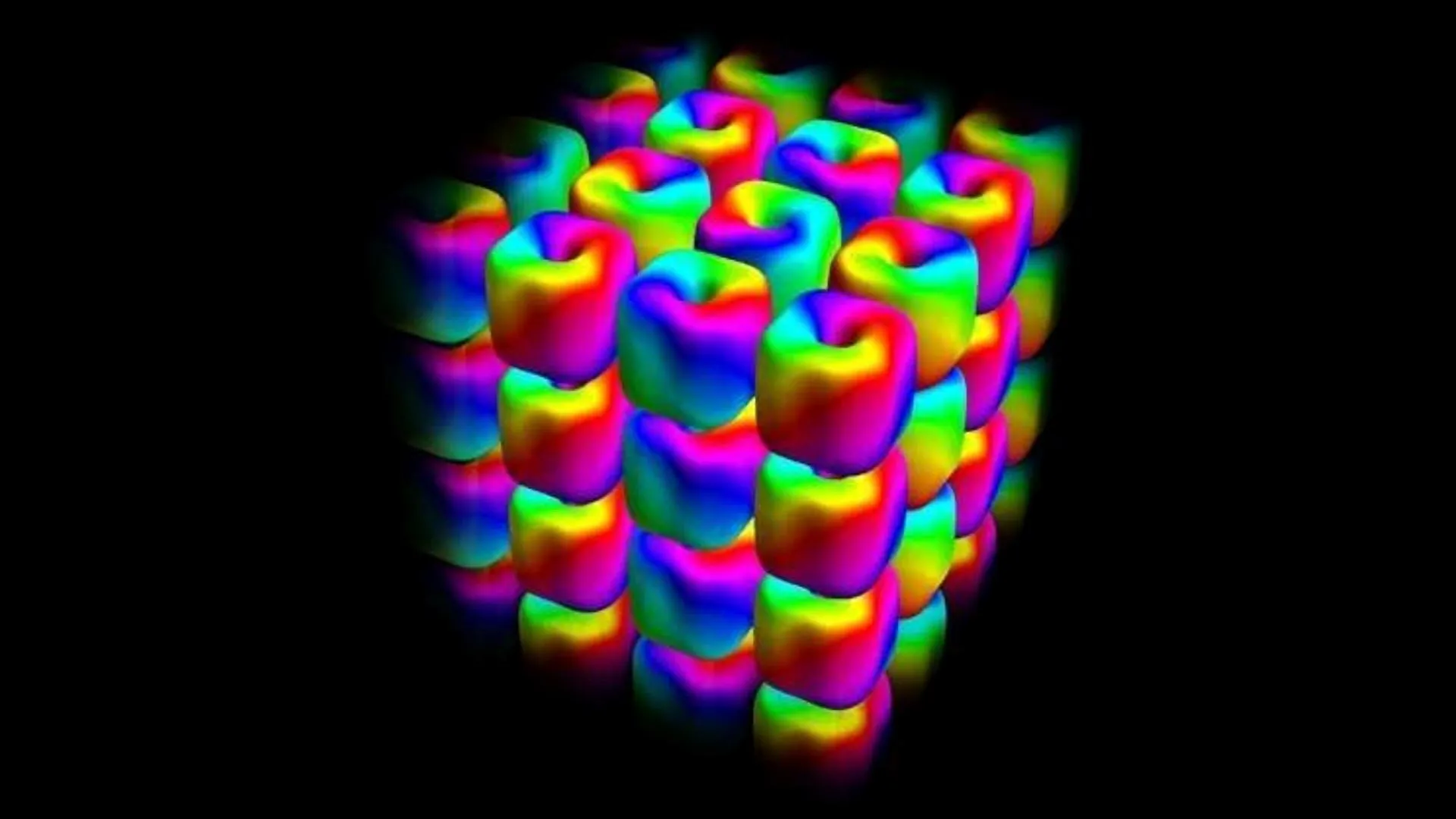
Spacetime Hopfion Crystals: A New Frontier in Robust Facts Processing
Have you ever imagined data storage so dense adn secure it’s virtually error-proof? Or communication systems resilient enough to withstand any interference? A groundbreaking international collaboration between researchers in Singapore and Japan has unveiled a blueprint for achieving just that – by harnessing the power of ”hopfion” crystals, intricate patterns of light woven through both space and time. This isn’t just a theoretical curiosity; it’s a potential revolution in photonics, promising advancements in data storage, communications, and even atom trapping.
This article delves into the science behind spacetime hopfion crystals, exploring their creation, properties, potential applications, and the challenges that lie ahead. We’ll break down the complex concepts into understandable terms, providing a thorough overview for anyone interested in the future of information technology.
Understanding Hopfions: knots of Light with Remarkable Potential
Hopfions are three-dimensional topological textures – think of them as knots of light where the internal “spin” patterns are interwoven into closed, interlinked loops. While observed or theorized in magnetic materials and light fields, they’ve traditionally been created as isolated entities. The breakthrough lies in the ability to assemble these hopfions into ordered,repeating arrays,mirroring the structure of crystals but extending this pattern into the temporal dimension.
This isn’t simply about arranging hopfions in space; it’s about creating a dynamic, evolving structure that repeats predictably over time. This temporal repetition is key to their potential for robust information processing.
The Recipe for Spacetime crystals: Bichromatic Light Fields
The researchers achieved this remarkable feat using a “bichromatic” light field – essentially, light composed of two different colors. By carefully layering beams with distinct spatial modes and opposite circular polarizations, they defined a ”pseudospin” that evolves in a controlled rhythm.
Here’s a breakdown of the process:
- two-Colour Approach: utilizing two distinct wavelengths of light is fundamental.
- Spatial Mode Control: manipulating the shape and direction of the light beams.
- Opposite Circular Polarizations: Employing light waves that rotate in opposite directions.
- Controlled Rhythm: When the two colors are set to a simple ratio, the resulting interference creates a repeating pattern, forming a chain of hopfions that recur with each cycle.
This process allows for precise control over the hopfion lattice, enabling researchers to tune its topological strength – essentially, how tightly the loops are woven.they can even flip the sign of this strength by simply swapping the wavelengths of light used. Simulations demonstrate near-perfect topological quality when the field is observed over a complete cycle.
From Chains to Crystals: Building Three-Dimensional Structures
The research doesn’t stop at one-dimensional chains. The team outlines a pathway to create true three-dimensional hopfion crystals. This involves a “far-field lattice” formed by an array of tiny emitters,each meticulously designed with tailored phase and polarization,and driven by the two close colors.This lattice naturally divides into subcells with opposing local topologies, yet maintains a clear, alternating pattern throughout the entire structure. The researchers propose practical layouts utilizing:
Dipole Arrays: Arrangements of tiny radiating elements.
grating Couplers: Structures that efficiently transfer light between different mediums.
Microwave Antennas: Devices used to emit and receive microwave radiation.
This design differs significantly from previous optical hopfion research,which relied on beam diffraction. Instead, this approach operates within a fixed plane, leveraging the periodic beating of the two colors to create the structure.
why This Matters: Applications and Future Implications
The implications of this discovery are far-reaching. Topological textures like skyrmions have already shown promise in dense, low-error data storage and signal routing. Extending this to hopfion crystals in light could unlock:
High-Dimensional Encoding: Storing more information in less space.
Resilient Communications: Creating communication systems less susceptible to interference.
atom Trapping Strategies: Developing new methods for manipulating and controlling atoms.
Novel Light-Matter Interactions: Exploring new ways for light and matter to interact.
As the authors state, the “birth of spacetime hopfion crystals” paves the way for condensed, robust topological information processing across optical, terahertz, and microwave domains. Read the original research paper in Nature Photonics* for a detailed scientific account.
Challenges and Future Research
While the potential is immense, challenges remain. Maintaining the topological integrity of these structures over long distances and in complex environments is a key area of focus.The researchers also investigated the conditions



![EV Charging News & Transportation Updates | [Year]](https://i0.wp.com/spectrum.ieee.org/media-library/image.jpg?resize=330%2C220&ssl=1 "EV Charging News & Transportation Updates | [Year]")


![EV Charging News & Transportation Updates | [Year]](https://i0.wp.com/spectrum.ieee.org/media-library/image.jpg?resize=150%2C100&ssl=1 "EV Charging News & Transportation Updates | [Year]")


