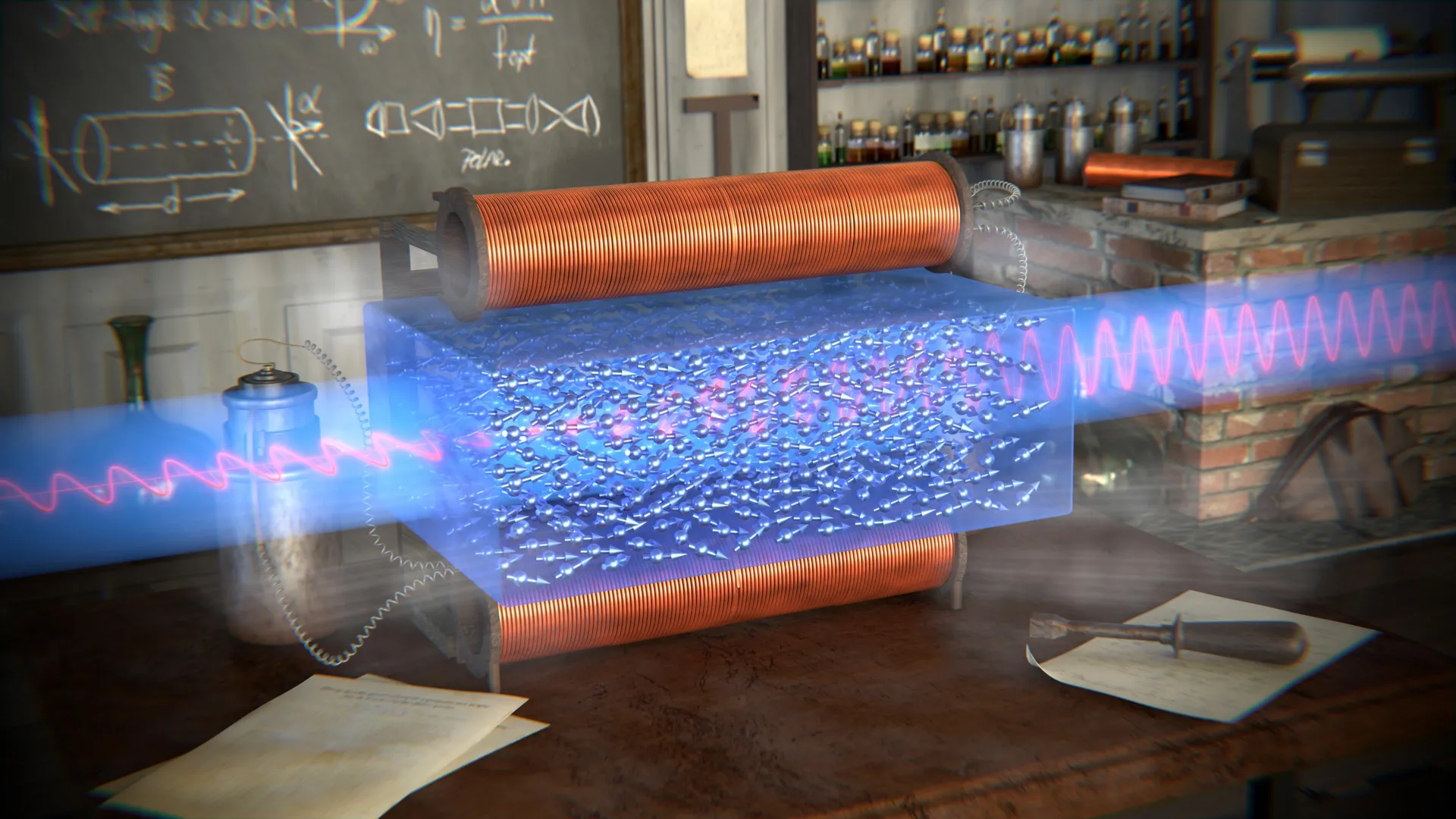
Light’s Hidden Power: New Research Reveals the Magnetic Component of Light Drives the Faraday Effect
For nearly two centuries, our understanding of how light interacts wiht matter has been fundamentally shaped by a single assumption: that only the electric field of light plays a role in phenomena like the Faraday Effect. Now, groundbreaking research from the Hebrew University of Jerusalem is challenging this long-held belief, revealing that the magnetic component of light is not merely a bystander, but an active participant – and a surprisingly powerful one. This revelation isn’t just a refinement of existing physics; it’s a potential catalyst for advancements in optics, spintronics, and the burgeoning field of quantum technologies.
the Faraday Effect: A Century-Old Mystery, now Partially unlocked
The Faraday Effect, discovered in 1842 by Michael Faraday, describes the rotation of the polarization of light as it passes through a material subjected to a magnetic field.Imagine shining a polarized light beam through a special crystal; the plane of polarization will twist as it travels. Scientists have long understood this “twist” as a result of the electric field of light interacting with the electric charges within the material.
But what if that’s only half the story?
A team led by Dr. Amir Capua and benjamin Assouline at the Hebrew University’s Institute of Electrical Engineering and Applied Physics has demonstrated, through rigorous theoretical calculations and analysis, that the oscillating magnetic field of light directly contributes to this effect. their findings, published in Scientific Reports (a Nature portfolio journal), represent the frist concrete evidence supporting this previously underestimated interaction.
Beyond Illumination: Light’s Magnetic Influence on Matter
“In simple terms,it’s an interaction between light and magnetism,” explains Dr. Capua. “The static magnetic field ‘twists’ the light, and the light, in turn, reveals the magnetic properties of the material. What we’ve found is that the magnetic part of light has a first-order effect, it’s surprisingly active in this process.”
the team’s breakthrough lies in applying the Landau-Lifshitz-gilbert (LLG) equation – a cornerstone of understanding how spins behave in magnetic materials – to model the interaction between light’s magnetic field and atomic spins. This revealed that light’s magnetic field can exert a torque on these spins, much like a static magnetic field would. Essentially, light isn’t just illuminating matter; it’s magnetically influencing it.
Quantifying the Magnetic Contribution: A Significant Impact
To validate their theoretical model, the researchers focused on Terbium Gallium Garnet (TGG), a crystal frequently used in Faraday Effect studies.Their analysis yielded compelling results: the magnetic component of light accounts for approximately 17% of the observed polarization rotation in the visible spectrum. However, this contribution dramatically increases in the infrared spectrum, reaching as high as 70%.
This isn’t a negligible effect.It signifies that a significant portion of the Faraday Effect – and potentially other light-matter interactions – has been attributed to the wrong source for nearly two centuries.
Implications for Future Technologies: A New Era of Light-Based Control
The implications of this discovery are far-reaching. By recognizing the magnetic influence of light, scientists can unlock new avenues for manipulating matter at a basic level. Here are just a few potential applications:
* Optical Data Storage: Harnessing light’s magnetic field coudl lead to more efficient and higher-density optical data storage solutions.
* Spintronics: Spintronics, a field focused on utilizing the spin of electrons for facts processing, could benefit from light-based control of magnetic materials. This could lead to faster, more energy-efficient electronic devices.
* Magnetic Control with Light: Imagine precisely controlling magnetic properties using only light – a capability that could revolutionize fields like materials science and engineering.
* Quantum Computing: The work may contribute to advancements in spin-based quantum computing,offering new ways to manipulate qubits (quantum bits) using light.
“Our results show that light ‘talks’ to matter not only through its electric field, but also through its magnetic field, a component that has been largely overlooked until now,” emphasizes Benjamin Assouline. This revised understanding opens up a new frontier in our exploration of light-matter interactions, promising a future where light’s full potential is finally realized.
Evergreen insights: The Expanding Role of Magnetism in Optics
The recognition of light’s magnetic component as a significant force in material interactions represents a paradigm shift in optics.Historically, the field has been dominated by the study of light’s electric properties. Though, the growing understanding of the interplay between light and magnetism is revealing a more complex and nuanced picture.This

![AEW National Title Defense: [Champion’s Name] at ROH – Date & Details](https://i0.wp.com/www.wrestlinginc.com/img/gallery/tony-khan-first-aew-national-champion-will-defend-new-title-at-upcoming-roh-event/l-intro-1763697053.jpg?resize=150%2C150&ssl=1 "AEW National Title Defense: [Champion’s Name] at ROH – Date & Details")