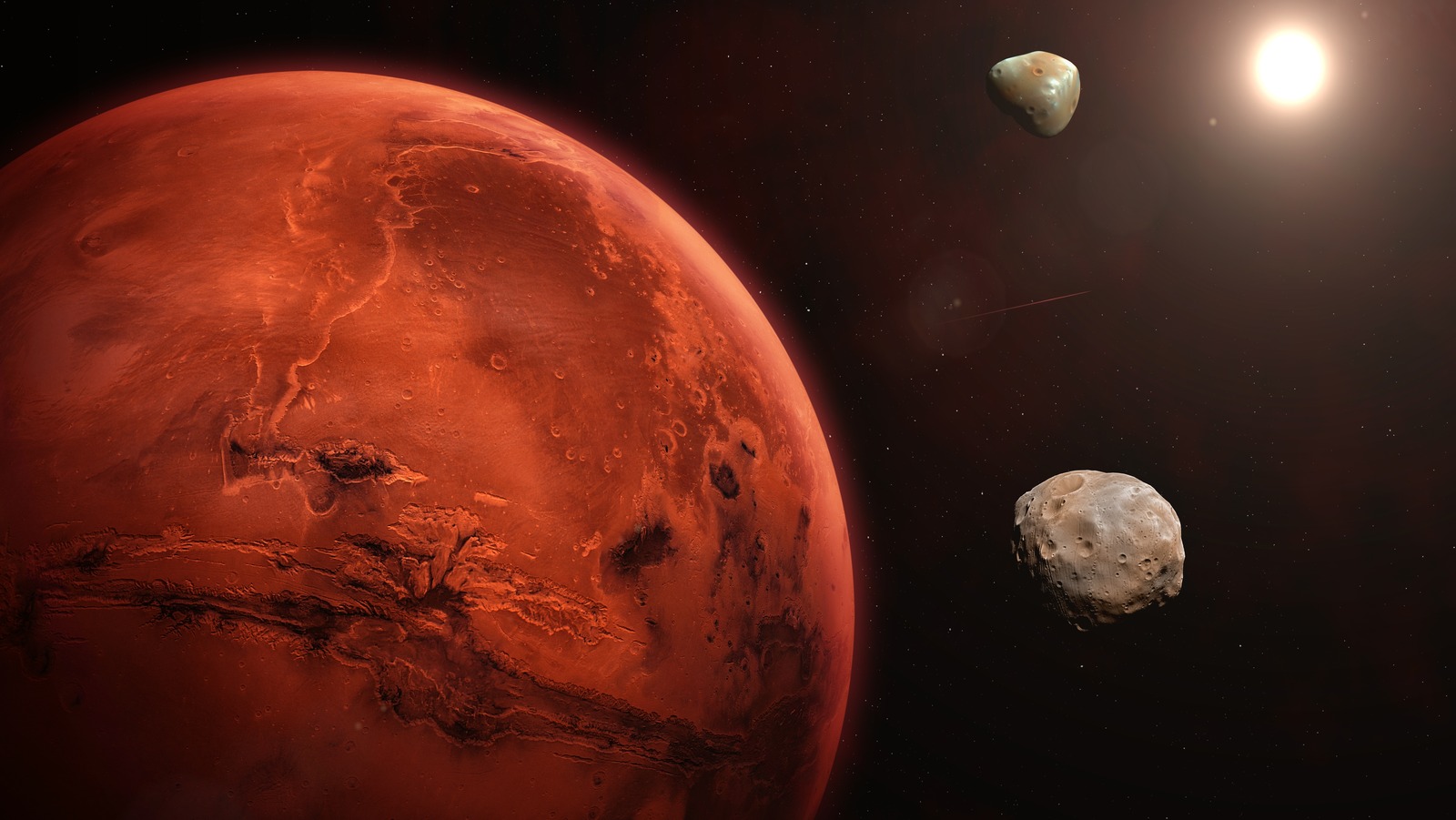
Unraveling the Mystery of Mars’ Moons: Phobos and deimos
For decades,scientists have pondered the origins of Mars’ two small moons,Phobos and Deimos. their peculiar shapes and compositions have fueled debate, leaving us with more questions than answers. But exciting new missions promise to finally unlock the secrets these celestial bodies hold.
The Enigmatic Moons
Phobos and Deimos are drastically different from most moons in our solar system. They’re small, irregularly shaped, and appear to be composed of materials unlike those found in the planets they orbit. This has led to two primary theories about their formation.
Are they captured asteroids, pulled into Mars’ gravitational embrace? Or did they originate from debris ejected from Mars itself during a massive impact event? The answer has remained elusive – until now.
Why Are These Moons So Strange?
Several characteristics make Phobos and Deimos stand out.
* their composition: They’re darker than most asteroids, suggesting they come from the outer reaches of the asteroid belt.
* Their orbits: Both moons orbit Mars very quickly and close to the planet.
* Their shapes: They aren’t spherical like our Moon, indicating they don’t have enough gravity to pull themselves into a round shape.
* Phobos’ impending doom: Phobos is spiraling inward towards Mars and is predicted to either crash into the planet or break apart into a ring within the next 50 million years.
The Leading Theories Explained
Let’s delve deeper into the two main hypotheses.
1. The Captured Asteroid Theory: This suggests Phobos and Deimos were asteroids wandering through space that Mars’ gravity snagged. This explains their dark composition and irregular shapes.However, the capture process is complex and requires specific conditions, making it a challenging scenario to fully support.
2. The Giant Impact Theory: This proposes that a massive collision with Mars early in its history ejected a vast amount of debris into orbit. Over time,this debris coalesced to form Phobos and Deimos.This theory aligns with the formation of our own Moon, but requires a specific type of impact and debris composition.
A Mission to Uncover the Truth
Our best hope for definitive answers lies with the Martian Moons eXploration (MMX) mission. This enterprising project, led by the Japanese Aerospace Exploration Agency (JAXA), is poised to revolutionize our understanding of these moons.
The spacecraft will orbit Mars and make multiple flybys of both Phobos and Deimos. Crucially, it will land on Phobos, collect a sample of its surface material, and return it to Earth for detailed analysis. I’ve found that sample return missions are invaluable, as they allow for laboratory analysis with instruments far more elegant than anything we can send to Mars.
What Will the MMX Mission Reveal?
The analysis of the Phobos sample could provide crucial clues.
* Compositional analysis: Determining the exact minerals and elements present will help pinpoint its origin. Is it rich in clay and silicate, supporting the asteroid theory? Or does it contain iron and other materials indicative of a Martian origin?
* Age dating: Establishing the age of the sample will help determine when Phobos formed, possibly linking it to specific events in Mars’ history.
* Internal structure: Studying the sample’s structure could reveal how Phobos formed and evolved over time.
The MMX mission is currently on track for a 2026 launch, with a planned return to Earth by 2031. It represents a pivotal moment in martian science.
The Future of Martian Moon Exploration
While we await the MMX mission’s results, scientists continue to study Phobos and Deimos using telescopes and computer models. However, remote observation has its limitations. With the return of a physical sample, we’ll finally have the prospect to truly pull back