New ‘Optical Sieve’ Offers Rapid, Affordable Detection of Nanoplastics – A Critical Step for Environmental & Health Research
The pervasive presence of plastic pollution is one of the defining environmental challenges of our time. While much attention focuses on visible plastic debris,the insidious threat of nanoplastics – particles smaller than a human hair and resulting from the breakdown of larger plastics - is only begining to be understood. These sub-micrometer particles pose a important concern due to their ability to bypass biological barriers, including the skin and even the blood-brain barrier, perhaps impacting both environmental and human health. However, detecting and quantifying these incredibly small particles has been a major hurdle for researchers – until now.
A collaborative effort between researchers at the University of Stuttgart and a team from Melbourne,Australia,has yielded a groundbreaking new method for rapid,affordable,and reliable nanoplastic detection. This innovation addresses a critical gap in our understanding of nanoplastic impacts and opens doors for more comprehensive environmental monitoring and health studies.
The Challenge of Nanoplastic detection
Traditional methods for analyzing nanoplastics, such as scanning electron microscopy, are ofen expensive, require highly trained personnel, and are time-consuming. These limitations have hindered widespread investigation into the distribution, concentration, and effects of nanoplastics in various environments. The sheer size of these particles – invisible to the naked eye – necessitates elegant techniques, creating a bottleneck in research progress.
introducing the ‘Optical Sieve’: A paradigm Shift in Nanoplastic Analysis
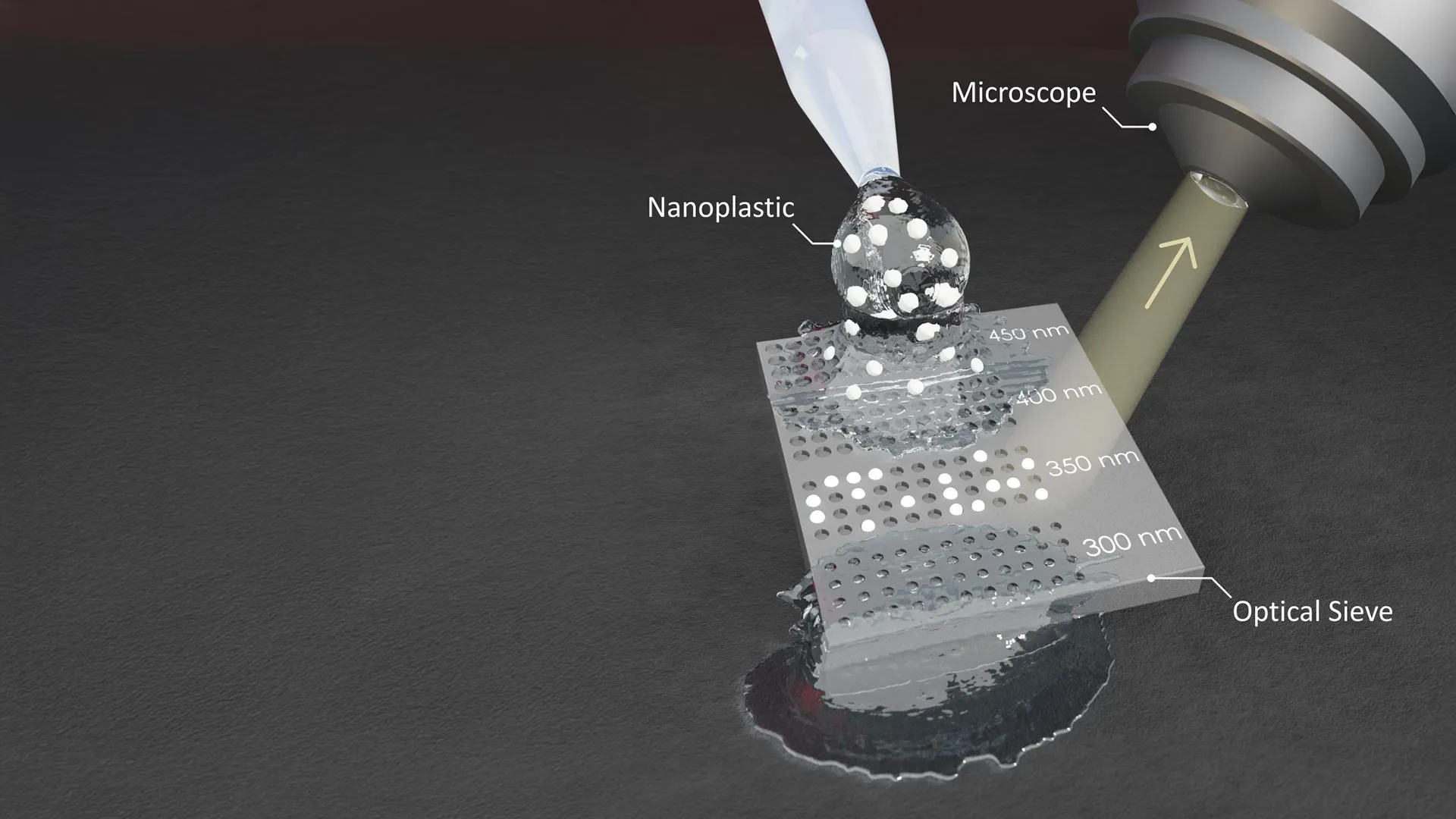
The newly developed method, dubbed the “optical sieve,” offers a compelling alternative. Instead of relying on complex and costly electron microscopy, this technique leverages the principles of light interaction with nanoscale structures to visualize nanoplastics using a standard optical microscope. The core of the technology lies in Mie voids – tiny, precisely engineered depressions etched into a semiconductor substrate.
This approach builds upon foundational research published in 2023 by the University of Stuttgart team, demonstrating the unique optical properties of these nanoscale indentations.The size and depth of the voids are carefully calibrated to interact with light in a way that produces a distinct, bright color reflection. When a nanoplastic particle enters a void, it alters this reflection, causing a noticeable color change.
“The test strip works like a classic sieve,” explains Dominik Ludescher, phd student and lead author of the study published in Nature Photonics. “Particles are filtered based on size, and the resulting color change indicates their presence.” This simple yet elegant principle allows for both the detection and quantification of nanoplastics within a size range of 0.2 to 1 µm.
Beyond Detection: Determining Size and Concentration
The optical sieveS capabilities extend beyond simply identifying the presence of nanoplastics. By utilizing voids of varying sizes, the system can effectively sort particles based on their dimensions. Particles too large will pass through,while those too small won’t adhere properly and will be washed away during the cleaning process. This allows researchers to determine not only the number of particles but also their size distribution – a crucial factor in assessing potential environmental and health impacts.
“If a particle is too large, it won’t fit into the void and will be simply flushed away during the cleaning process,” says Ludescher. “If a particle is too small, it will adhere poorly to the well and will be washed away during cleaning.”
Validation with Synthesized Environmental Samples
To demonstrate the efficacy of the optical sieve, the researchers created a realistic environmental sample by spiking a lake water sample (containing sand and organic matter) with known concentrations of spherical nanoplastic particles (150 µg/ml). The system accurately persistent both the number and size distribution of the added particles, validating its potential for analyzing complex real-world samples.
Future Implications and Collaborative Opportunities
The potential applications of this technology are far-reaching. dr. Mario Hentschel, Head of the microstructure Laboratory at the 4th Physics Institute, envisions the optical sieve evolving into a portable analysis tool for on-site environmental monitoring. “In the long term, the optical sieve will be used as a simple analysis tool in environmental and health research.The technology could serve as a mobile test strip that would provide information on the content of nanoplastics in water or soil directly on site.”
The research team is now focused on expanding the capabilities of the optical sieve, including:
Analyzing non-spherical particles: Real-world nanoplastics often exhibit irregular shapes, and the team is working to adapt the system to accommodate these variations.
Distinguishing between plastic types: Identifying the specific polymer composition of nanoplastics is critical for understanding their source and potential toxicity.
* Collaborating with environmental experts: The team actively seeks partnerships with research groups specializing in the analysis of real-world samples from diverse aquatic and terrestrial environments.
This innovative “optical sieve” represents a significant advancement in nanoplastic detection, offering a cost