Sarah Matusek
2026-01-26 10:00:00
The fatal shooting of another U.S. citizen by federal agents is amplifying divisions in a city that was already a focal point of tension over U.S. immigration enforcement.
Local officials say a Border Patrol agent on Saturday shot and killed Alex Pretti, an intensive care unit nurse, while Mr. Pretti was observing an immigration enforcement operation in Minneapolis.
Witness accounts and visual investigations by researchers and journalists suggest that multiple agents had already held Mr. Pretti to the ground – and removed his gun – before at least one opened fire Saturday. Mr. Pretti appeared to be lawfully armed in a public space, according to Minneapolis Police Chief Brian O’Hara.
Why We Wrote This
A second fatal shooting of a U.S. citizen by federal agents in Minneapolis has sparked protests and calls for investigation. Ongoing immigration enforcement efforts are also upending everyday lives for many Twin City residents.
Video footage from bystanders appears to show Mr. Pretti holding a phone and recording Border Patrol agents before his death. Mr. Pretti appeared to place himself in front of another person who was shoved by federal agents. The agents sprayed Mr. Pretti and others with an irritant before tackling him. In an ensuing scrum, agents appeared to discover his gun. After shots were fired, someone can be heard saying, “Where’s the gun?” An investigative team from The New York Times reported that it appears at least 10 shots were fired within five seconds.
Trump administration officials immediately suggested Mr. Pretti wanted to “massacre law enforcement.” White House adviser Stephen Miller called him “a would-be assassin.” Homeland Security Secretary Kristi Noem said he committed an “act of domestic terrorism.” The federal government says its agents acted defensively.
Ongoing controversy over immigration enforcement brought Vice President JD Vance to Minneapolis last Thursday, when he called for more cooperation between local, state, and federal officials. He acknowledged that most protesters “have been peaceful.”
Some protesters have vandalized and damaged the property of hotels. The government claims agents have faced assault and had their tires slashed. Protesters also disrupted a Sunday service at a St. Paul church, over a pastor’s alleged leadership role at an ICE field office. The federal government arrested three individuals whom it planned to charge.
Mr. Pretti’s death marks the third time in three weeks that federal agents in Minneapolis have shot civilians, including the killing of Renee Good on Jan. 7.
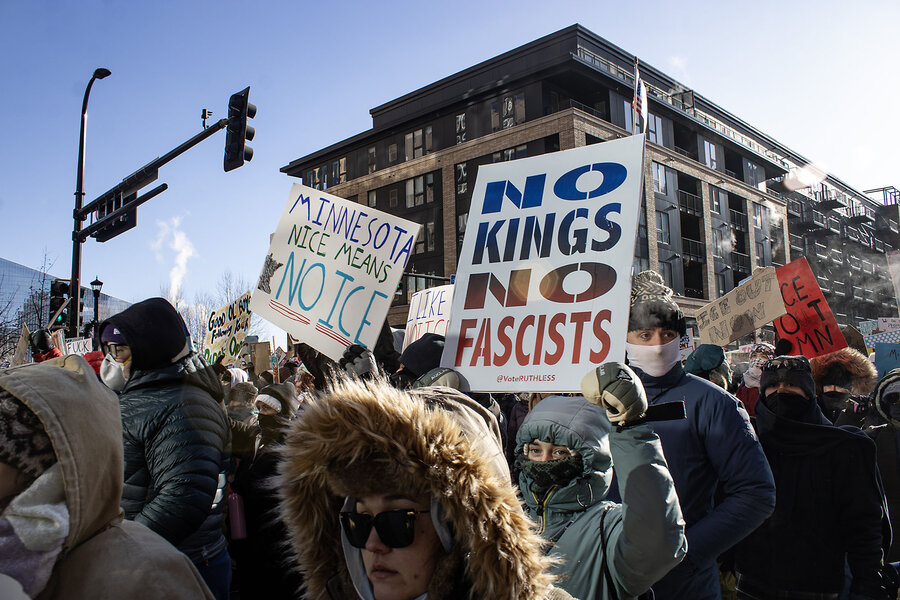
Despite exhaustion and grief among many residents, protests endure, even in freezing temperatures. Many protesters say that 2,000-plus federal agents – sent by the Trump administration to crack down on illegal immigration – are using excessive force and running roughshod over cornerstone constitutional rights of free assembly and due process. Federal agents, meanwhile, say local “sanctuary” policies, which limit cooperation on immigration enforcement, endanger Americans and protect criminals.
On the ground, the resistance to federal agents echoes with whistles, curses, and shouts of “Shame!” Flash-bangs pop on pavement, and helicopters roar overhead. Retirees protest at businesses – many with anti-ICE signs on their doors. Students have walked out of class. Schools are offering remote options as attendance falls. Faith leaders are coordinating meals for families too worried to leave home, and face arrest as they rally in their stoles.
“Minnesota is being traumatized right now,” says Michael Brodkorb, a former deputy chair of the state Republican Party. “There’s going to be a time in which, when this is all said and done, that this state is going to have to try to heal again.”
Two months on, there appears to be no end to the Department of Homeland Security’s Operation Metro Surge in the Twin Cities. On Friday, thousands of marchers in Minneapolis protested the surge of Immigration and Customs Enforcement (ICE) officers and other federal agents. Protesters like Mark O., his mustache streaked with ice, braved double-digit temperatures below zero.
“Me, being a person of color, I shouldn’t have to be fearful for my life just to go outside and buy groceries,” says the Mexican American construction worker, who like others interviewed asked that his last name not be published for privacy.
Protests expanded in many cities across the United States over the weekend after Mr. Pretti’s death. There are rising calls to investigate the deaths of Ms. Good and Mr. Pretti – including from some Republican members of Congress. The scrutiny comes alongside condemnation of federal actions by local law enforcement in Minnesota.
Daily life altered
Many residents of this city of about 430,000 have altered their daily routines in response to the influx of federal agents. Some joined messaging groups to track ICE and Border Patrol agents.
Across the Minneapolis-St. Paul region, chats on the encrypted app Signal chime with news of federal-agent sightings. That cues protesters and legal observers with whistles to gather on the streets.
Outside, residents bundle up in hats, gloves, and gas masks.
Indoors, many businesses that rely on immigrant clientele have seen a drop in sales. That includes Somali malls, where vendors sell dresses, rugs, sambusas, and strong, sweet tea. Amid ongoing, billion-dollar fraud investigations that have implicated people of Somali descent, President Donald Trump last month called Rep. Ilhan Omar and other members of the Somali community “garbage.”
Mohamed Abdulle rejects such labels. “We know who we are,” says Mr. Abdulle, a teaching assistant and tax preparer at a Somali mall. “Our community, they are hard workers,” he says. He assumes the Trump administration is using “our community as a bridge to go after the state.”
At his open-door office earlier this month, Mr. Abdulle says no customers came in that day. Typically, he says, there are five to 10.

Sarah Matusek/The Christian Science Monitor
Other workers face complications. José, a mechanic from Venezuela, says federal officers detained him in December before releasing him with an ankle monitor. Although he entered the country illegally in 2023, he has a pending asylum application, which secured him a work permit. The enforcement surge, he says, caused his crew leader to cancel his work.
“We’re adrift. … It’s difficult to live like this,” says José, who claims he fled extortion and threats from criminal groups in Venezuela. “Hope comes from my family – and faith in God,” he says.
Who gets stopped
Native Americans are also organizing, through donation drives and community patrols. The Department of Homeland Security has denied detaining tribal members on suspected immigration violations, despite allegations to the contrary. Still, fear of mistaken arrest is driving some families to apply for tribal IDs as proof of their Indigenous heritage.
In Minneapolis last week, Cyrena Bugg sat for a photo in front of a blue screen. The image will appear on her ID from the Spirit Lake Tribe, which drove in from North Dakota to help members apply.
A resident of a housing complex where many Native Americans live, Ms. Bugg says she’s seen federal agents questioning teenagers. “I keep my children homeschooled now because I don’t want them getting harassed,” she says.

Sarah Matusek/The Christian Science Monitor
U.S. citizens and lawfully present refugees have been swept up in arrests. The legal basis for those detentions is not always immediately clear. Locals accuse federal agents of racial profiling, which Homeland Security denies. The Supreme Court ruled in federal agents’ favor last year when, in an emergency order, it affirmed that characteristics like ethnicity, combined with other factors, could justify investigative stops.
“We can choose”
Homeland Security claims that ICE and other immigration law enforcement have arrested over “10,000 illegal aliens in Minnesota” since President Trump’s inauguration in January 2025. The Monitor cannot verify that figure, and it’s unclear how many people arrested have since been released.
In a letter to the governor Saturday, U.S. Attorney General Pam Bondi asked for social-services program records, the end of sanctuary policies, and the state’s voter rolls. In response, Gov. Tim Walz’s office said in a statement: “We repeat our request to the administration to engage in a serious conversation about ending this federal occupation.”

A federal judge has so far blocked federal authorities from “destroying or altering evidence” of the shooting of Mr. Pretti, after state officials said their access was denied.
Minnesota officials have asked the National Guard to help keep the peace, repeating calls for federal forces to leave. President Trump earlier this month threatened to invoke the Insurrection Act, which could be used to deploy the military as domestic police.
Amid the contention, some locals see a swelling mental health crisis. They say federal violence compounds grief from the 2020 George Floyd murder and the Annunciation Catholic Church shooting last year that killed two students.
That day in August, Melissa Tews wrapped her children in hugs when they reunited at the Annunciation school gym. This month, the mother sought advice from the school therapist, who’s helped her family since the summer, to explain the Renee Good shooting to her 9-year-old son.
“That was hard,” says Dr. Tews, a Minneapolis pharmacist. Yet she says that seeing the community rally together again, and remain largely peaceful, gives her hope.
“Hatred is what drives, I think, this violence and destruction. And love and connection are what move us forward,” she says. “We can choose.”
On Saturday morning, as she drove her son home from a basketball game, Dr. Tews decided not to mention the latest shooting breaking on the news. Once again, she needed time to find the right words.