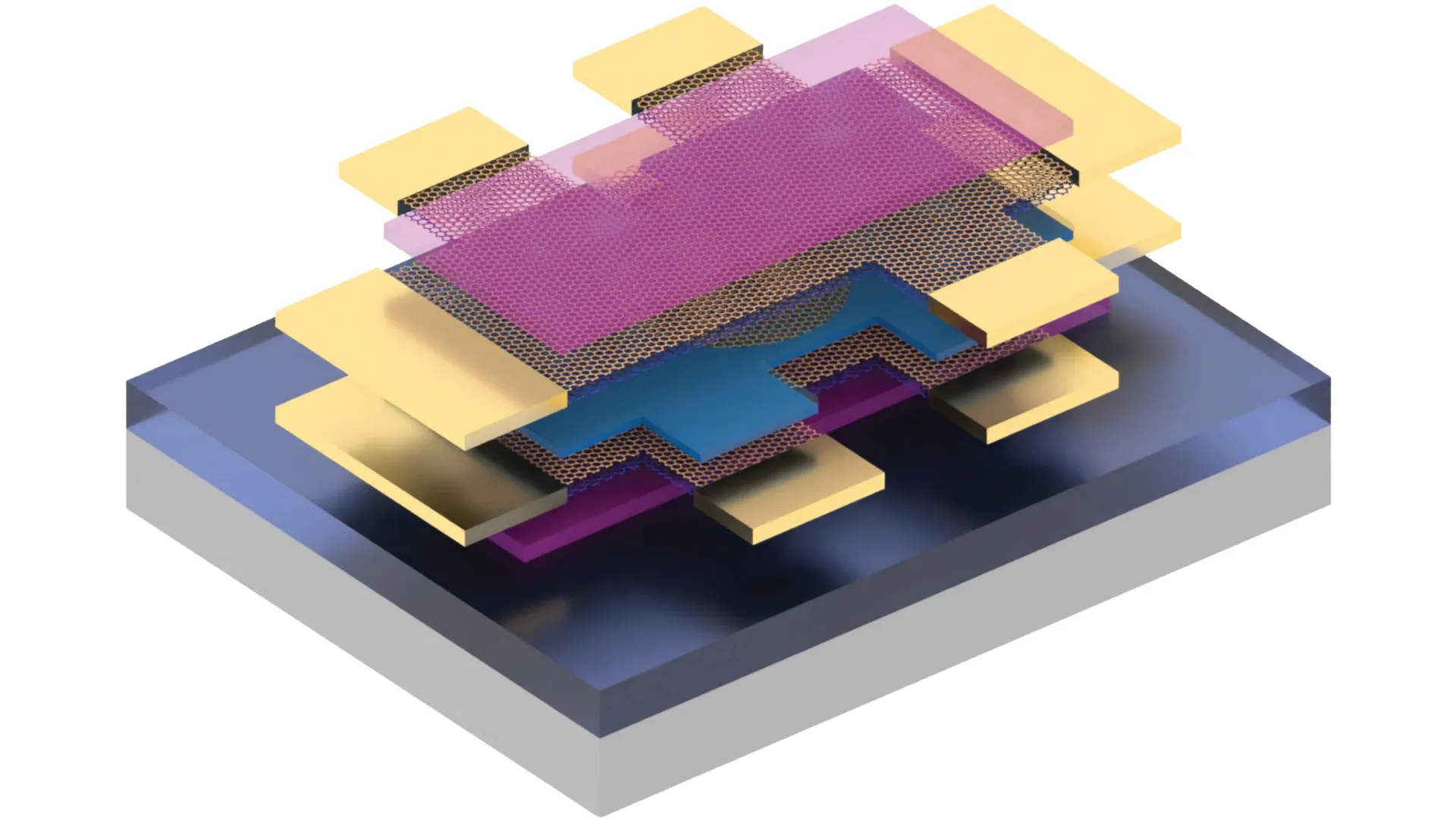
Unconventional Superconductivity Confirmed in “Magic-Angle” graphene: A Leap Towards Next-Generation Quantum Materials
The quest for room-temperature superconductivity – materials that conduct electricity with zero resistance – has long been a holy grail of physics. Recent research from MIT, building on groundbreaking work initiated by Pablo Jarillo-Herrero‘s group, has delivered a notable breakthrough, definitively confirming unconventional superconductivity in “magic-angle” twisted bilayer graphene (MATTG). this discovery,published with meticulous detail and rigorous methodology,not only validates the burgeoning field of “twistronics” but also opens exciting new avenues for designing and controlling advanced quantum materials.
The Rise of Twistronics and the “Magic Angle”
For decades, superconductivity was understood through the lens of conventional theory – electron pairing mediated by vibrations within the material’s atomic lattice (phonons). However, the unexpected emergence of superconductivity in graphene layers stacked and twisted at a precise 1.1-degree angle, first observed by jarillo-Herrero’s team in 2018, challenged this established understanding. This “magic angle” creates a unique electronic landscape, dramatically altering the material’s properties and giving rise to what’s now known as “twistronics.”
this initial discovery sparked a flurry of research, with scientists exploring various graphene structures and observing further indications of unconventional superconductivity. The core question remained: was this truly a novel form of superconductivity, distinct from anything previously observed? Answering this required direct measurement of the superconducting gap – a basic characteristic defining the strength and nature of electron pairing.
Probing the Quantum Realm: Tunneling Spectroscopy and Beyond
Superconductivity arises when electrons overcome their natural repulsion and form “Cooper pairs,” allowing for lossless current flow. In conventional superconductors,these pairs are loosely bound and relatively distant. Though, early observations in magic-angle graphene suggested a far more intimate pairing mechanism. “We could already see signatures that these pairs are very tightly bound, almost like a molecule,” explains Jeong Min Park, co-lead author of the recent MIT study. “There were hints that there is something very different about this material.”
To definitively prove this, the MIT team, led by experts in quantum materials and nanoscale measurement techniques, employed tunneling spectroscopy – a elegant method leveraging the wave-particle duality of electrons. By carefully measuring how electrons “tunnel” through barriers, researchers can infer the strength of their binding within the material. However, tunneling data alone isn’t conclusive.
Recognizing this limitation,the team innovatively combined tunneling spectroscopy with electrical transport measurements – tracking current flow and resistance. This integrated approach, a testament to their experimental prowess, allowed for a simultaneous observation of the superconducting gap and zero resistance, the hallmark of superconductivity.
A V-Shaped Revelation: Unveiling a New Mechanism
The results were striking. As the material transitioned into a superconducting state, a sharp, V-shaped curve appeared in the tunneling data. This is a stark contrast to the flat,smooth pattern characteristic of conventional superconductors. This unique signature unequivocally demonstrates that MATTG operates under a fundamentally different mechanism.
“The V shape points to a new mechanism behind MATTG’s superconductivity,” states Park. ”Even though the exact process is still unknown, it’s now clear that this material behaves unlike any conventional superconductor discovered before.”
The team’s findings strongly suggest that electron pairing in MATTG isn’t driven by lattice vibrations, as in customary superconductors. Instead, the prevailing theory posits that strong electronic interactions – electrons directly influencing each other’s pairing – are the driving force. This leads to a superconducting state with a unique symmetry, opening up possibilities for manipulating and controlling superconductivity in unprecedented ways.
Implications for Future Technologies and the Path Forward
This research isn’t just an academic exercise; it has profound implications for the future of technology. The ability to design and control superconductivity could revolutionize energy transmission, enabling lossless power grids. Moreover, unconventional superconductors like MATTG are promising candidates for building more robust and efficient quantum computers.
The MIT team is already leveraging their newly developed experimental platform to investigate other twisted and layered materials, aiming to unravel the underlying principles governing these exotic quantum states. “This allows us to both identify and study the underlying electronic structures of superconductivity and other quantum phases as thay happen, within the same sample,” explains Park. “This direct view can reveal how electrons pair and compete with other states, paving the way to design and control new superconductors and quantum materials.”
This research, supported by a diverse range of funding sources including the U.S. Army Research Office, the National Science Foundation, and the Gordon and Betty Moore Foundation, represents a significant step forward in our understanding of superconductivity and a promising glimpse into the future of quantum materials. It solidifies the position of MIT as a leading institution in this rapidly evolving field and underscores the