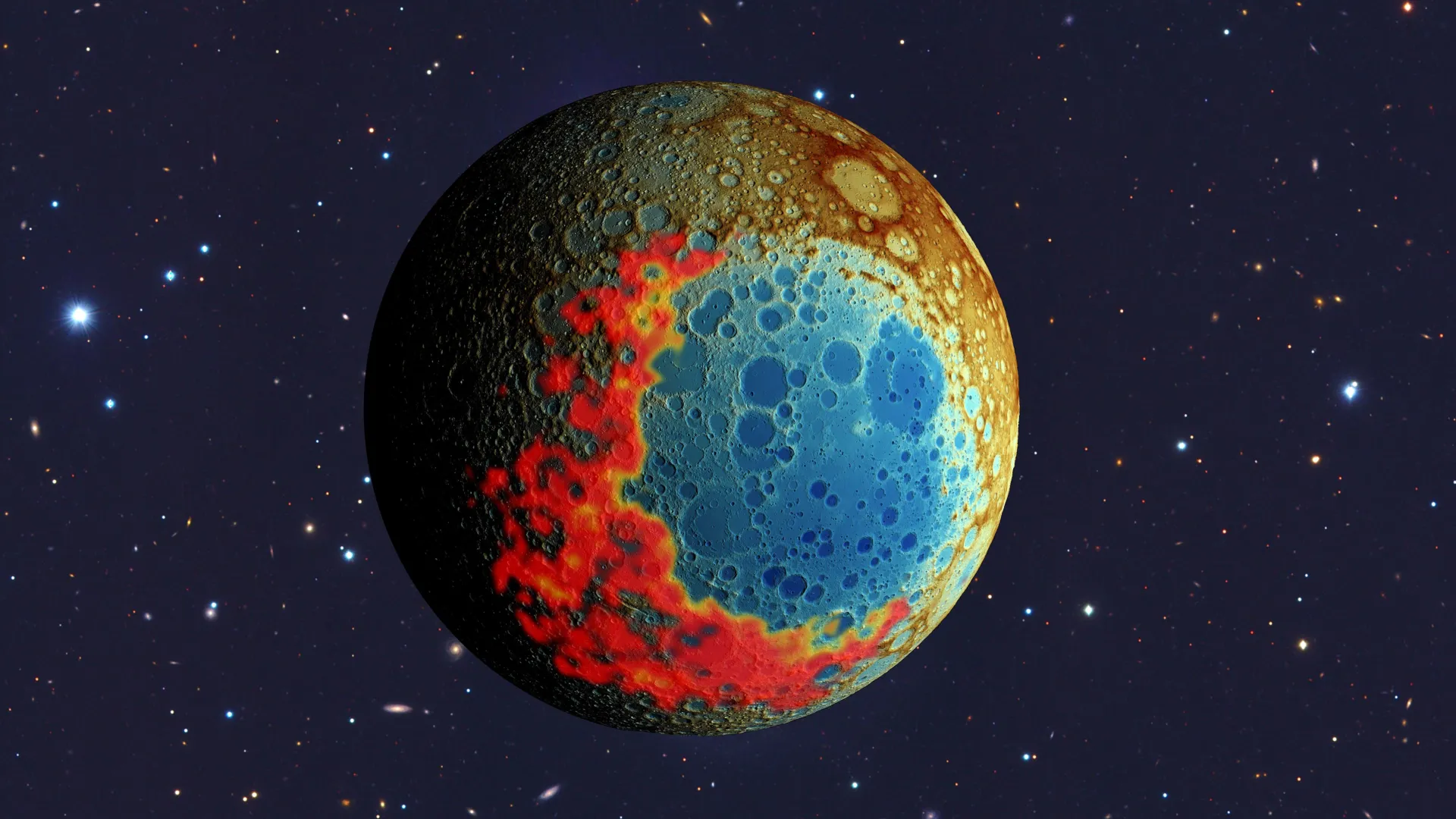
Unraveling the Moon‘s Origins: How a giant Impact and a “Magma Ocean” Shaped Our Celestial Neighbor
For decades, scientists have sought to understand the Moon’s formation and the peculiar asymmetry that defines its surface – a heavily cratered far side and a smoother, volcanic near side. Recent research, building on decades of lunar study and bolstered by analysis of the south Pole-Aitken (SPA) impact basin, is painting a compelling picture of a Moon born from a colossal impact and sculpted by the slow cooling of a global “magma ocean.” This evolving understanding not only strengthens the prevailing giant-impact hypothesis but also provides unprecedented insights into the moon’s internal structure and its 4.5 billion-year evolutionary journey.
The Giant Impact and the Birth of a Magma Ocean
The leading theory for the moon’s origin posits that it formed from the debris ejected after a Mars-sized object, frequently enough called Theia, collided with the early Earth. This cataclysmic event would have vaporized much of both bodies, creating a swirling disk of molten rock and gas. Over time, gravity coalesced this material into the Moon.
Crucially, this initial state wasn’t a solid sphere. Instead, the early Moon was likely entirely molten – a global magma ocean. As this ocean cooled, denser minerals like iron and magnesium sank towards the center, forming the lunar mantle. Lighter elements, including aluminum, calcium, and silicon, rose to the surface, eventually solidifying into the lunar crust.
However, not all elements behaved predictably. Certain elements – potassium (K), rare earth elements (REE), and phosphorus (P) – collectively known as “KREEP” – resisted this neat segregation. These elements remained concentrated in the last vestiges of the molten magma ocean, a phenomenon analogous to the way high fructose corn syrup concentrates in the remaining liquid when soda is frozen.
The Mystery of KREEP and the Lunar asymmetry
KREEP’s distribution is far from uniform.It’s remarkably concentrated on the Moon’s near side, the face we see from Earth. This concentration is directly linked to the extensive volcanic plains - the “face” of the Moon – formed by intense volcanism fueled by the heat-producing elements within KREEP. But why did KREEP become localized to the near side? And how did this influence the moon’s overall evolution?
This is where the puzzle of the lunar asymmetry comes into play.The Moon’s far side crust is substantially thicker than that of the near side. Researchers at the University of Arizona, led by Dr. jeff Andrews-Hanna, propose a compelling solution: as the far side crust thickened, it effectively squeezed the remaining magma ocean towards the sides, much like toothpaste being expelled from a tube. This process concentrated the KREEP-rich material on the near side, triggering the volcanism that shaped its familiar appearance.
The South Pole-Aitken Basin: A Window into the Lunar Past
recent analysis of the South Pole-aitken (SPA) basin, the largest and deepest impact crater in the solar system, provides crucial evidence supporting this theory. The SPA basin, located on the far side of the Moon, offers a unique possibility to probe the lunar interior.
The study revealed a striking asymmetry in the ejecta blanket surrounding the basin. The western side of the ejecta is rich in radioactive thorium – a key component of KREEP – while the eastern flank shows little to no thorium enrichment. This suggests that the impact excavated material from a region where the crust was underlain by the last remnants of the KREEP-enriched magma ocean, exposing it on the western side.
“Our study shows that the distribution and composition of these materials match the predictions that we get by modeling the latest stages of the evolution of the magma ocean,” explains Dr. Andrews-Hanna. “The last dregs of the lunar magma ocean ended up on the near side, but at some earlier time, a thin and patchy layer of magma ocean would have existed below parts of the far side, explaining the radioactive ejecta on one side of the SPA impact basin.”
The Future of Lunar Exploration: Artemis and the search for Answers
While remote sensing data from orbiting spacecraft have provided invaluable insights, the ultimate answers lie in direct analysis of lunar samples.The Artemis program,NASA’s aspiring initiative to return humans to the Moon,promises to deliver just that.
“With Artemis, we’ll have samples to study here on Earth, and we will know exactly what they are,” says Dr. andrews-Hanna. “Our study shows that these samples may reveal even more about the early evolution of the Moon than had been thought.”
These samples, analyzed in state-of-