
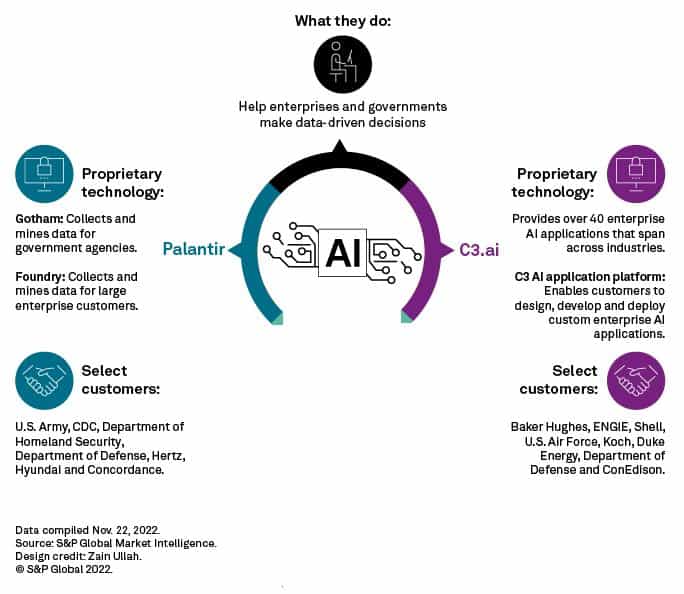
The intersection of artificial intelligence and global security has found a polarizing focal point in Palantir Technologies. Once viewed primarily as a secretive data-mining tool for intelligence agencies, the company is now navigating a volatile transition into a commercial AI powerhouse, facing simultaneous expansion into European markets and a sharp critique from some of Wall Street’s most famous contrarians.
The market’s reaction to Palantir’s trajectory reached a boiling point on April 9, 2026, as shares of the company plummeted by approximately 7.30%, closing at $130.49 following a public critique from investor Michael Burry. The volatility underscores a growing debate over whether Palantir’s “infrastructure” approach to AI can withstand the rise of more intuitive, generative models that promise faster deployment and lower costs for enterprise clients.
At the heart of this tension is the clash between legacy data integration and the new wave of Large Language Models (LLMs). Although Palantir continues to deploy its capabilities across high-stakes environments—ranging from geopolitical conflicts in the Middle East to the corporate boardrooms of the CAC 40—critics argue that the company’s reliance on human-intensive deployment may be becoming a liability in an era of automated intelligence.
For investors and global policymakers, the stakes extend beyond a single stock price. The ability of a private firm to integrate deeply into national security frameworks and corporate infrastructure creates a symbiotic relationship between software and sovereignty, making Palantir’s operational model a critical case study in the AI arms race.
The Burry Thesis: ‘Brains’ vs. Infrastructure
Michael Burry, the Scion Asset Management founder known for his role in “The Big Short,” has intensified his bearish stance on Palantir, suggesting that the company is being overtaken by the AI startup Anthropic. In a post on X, which he later deleted, Burry claimed that Anthropic is effectively “eating Palantir’s lunch,” arguing that the market is pivoting toward “easier, cheaper, [and more] intuitive” solutions according to reports of his social media activity.
Burry’s analysis centers on the explosive growth of Anthropic’s annual recurring revenue (ARR), which he notes climbed from $9 billion to $30 billion in just a matter of months as cited in his critique. To Burry, this rapid scaling is evidence that “brains” (generative AI models) will ultimately triumph over “infrastructure” (the complex data plumbing Palantir provides).
A key point of contention in Burry’s thesis is the nature of Palantir’s business model. He argues that the company operates less like a high-growth software firm and more like a low-margin consulting business. This criticism stems from Palantir’s use of Forward Deployed Engineers (FDE), staff members who are sent to live and work within a customer’s office for months to maintain and integrate systems per Burry’s claims. Burry further noted that while Anthropic is scaling at “lightning speed,” it took Palantir 20 years to reach $5 billion in revenue.
This bearish outlook is not a recent development. Around September 2025, Burry disclosed a significant short position against Palantir through long-dated put options, forecasting a multiyear decline in the company’s value as detailed in financial reports.
Counter-Arguments and Analyst Defenses
Not all market observers share Burry’s skepticism. Dan Ives, a top analyst at Wedbush Securities, has dismissed Burry’s claims, describing the narrative that Anthropic is overtaking Palantir as “the wrong seize” and a “fictional narrative” according to industry reports. Wedbush has reiterated its recommendation on Palantir, suggesting that the company’s fundamental strengths remain intact despite the noise surrounding generative AI competition.
Supporters of Palantir argue that the company provides a level of operational depth that a standalone LLM cannot replicate. While Anthropic provides the “intelligence” or the “brain,” Palantir provides the “nervous system”—the secure, integrated environment where that intelligence can be applied to real-world data without compromising security or accuracy. This distinction is particularly vital in government and defense contracts, where “hallucinations” common in generative AI are unacceptable.
Comparing the AI Approaches
| Feature | Palantir (Infrastructure/Platform) | Anthropic (Model/Brain) |
|---|---|---|
| Core Value | Data integration and operational decision-making | Advanced generative reasoning and LLMs |
| Deployment | High-touch via Forward Deployed Engineers (FDEs) | Low-touch via API and intuitive interfaces |
| Primary Market | Government, Defense, Large Enterprise (CAC 40) | General Enterprise, Developers, AI Research |
| Growth Driver | Deep system integration and security | Rapid ARR scaling and model capability |
Global Reach: From Defense to the CAC 40
Despite the volatility in its stock price, Palantir continues to expand its footprint globally. The company has positioned itself as a critical tool for the United States and its allies, leveraging technology to create a strategic advantage in modern warfare. This “weaponization” of data is seen as a deterrent, with the philosophy that superior technology is required to stop conflict by demonstrating overwhelming capability to adversaries.

Beyond the battlefield, Palantir is aggressively targeting the commercial sector in Europe. Its presence in the CAC 40—the benchmark index for the French stock market—signals a shift toward becoming a standard operating system for the world’s largest corporations. By integrating its AI platforms into the core of these businesses, Palantir aims to move from a niche consultancy to an omnipresent layer of corporate infrastructure.
However, this expansion brings its own set of challenges. The European market is characterized by stringent data privacy laws and a general skepticism toward U.S.-based surveillance technology. Palantir’s ability to navigate these regulatory waters while maintaining its “omnipresent” ambitions will determine whether it can truly scale its commercial growth story in the face of rising competition from leaner AI startups.
What So for the AI Arms Race
The conflict between the “infrastructure” model and the “generative” model represents a broader struggle in the AI industry. For years, the goal was to build the most powerful model. Now, the focus is shifting toward how that power is actually applied to complex, messy, real-world data. Here’s where Palantir believes its advantage lies.
If Burry’s thesis is correct, the “friction” of Palantir’s deployment model—the need for human engineers to be on-site—will become an obsolete burden. If the analysts at Wedbush are correct, the “friction” is actually a moat, ensuring that Palantir’s systems are so deeply embedded in a client’s operations that they become impossible to replace.
The impact of this struggle will be felt across several stakeholders:
- Government Agencies: Who must decide between the stability of integrated platforms and the agility of new AI models.
- Enterprise CEOs: Who are weighing the cost of high-touch implementation against the promise of “intuitive” AI solutions.
- Investors: Who are attempting to price in the long-term value of a company that takes decades to build its revenue base versus startups that scale in months.
As the AI landscape continues to evolve, the “brains vs. Infrastructure” debate will likely serve as a bellwether for the next phase of the tech economy. The question is no longer just about who has the best AI, but who can most effectively operationalize it at scale.
Investors and industry observers are now looking toward Palantir’s next official financial filings and quarterly results to see if the company’s commercial growth can outpace the skepticism of the market’s most prominent bears. We will continue to monitor these developments as the company attempts to prove its scalability.
Do you believe the “infrastructure” approach is a sustainable moat, or is the era of high-touch deployment coming to an end? Share your thoughts in the comments below.