
That sharp, stabbing sensation in your heel during your first steps out of bed is a hallmark experience for millions of adults. For many, this isn’t just a morning inconvenience but the beginning of a chronic struggle with plantar fasciitis, a condition characterized by inflammation and degeneration of the thick band of tissue that supports the arch of the foot.
While the pain can be debilitating, This proves rarely the result of a single “wrong step.” Instead, it typically develops as a progressive accumulation of micro-trauma. Those between the ages of 40 and 60 are particularly susceptible, though the risk extends to anyone whose daily routine places excessive demand on their feet—from habitual runners and dancers to professionals who spend eight hours a day on their feet. In fact, research suggests that approximately 10 percent of the population will experience plantar fasciitis at some point in their lives.
The goal of managing this condition is not simply to mask the pain, but to address the mechanical failures that caused it. By focusing on “pre-loading” the tissue, strengthening the intrinsic muscles of the foot, and releasing tension in the posterior chain—specifically the calves—individuals can move from acute pain toward long-term stability. Because musculoskeletal recovery is often a sluggish process, the timeline for relief usually mirrors the timeline of the injury; a condition that took months to develop will rarely vanish in a few weeks of stretching.
Understanding the anatomy of the foot is the first step toward recovery. The plantar fascia acts as a shock absorber and a propellant, spanning from the heel to the base of the toes. When the tension on this tissue consistently exceeds its capacity, it leads to micro-tears and inflammation. This is often exacerbated by a “workload spike”—a sudden increase in activity or a change in environment that the foot isn’t conditioned to handle.
Identifying the Root Causes and Symptoms
Plantar fasciitis is rarely caused by one factor alone, but rather a “constellation” of triggers. One of the most common culprits is unsupportive footwear. Flip-flops, worn-out sneakers, and high heels fail to provide the necessary support for the medial longitudinal arch, forcing the fascia to absorb more ground reaction force than it is designed to handle. Similarly, walking barefoot on hard surfaces—especially at home—removes the protective barrier between the foot and the floor, increasing the risk of repetitive micro-trauma.
Environmental factors also play a significant role. Walking on uneven or rocky terrain requires the foot to constantly adapt, which can lead to acute stress on the fascia. Physiological predispositions, such as having exceptionally flat feet or extremely high arches, can alter how weight is distributed across the sole, making the tissue more prone to inflammation. Weight gain or a sudden change in a fitness routine can also create a workload spike that the fascia cannot sustain.
The symptoms typically manifest as intense heel pain, particularly during the first few steps of the day. This occurs because the fascia constricts overnight; when you stand up, the tissue is suddenly stretched, causing a flash of pain. Over time, this tightness can migrate. Because the body seeks the path of least resistance, inflammation in the arch often forces the calf muscles to overcompensate. This creates a chain reaction of tightness that can travel up the leg, potentially affecting the hips and lower back.
Preventative Strategies for Foot Health
Management is as much about what you wear as it is about how you stretch. A critical but often overlooked aspect of prevention is monitoring the lifespan of your footwear. Depending on body weight and activity level, most athletic shoes provide optimal support for roughly 350 to 400 miles. Once the grooves of the sole begin to merge or the tread wears thin, the shoe may be doing more harm than good by failing to stabilize the arch.
Conditioning for your terrain is equally essential. If you typically walk on flat pavement but suddenly spend a week hiking in the hills or walking on beach sand in flip-flops, you are introducing unfamiliar stimuli to your feet. In these scenarios, the lack of external support increases the load on the medial arch, which can spark an episode of fasciitis.
To prevent the onset of pain, experts recommend a three-pronged approach: pre-loading stretches to lengthen the fascia before the environment forces it, strengthening the intrinsic muscles that form the arch, and maintaining consistent flexibility in the leg muscles to prevent stress from moving up the posterior chain.
6 Effective Stretches to Relieve Plantar Fasciitis Pain
The following exercises are designed to increase blood flow, reduce inflammation, and restore the mechanical efficiency of the foot. Consistency is key; these should be integrated into a daily routine rather than used as a one-time fix.

1. The Pre-Loading Bed Stretch
This stretch is designed to be performed before your feet even hit the floor, relieving the tension that accumulates overnight and increasing blood flow to the affected area.
- Sit on the edge of your mattress.
- Place your right ankle on your left thigh, just above the knee.
- Grasp your right ankle with your right hand and your toes with your left hand.
- Gently pull your toes backward toward your shin until you perceive a stretch along the bottom of the foot.
- Hold for 20 seconds; repeat three times for both feet.

2. Myofascial Release Massage
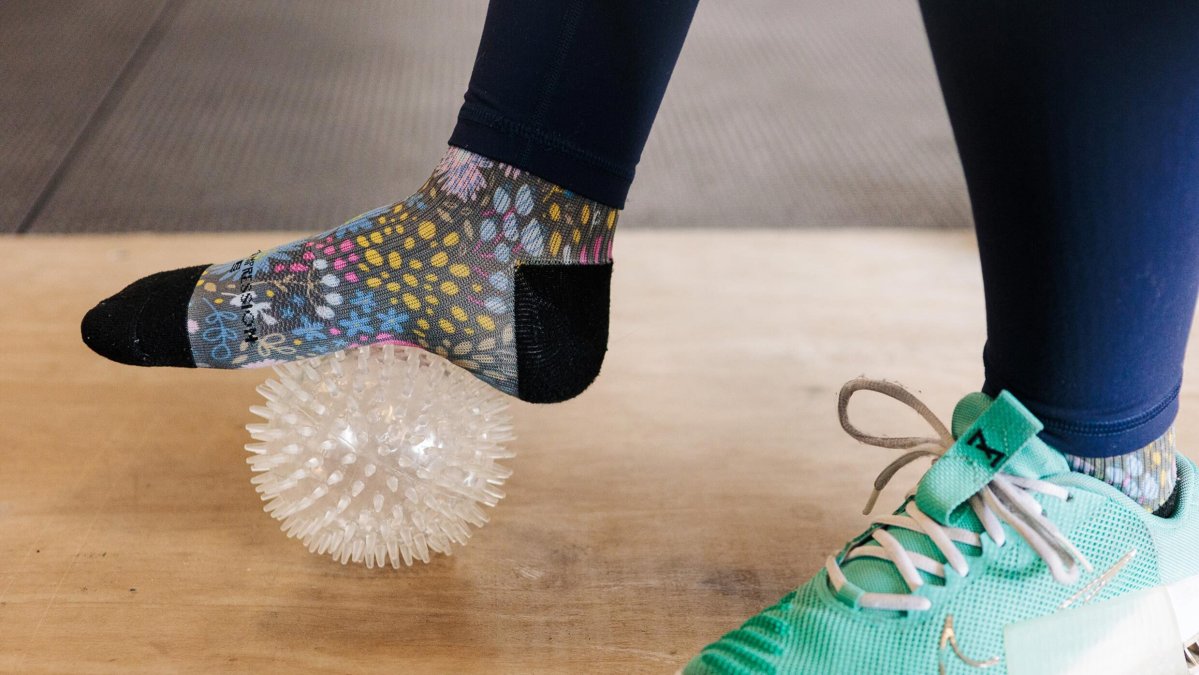
Using a tool to massage the fascia helps break up tightness and promotes healing. Using a frozen water bottle can provide the added benefit of cryotherapy to reduce inflammation.
- Sit in a chair or stand with one foot resting on a minor massage ball or a frozen water bottle.
- Starting just below the ball of the foot and moving toward the heel, slowly roll the object forward and backward.
- Perform 10 complete rolls per foot, completing two sets.

3. Controlled Heel Raises
Strengthening the calf muscles provides better overall support for the plantar fascia, which reduces the direct load on the arch during movement.
- Stand with the balls of your feet on the edge of a step. Use a wall or railing for balance.
- Slowly lower your heels below the level of the step until you feel a stretch in the calf.
- Slowly rise back to the starting position.
- Perform 10 reps; complete two sets.

4. Resisted Ankle Inversion
This exercise targets the stabilizer muscles of the ankle, improving mobility and reducing the stiffness that can contribute to arch pain. Ensure your hip remains still during the movement.
- Sit on the floor with legs extended. Secure a resistance band around the ball of your right foot.
- Cross your left leg over the right, pressing the bottom of the left foot against the band to anchor it.
- Slowly rotate your right ankle inward against the resistance of the band, then return to center.
- Perform 10 reps; complete two sets per foot.

5. Toe Towel Scrunches
This exercise focuses on the intrinsic muscles of the foot—the deeper layers that actually form and support the arch.

- While sitting or standing, place your foot flat on a towel.
- Using only your toes, curl and scrunch the towel to draw it toward your heel.
- Perform 10 to 15 reps; complete two sets per foot.
- Optional: Once this becomes uncomplicated, place a small weight (2–4 lbs) on the end of the towel to increase the challenge.

6. Dual-Phase Wall Calf Stretches
Because the calf is composed of different muscle groups, two versions of this stretch are necessary to fully release the posterior chain.
Gastrocnemius (Straight-Knee) Version: Stand facing a wall with hands flat. Extend your right leg behind you with the foot flat and the knee straight. Bend your left knee until you feel a stretch in the right calf. Hold for 20 seconds; repeat three times per leg.
Soleus (Bent-Knee) Version: From the same position, keep your right foot flat but bend both knees. This shifts the stretch deeper into the lower calf. Hold for 20 seconds; repeat three times per leg.

Summary of Management and Recovery
Recovery from plantar fasciitis requires a shift in how you view your daily movements. It is not enough to stretch once a week; the tissue requires consistent, gentle loading to rebuild its capacity. By combining supportive footwear, terrain awareness, and a dedicated stretching regimen, most individuals can manage the pain and prevent the condition from becoming a permanent limitation.
| Focus Area | Primary Strategy | Key Goal |
|---|---|---|
| Footwear | Replace shoes every 350-400 miles | Maintain arch support |
| Morning Routine | Pre-loading toe stretches in bed | Reduce first-step pain |
| Tissue Health | Frozen bottle/ball rolling | Increase blood flow & flexibility |
| Strength | Towel scrunches and heel raises | Support the medial arch |
| Leg Chain | Dual-phase wall calf stretches | Relieve posterior chain tension |
If you are experiencing persistent pain that does not respond to stretching, or if you notice significant swelling and redness, it is important to consult a healthcare provider or a licensed physical therapist for a personalized diagnostic plan.
We encourage you to share your experiences with foot health or your favorite recovery tips in the comments below. Sharing these strategies helps our global community stay mobile and pain-free.