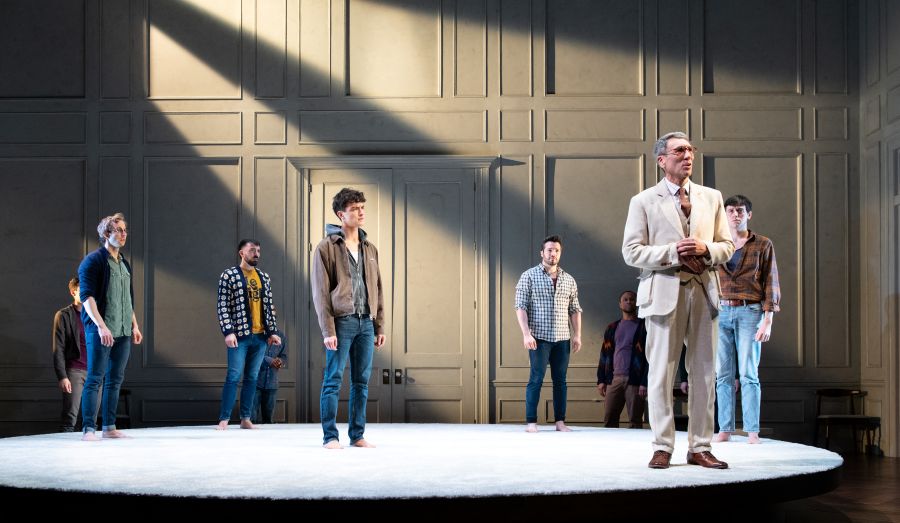
For Round House Theatre, which styles itself as a “theatre for everyone,” community conversations may not seem like a radical departure. But a space that brings intergenerational voices together at a theatre is still all too rare. Aligned with its production of Matthew López’s The Inheritance (Parts 1 and 2) (Aug. 28-Oct. 19), the Bethesda, Maryland, company has been hosting intergenerational pre-show discussions at some performance for LGBTQIA+ folks to prepare and process their experience.
The production is the second queer mega-play the D.C. area has seen in recent years; Arena Stage’s Angels in America was just two years ago. Creating this space to gather around The Inheritance means putting the play’s themes of community support, remembrance, and inclusivity for LGBTQIA+ elders into action.
“There are exchanges of knowledge and information that just make sense when you come at life from a different perspective,” said Round House development director Michael Barret Jones. “Either you have more history and more lived experience, or you’re more up to date on what’s new and now and more flexible.
“All of these conversations will happen before anyone sees this production, which hopefully will help set them up with a level of empathy and compassion for the characters, no matter where they are in their own journey,” he continued. “In these conversations, we’re learning that there are ways to engage with people from all different walks of life, and we lose our humanity when we shut off communication. How do we take from what we’ve been given? How do we pass it forward?”
SAGE Advice
The conversations, modeled the SAGE Table initiative launched by SAGEUSA (Services & Advocacy for LGBTQ Elders) in 2017, reflect the play’s themes of chosen family, legacy, resilience, and the long shadow of the AIDS crisis. In a SAGE Table, LGBTQ+ folks across generations share a meal, a meaningful conversation, and a plan “for sustaining the intergenerational connections we make,” the organization states, encouraging folks to share contact information and stay connected beyond the table.
Barret Jones first encountered SAGE Tables while living in New York City and working at a storied queer haven, the Eagle Bar. One day he and his co-workers realized that a longtime friend of the bar had died—and no one had noticed. “No one knew for a couple of weeks because no family, no one, was checking in,” he recalled. “It was a humbling moment.”
The bar owners asked Barret Jones if he’d help plan an event to honor that friend’s memory. The night of that first SAGE Table, eight conversations unfolded, covering technology, financial planning, religion, family, and hookup apps. After that night, the bar began monthly social-educational programs that brought people together intergenerationally, including interviews, plays, drag shows, and conversations with HIV leaders, until the Covid-19 pandemic ended that.
Now in the D.C. area and working for Round House, Barret Jones thought that SAGE Tables as a model for events around The Inheritance felt like a no-brainer. “How do these 60-year-old characters talk to the 30-year-olds?” he wondered. “How do they communicate what their experience was, when there’s a missing piece? I thought this would be a really amazing place to bring this format of conversation back.”
When Barret Jones realized that D.C. no longer had a SAGE chapter, he had friends at SAGE to reach out to. He considered bandwidth, the amount they could do, and the purpose of the conversations. Initially, because The Inheritance is primarily focused on gay men, they planned three sessions with men and one for women, as well as two that were open to anyone across the gender and sexuality spectrum. But Round House received questions from women about why they only got one session. The theatre adjusted, turning one session for men into a second session for women. The company brought in actor Holly Twyford and director Aria Velz to lead the women’s conversations.
“Our intention was absolutely clear that the men and women’s sections were for anyone who identified as gay, bi, trans, queer, lesbian,” said Barret Jones. “It is up to the individual how they define themselves; we are saying, ‘This is what we intend the space to be.’ There are sometimes needs for conversations in spaces where the members of the dominant cultural paradigm don’t have a space.”
Codes and Conversations
Barret Jones said that in the first men’s group, he was the youngest, sitting dead center of Generation X; the oldest was someone in their 90s, who would be classified as the pre-boomer “silent generation.” On Aug. 19, they hosted recent college graduates through senior boomers; one women’s group had people in their 70s and in their 20s. They’ve also offered space for folks to audit without joining the conversation.
Each event starts with a list of basic ground rules for group discussions: Be respectful, “I” statements,” and curating the standard of “brave space, not safe space.” Then some basic questions start off the conversation, like: What’s your earliest memory of being LGBTQ? What’s something you always wanted to know?
Some discussions addressed the evolution of terminology within LGBTQ+ communities, such as reclamation of some slurs but not others; perceptions of gender over the years; and the way some codes and secret languages (like Polari) have disappeared in an age open queerness; and the ways some of these codes have become so ingrained in language that we don’t even recognize them as code. “The conversations were about how that’s both a wonderful thing and also, are we missing something special that we used to have culturally?” Barret Jones wondered. “Which ties directly to The Inheritance.”
On Wed., Aug. 27, I attended the first all-queer community space, which included a ticket to The Inheritance, Part 1 during previews. Barret Jones was not kidding when he said, “The people who are supposed to be in this room will end up in this room”: All four boomers registered to come apparently canceled. But the conversation among mainly Gen X and Gen Z queer folks was still enlightening, covering what it means to be queer “enough,” to “perform” queerness, language around queerness in Gen Z and Gen Alpha, and education around sexuality and gender in the past and present, icnluding different approaches in school systems during the ’80s HIV/AIDS pandemic.
At intermission, the company hosted a check-in for theatregoers to reflect on the story so far. According to theatregoer Damarcus Alexander, what resonated was how “even when you find a gay family, they can shade and grieve you—it’s the purest form of love to make sure you’re ready for this world. It’s a microcosm of what’s really out there.”
Starting with the macro of the queer community at large and zeroing into the micro of The Inheritance, the session filled a necessary space. The difference between a post-show director conversation and a pre-show community gathering seemed to me that the latter feels more open and less show-specific. The show itself, meanwhile, feels like a nostalgic, dreamlike, endearing gathering that culminates in a call for empathy: To gather is to breathe together. The next and last session will be on Sept. 16, midway through the production’s run. (Part Two began performances last night.)
The conversations are not about amassing the largest groups but about serving the people in the room, because just one person could get a lot out of it. According to SAGE, older LGBTQ+ people are twice as likely to be single and live alone, and four times less likely to have children to care for them, with two in five feeling disconnected from the younger LGBTQ+ community, and nine in 10 expecting healthcare providers to discriminate against them.
“It’s about being aware that in the LGBTQ community, there are folks who other people might not be watching for,” said Barret Jones. “My father is openly gay. He is in assisted living. He is the only gay person in that assisted living facility. He is incredibly isolated and alone, despite seeing people every day, because there’s no one else like him, and that’s really hard to process. Because ain’t none of us getting younger.”
Daniella Ignacio, a writer, theatre artist, and musician based in Washington, D.C., is a contributing editor of this magazine.