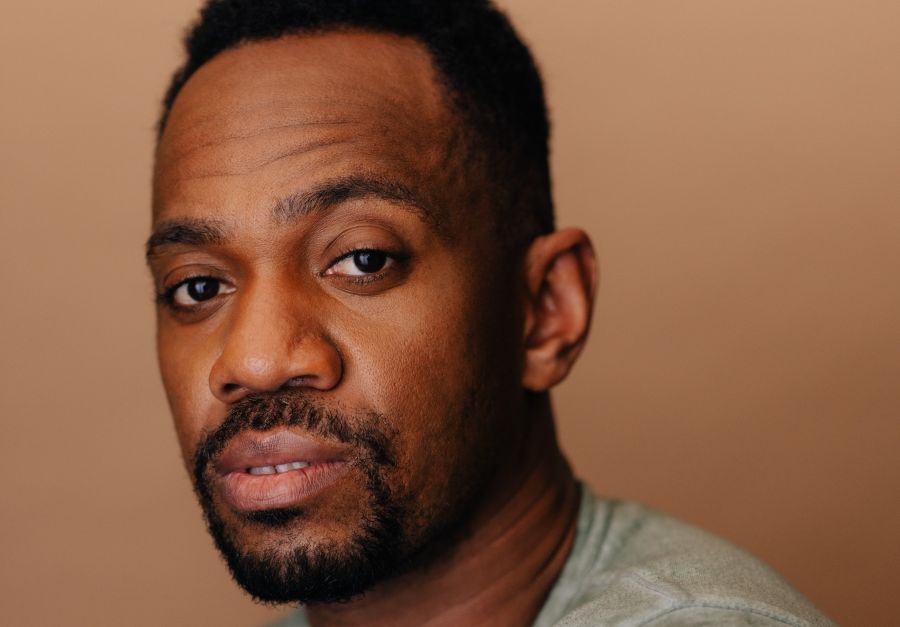
As D.C. theatres brace themselves for year two of Trump’s second administration, many are considering the balance between revolution and caution in artistic practice. Woolly Mammoth has always been planted firmly on the revolutionary side of the ledger, since its founding and leadership under Howard Shalwitz for 38 years and under his successor, Maria Manuela Goyanes, under whom Woolly earned its first Tony Award with Michael R. Jackson’s A Strange Loop. After seven years, Goyanes departed in September for Lincoln Center, with an interim artistic collective maintaining artistic efforts. Now Reggie D. White—a prolific playwright, director, and actor in his own right—has been named Woolly’s next artistic director, continuing his journey on a path he didn’t think was imaginable. He’ll start at the job next spring.
He comes from Arena Stage, where he was the right-hand man to artistic director Hana S. Sharif as senior director of artistic strategy and impact, and previously St. Louis Rep (also with Sharif). According to Goyanes, Shalwitz, and the theatre’s current managing director, Kimberly E. Douglas, White fits in with Woolly’s mission; Douglas said he “embodies the spirit of artistic ambition, takes thoughtful risks, and values openness.”
In his career as an actor, White made his Broadway debut in Matthew López’s The Inheritance and has performed many film and theatre roles, including most recently Goddess at the Public, and as a playwright he has had his plays developed at Bay Street Theater and Berkeley Rep. His play Fremont Ave recently had its world premiere at Arena and received an Edgerton Foundation New Play Award; it next plays South Coast Rep. I chatted with him last week about his career and his visions for Woolly’s future.
DANIELLA IGNACIO: Congratulations! What does it mean to begin this position at this moment in D.C., for you personally, as well as given where the city and the country are now?
REGGIE D. WHITE: I feel a little bit like Jonah from the biblical story. For the last 10 years of my career, a lot of people—friends, mentors, other artistic leaders—have looked at me and been like, “You’ve got the mark. You’re meant to be an artistic director,” and I was like, no, no, it’s too hard. The financial proposition doesn’t work. It’s too risky. All of the reasons why jobs like these are really challenging.
When I followed Hana from St. Louis Rep to Arena, I had them specifically craft a new title for me. I didn’t want to signal to the industry that I was interested in being an artistic director. After meeting with Kimberly, Woolly’s board—and I have a long friendship with Maria Goyanes—and Howard Shalwitz over the interview process, everybody made it clear to me: This was an opportunity that I couldn’t say no to. Woolly has positioned itself for the last 46 years as one of the last regional theatres committed to risk-taking that keeps the theatrical art form fresh and alive.
I think there is some real danger. I don’t know how many institutions in the country are being run by two Black executive leaders. With ink being spilled by folks happy with the new D.C. administration about rolling back DEI things, and DEI being a code word, it does potentially put us as a target, particularly if we continue to program the risky, provocative, soul-stirring work that Woolly has been known for—the risk-taking, provocative, soul-stirring work that makes me excited about the challenge. I’m unromantic about the fact that that will inherently make me a target. That will make Kimberly a target. It will make the institution a target. The board has been so toes down with their excitement about my leadership, and their support.
Can you share what they said to you that made you think, This is going to work out?
There was a lot of strategic fundraising. Having been a part of two artistic leadership transitions, I know one of the most difficult things is that the base of fundraising support, which is most often tied to the vision and leadership of a previous institutional leader, can shift or evaporate or change. That can make a new leader’s first tenure all about financial sustainability and drivability, and not about vision, mission, or impact. This board was really strategic. That is a great debt that I owe to Maria, that they did a lot of work to build a base of fundraising support so that my first three years won’t necessarily be primarily focused on survivability fundraising. It does give me some risk capital to make the programmatic choices that are the reason that they hired me.
Kimberly and the board have all expressed excitement in the version of leadership that puts me as an artist leader, and about me being able to bring all the different modalities of my artistry to bear from that leadership seat. That made me feel this was the right place, time, and moment. I feel like I have a real community of support. I don’t mean that in a Pollyanna way. The support feels muscular and rigorous. It actually makes me feel like this can be an expansive, transformative moment for Woolly. If we’re able to do what I hope we can do, then what will happen at Woolly will be a possibility model for what can happen when theatres stay brave in the face of difficult moments. I think people who want to be transformed by theatrical storytelling want us to encourage people to embrace their braver selves.
I’d like to ask about your approach to co-leadership and challenges. What do you see your role as, vs. that of Kimberly Douglas, when it comes to facing some of the issues D.C. theatres are experiencing: funding gaps under the current administration, contraction that led to some layoffs?
One of the great things about Kimberly is that she has such a long relationship with the institution, so I’m not jumping into unknown waters. Because Kimberly was there during the force reduction last year, she understands really intimately what feels like right-sizing for the institution, and she’s got a really good eye for what is out of balance in ambition against sustainability.
We also speak a shared language in artistic and value priorities, making sure that artists are well-compensated. People have always said that if you want to see a company’s commitment to their mission, look at their budget. Woolly has made a lot of decisions, particularly with its artist relief fund for its company members, that really put their money where their mouth is in terms of prioritizing artists, art-makers, and art lovers. Woolly, under Kimberly’s leadership, has relieved a lot of the pressure from ticket sales to be the primary driver of sustainability, which allows me to take programmatic swings.
What kind of work do you want to see at Woolly?
I’m always excited about art that shines light on the dark corners of our psyche. I want to reawaken the soul of D.C. and to reawaken D.C.’s imagination. I love art that invites a childlike sense of wonder and curiosity about the world, about humanity, our relationships with our neighbors, our friends, our families, ourselves. I think humor is a really powerful tool to break us out of the day-to-day rage that we exist in. As a theatre company based in D.C., it’s impossible to ignore the chaos in which we’ve been thrust by the current administration and our slow and steady journey into really terrifying and potential threats to our democracy.
I don’t want Woolly to become a place that people go to escape their reality, but I do want Woolly to be a place where people experience art that encourages them to lean in with curiosity and to see their neighbor, not as a potential foe, but as a member of a community that we’re all trying to survive in together. I’m interested in stories that allow folks to find different versions of healing. I’m more interested in work that poses questions than provides answers. Part of the toxicity and danger of the moment that we’re in is people are being offered simple answers to complex questions. That invites the flattening of our humanity, and that is the most dangerous thing we could do at this moment.
There are folks exploring nonlinear, text-based stories and clowning work that I find exciting and compelling. Every year at the Edinburgh Fringe, there’s always someone who’s got a new bright idea about how to reimagine a classic. I am excited for Woolly to be a place where people encounter new stories and new storytellers, where they encounter old stories in new ways. There’s a couple things I’m thinking about for next season; there’s two slots that I have.
I’m also curious about new-play development; earlier this year, Woolly hosted Pride Plays. Will you want to do new-works festivals?
In my career as an actor, playwright, and director, I’ve been the beneficiary of meaningful support from new-play festivals. Given the larger contraction in those kinds of incubators, I want Woolly to be as nimble as possible as we stand in the gap. I wouldn’t promise that a new-play festival will be a thing that you will see at Woolly in the first five years of my tenure, because Studio just started doing a New Pages, New Stages festival. There are lots of ways to support new work besides a traditional festival.
But we will remain committed to the development of new work. I’m really excited for my first set of commissions. There are storytellers that I’m really excited to give the keys to our stage, like: Yes, this is your moment. Let’s take all the limitations off, and let’s find the fullest, bravest, most courageous version of what story has been hanging around inside your soul, and put you in front of an audience.
Tell me about your relationships with Maria and Hana. Have you looked to them as guiding lights on the path of becoming an AD?
I met Maria when she was working at the Public as an associate producer 10-and-a-half years ago. I was working on Buzzer, the Tracey Scott Wilson play that Annie Kaufman directed. I was her associate director. She and I stayed in close contact. (We both loved tennis and we’re big fans of Rafael Nadal.)
I met Hana because we were match-made as artistic leaders of color; I won the TCG Fox fellowship in 2015. With her work at Hartford and Baltimore [Center Stage], we’ve come into contact with each other. Over the pandemic, we were on a couple of think tanks together, talking about structural change in the field and how we can evolve and iterate. She’s become a friend and mentor.
In 2022, a search firm called and asked me to submit for an AD search. I told Hana, because I knew she was on the board of TCG, “Is this a good idea? Should I do this?” And she was like, “I didn’t think that you were interested in leaving your freelance career.” I was like, “I actually don’t know that I am, but I’m curious.” She was like, “Well, if you’re curious, why don’t you come to St. Louis and be my associate?” I didn’t think that that was gonna happen, but she was like, “I’m so convinced that you’re the right person for the job, I won’t post it until you tell me no. Secondly, I always get what I want, so take your time.”
I did wait eight-and-a-half months; she joked that she’d never had to work so hard for a man’s attention before in her life. During that time I was doing Goddess at Berkeley Rep, I was directing Amen Corner in Seattle, there were lots of freelance things that I was considering. I was like, what would it mean to put my own artistic ambitions in the backseat in service of greater artistic leadership? At the end of 2022, I left and went to St. Louis and she brought me with her to Arena. We’ve been in a real tight-knit relationship for five seasons, which is kind of insane. We’re in the middle of programming our sixth season together.
And it’s been really wonderful to have Maria in D.C. Having those two brains in the same city is a real built-in community. Maria has left very large leading footprints for me to fill, so I hope to do her proud. I’m also grateful to have Hana and now Edgar Dobie, Arena’s executive producer, in my corner as we try to lift the tide together.
I really enjoyed Fremont Ave. What did it mean to put up your own work at Arena? And do you plan to do the same at Woolly?
This was pure coincidence: The interview process overlapped with the world premiere of my play Fremont Ave. at Arena Stage. It got great reviews and great press, and it extended, and that was all really lovely. So they were like, “Yeah, we want you to do your work at Woolly.” I’ve sort of been thinking about it like a first book deal: There are some things I will write that won’t be right for Woolly, and I certainly would never want my own artistic ambition to be greater than the mission of the institution. My own artistic values and Woolly’s are very aligned, so I can’t imagine there’s anything I would generate that wouldn’t be of interest, but it just may not be right.
You’re probably not going to see me onstage. I will write things, and I will direct things. I think it’s really important as an artist leader to engage with an artistic community, so I will likely direct at least every season, if not every other season, unless I’m deep in process on a play and need that time. The conversation between a curatorial leader who happens to be an interpretive artist in a community is powerful.
Is someone going to replace you at Arena as well?
It’s always the best compliment to leave a job and to be replaced by two people. After my departure, there will be two senior producers at Arena. The hope is to have at least one of them before I transition away in the spring, so there can be overlap with institutional knowledge in senior leadership. But I imagine that I will stay in close collaboration after my time at Arena ends.
I understand that you wrote a research paper on Woolly in college. I’m curious what you’d say to Reggie White then, now that you’re working with Woolly.
If I could talk to 19-year-old Reggie, who definitely procrastinated on that research paper, I would say, “Stop procrastinating. It’s gonna bite you in the ass when you get older.” I would also say, “Stay open to possibility, because you never know where life will take you if you just show up and do your best.” I hope someone’s possibilities are illuminated and expanded because of the work that I do. I feel profoundly honored in and of itself.
Daniella Ignacio, a writer, theatre artist, and musician based in Washington, D.C., is a contributing editor of this magazine.