
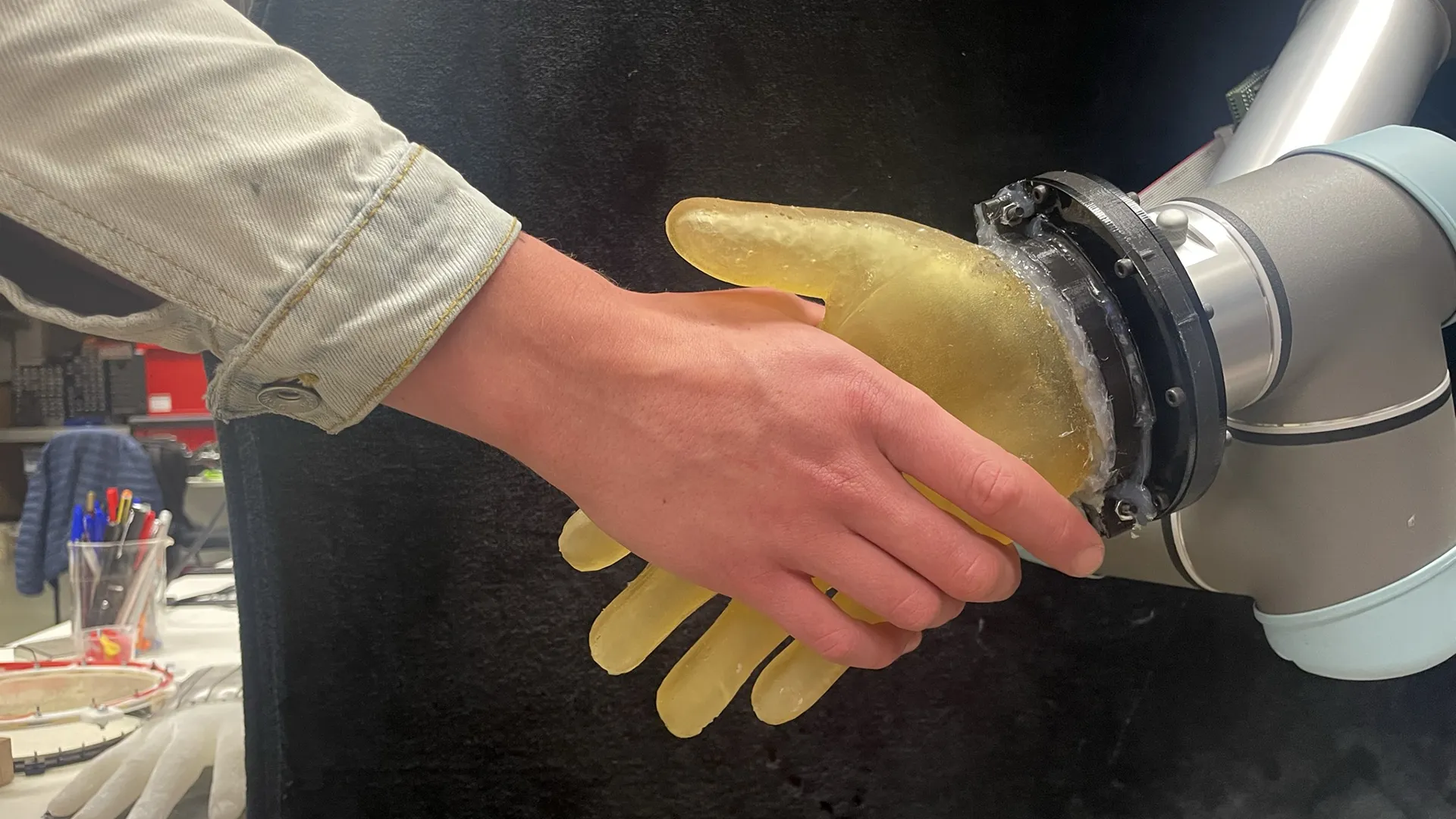
Revolutionary electronic Skin Brings Robots Closer to Human-Like Touch
For decades, the dream of robots capable of interacting with the world with the nuance and sensitivity of a human has remained largely elusive. A important hurdle has been replicating the complex sensory experience of touch. Now,researchers at the University of Cambridge and University College London (UCL) have made a groundbreaking leap forward,developing an electronic skin with the potential to revolutionize robotics,prosthetics,and a host of other industries. This isn’t just another incremental betterment in robotic sensors; it’s a fundamentally new approach to how robots “feel.”
The Challenge of Robotic Touch: Why Existing Solutions Fall short
Conventional robotic touch sensors typically rely on embedding numerous, specialized sensors within a limited area. Each sensor is designed to detect a specific type of stimulus – pressure, temperature, shear force – requiring a complex network and frequently enough resulting in interference between signals. Furthermore, these systems are often fragile and arduous to manufacture, hindering their widespread adoption. As Dr. David Hardman, lead author of the study published in Science Robotics, explains, “Having different sensors for different types of touch leads to materials that are complex to make.”
A Paradigm Shift: All-in-One, Multi-Modal Sensing
The Cambridge-UCL team has bypassed these limitations with a novel approach: a single material that acts as a comprehensive sensor. their electronic skin leverages ”multi-modal sensing,” were a single type of sensor reacts differently to various stimuli. This simplifies construction, enhances robustness, and dramatically reduces complexity.
“We wanted to develop a solution that can detect multiple types of touch at once, but in a single material,” Dr. Hardman states. “At the same time, we need something that’s cheap and durable, so that it’s suitable for widespread use,” adds co-author Dr. Thomas George Thuruthel from UCL.
How It Works: From hydrogel to Intelligent Skin
The core of this innovation lies in a soft, stretchy, and electrically conductive hydrogel - a gelatine-based material – that can be easily melted down and molded into complex shapes. The researchers cast this material into the form of a human hand, then strategically placed 32 electrodes at the wrist.This seemingly simple configuration unlocks an astonishing level of sensitivity.
Through these electrodes, the skin can detect signals from over 860,000 tiny pathways within the material, allowing it to discern a wide range of tactile information:
Pressure: Detecting the force of a touch, from a gentle caress to a firm grip.
Temperature: Identifying hot and cold surfaces.
Damage: Recognizing cuts, punctures, and other forms of physical harm.
Multi-Point Contact: Sensing multiple touches together.
Machine Learning: Teaching the skin to “Understand” Touch
The raw data generated by the electronic skin is immense.To make sense of it, the researchers employed machine learning techniques. They subjected the skin to a battery of tests – heat, pressure from fingers and robotic arms, gentle touches, and even intentional cuts with a scalpel – and used the resulting data to train a model to interpret the signals. This allows the skin to accurately “recognize” different types of touch and respond accordingly.
“We’re able to squeeze a lot of information from these materials – they can take thousands of measurements vrey quickly,” explains Hardman. “They’re measuring lots of different things at once, over a large surface area.”
Beyond Humanoid Robots: A Broad Spectrum of Applications
While the most immediate application is likely in the progress of more sophisticated humanoid robots and advanced prosthetic limbs that can restore a sense of touch, the potential extends far beyond. The researchers envision applications in:
Automotive Manufacturing: Improving robotic assembly and quality control.
Disaster Relief: Enabling robots to navigate and interact with hazardous environments.
Healthcare: Developing more intuitive and responsive robotic surgical tools.
Remote Handling: Allowing operators to safely manipulate objects in dangerous situations.
The Future of Touch: Durability and Real-world Integration
The current iteration of the electronic skin isn’t yet as sensitive as human skin, but the team believes it surpasses existing robotic touch technologies. Their focus now is on enhancing the material’s durability and conducting further testing in real-world robotic applications.
“We’re not quite at the level where the robotic skin is as good as human skin, but we think it’s better then anything else out there at the moment,” says Thuruthel. “Our method is flexible and easier to build than traditional sensors, and we’re able to calibrate it using human touch for a range of tasks.”
This research,supported by Samsung Global Research Outreach




