
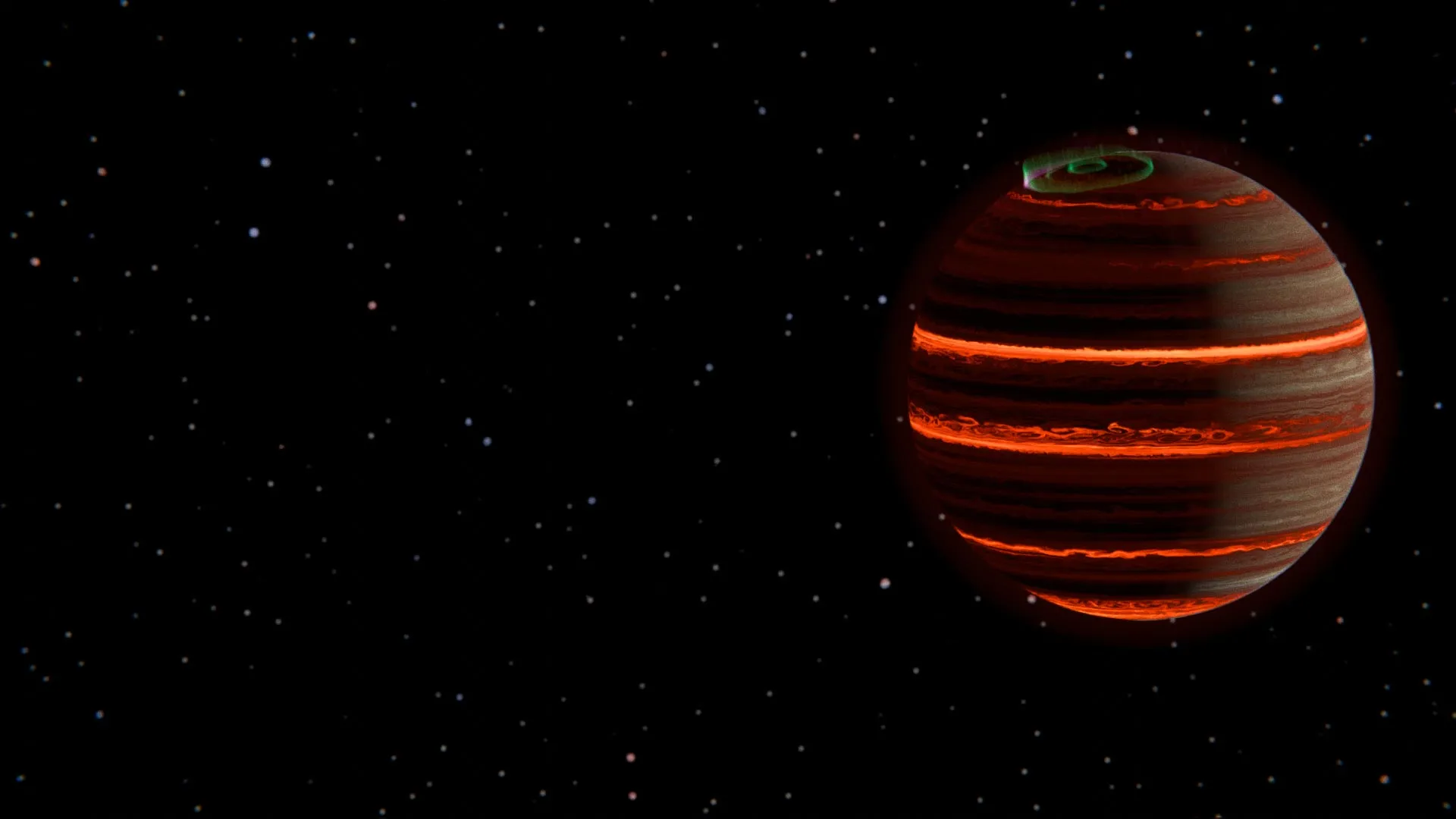
rogue Planet SIMP-0136 Reveals Stunning Weather Patterns: A First Look at Extrasolar Meteorology
(Last Updated: October 26, 2023)
For decades, the search for exoplanets - planets orbiting stars beyond our Sun – has captivated scientists and the public alike.But what about planets without a star? These ”rogue planets” or “free-floating planets” drift through space, unbound to any stellar host. Now, thanks to the groundbreaking capabilities of the James Webb Space Telescope (JWST), we’re beginning to understand the surprisingly dynamic weather systems on these isolated worlds.A recent study, led by researchers at Trinity College Dublin, has unveiled remarkable details about the atmosphere of SIMP-0136, a nearby rogue planet, revealing features akin to Earth’s Northern Lights and hinting at colossal storms.
A Weather Report From Beyond Our Solar System
The findings, published in Astronomy & Astrophysics, represent a significant leap forward in exoplanetary science. Instead of relying on theoretical models, the team, spearheaded by Dr. Evert Nasedkin, utilized JWST’s unparalleled sensitivity to directly observe changes in SIMP-0136’s atmosphere as the planet rotated. This allowed them to map temperature fluctuations, cloud cover, and chemical composition with unprecedented precision.
“These are some of the most precise measurements of the atmosphere of any extra-solar object to date, and the first time that changes in atmospheric properties have been directly measured,” explains Dr. Nasedkin. “We’re essentially receiving a weather report from another world.”
Northern Lights on a Scorching World
One of the most striking discoveries was the detection of strong auroral activity on SIMP-0136. Like the mesmerizing Northern lights on Earth or the intense aurorae surrounding Jupiter,these auroras indicate a powerful interaction between the planet’s atmosphere and charged particles. Tho, the similarities end there.SIMP-0136 boasts a surface temperature exceeding 1,500°C (2,732°F) – making this summer’s heatwaves seem positively frigid in comparison.
The team was able to detect temperature variations smaller than 5°C, revealing subtle shifts in the planet’s chemical makeup. These changes strongly suggest the presence of massive storms, possibly comparable to Jupiter’s iconic Great Red Spot, swirling across the planet’s surface.
Silicate Clouds and Atmospheric mysteries
Further analysis revealed another unexpected characteristic: remarkably stable cloud coverage. Unlike Earth, where cloud patterns constantly shift and evolve, SIMP-0136’s clouds appear consistent across its entire surface. But these aren’t the water-based clouds we’re familiar with.At such extreme temperatures, the clouds are composed of silicate grains – essentially, sand.
“Different wavelengths of light are related to different atmospheric features,” explains Dr. Nasedkin. “By using cutting-edge models,we coudl infer the temperature of the atmosphere,the chemical composition,and the position of the clouds,much like observing changes in color across Earth’s surface.”
This consistency in cloud cover presents a puzzle for researchers. Understanding why the cloud patterns remain static despite the planet’s intense heat and atmospheric dynamics is a key focus of ongoing research.
The Rise of ’Exo-Aimsir’ and the Future of Exoplanetary Meteorology
This groundbreaking research is the first publication from the newly established ‘Exo-Aimsir’ group at Trinity College Dublin,led by Professor Johanna Vos. The team, comprised of researchers including Merle Schrader, Madeline Lam, and Cian O’Toole, is dedicated to unraveling the mysteries of exoplanetary atmospheres.
Building on previous data collected by a team at Boston University, the Exo-Aimsir group’s advanced modeling techniques have unlocked a deeper understanding of SIMP-0136’s atmospheric processes.
Professor Vos emphasizes the significance of this work: “This shows that by applying our state-of-the-art modelling techniques to cutting-edge datasets from JWST, we can begin to piece together the processes that drive weather in worlds beyond our solar system.Understanding these weather processes will be crucial as we continue to discover and characterize exoplanets in the future.”
Looking Ahead: From Rogue Planets to Habitable Worlds
while current spectroscopic variability observations are largely limited to isolated objects like SIMP-0136, the future holds immense promise.The next generation of telescopes, such as the Extremely Large





![U.S. Data Center Growth: Leading the Global Surge | [Year] Trends & Forecasts](https://i0.wp.com/spectrum.ieee.org/media-library/image.jpg?resize=330%2C220&ssl=1 "U.S. Data Center Growth: Leading the Global Surge | [Year] Trends & Forecasts")


