
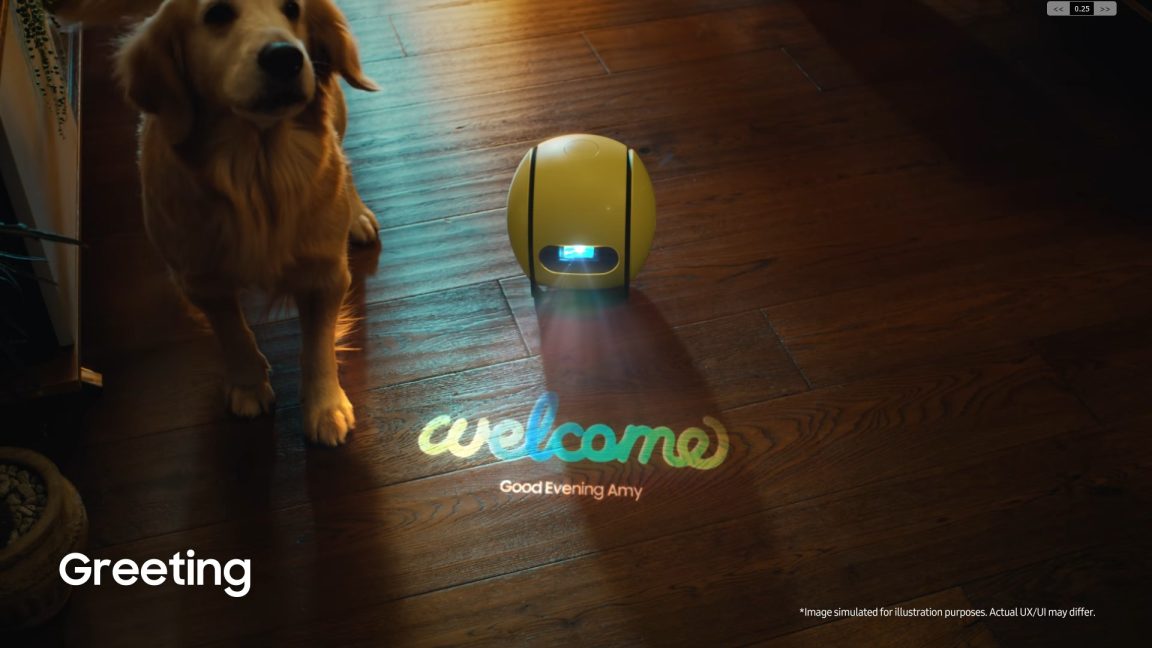
remember the buzz around Samsung’s Ballie, the adorable robot assistant unveiled at CES 2025? It promised a seamless integration of artificial intelligence into your daily life, handling tasks like adjusting your home’s lighting, welcoming guests, adn keeping your schedule organized.
As of today,January 8,2026,that promise remains largely unfulfilled. Recent reports indicate that the highly anticipated home robot has been “indefinitely shelved,” according to Bloomberg. This shift in direction positions Ballie not as a consumer product, but as an internal “active innovation platform.”
Essentially, Samsung is leveraging the technology developed for Ballie to enhance other products and experiences. A company representative explained that years of real-world testing have provided valuable insights into spatially aware and context-driven technologies, particularly in the realms of smart home integration, ambient AI, and privacy-focused design.
Interestingly, the registration website for early access to Ballie remains active, suggesting a potential, albeit uncertain, future release. However, current circumstances suggest Samsung is prioritizing internal progress over immediate consumer availability.
It appears the company is reassessing the feasibility of delivering a consistently reliable and feature-rich experience at a price point consumers are willing to accept. This decision aligns with a broader trend within the tech industry, where companies are carefully evaluating their AI strategies,particularly concerning chatbots and smart home devices.
The robotics market has seen its share of challenges recently; iRobot, the maker of Roomba, filed for bankruptcy in late 2025, highlighting the difficulties in achieving profitability in this space.
Samsung’s move suggests a strategic pivot,focusing on integrating ballie’s innovations into existing product lines rather than launching a standalone robot. This approach allows the company to capitalize on its research and development efforts without the risks associated with a potentially challenging market entry.
The Evolving Landscape of Home Robotics
the story of Ballie serves as a compelling case study in the complexities of bringing advanced robotics to market. I’ve found that consumer expectations for these devices are incredibly high, and delivering a truly seamless and reliable experience is a important hurdle.
The initial vision for Ballie,with its promise of natural language interaction and proactive assistance,was ambitious. However,maintaining consistent performance in diverse home environments,addressing privacy concerns,and justifying a potentially high price tag proved to be substantial challenges.
Furthermore, the recent advancements in AI, particularly with models like Google Gemini, have raised the bar for what consumers expect from bright assistants. According to a recent report by Statista, the global smart home market is projected to reach $324.80 billion in 2026, with robots representing a growing, yet still relatively small, segment.
Here’s a quick comparison of key factors influencing the home robot market:

![Kaan Ofli: Homecoming of a Champion | [Sport/Discipline] Star Returns
**OR**
Kaan Ofli Returns: The Champion’s Homecoming Story
**OR**
Welcome Home, Kaan Ofli: [Sport/Discipline] Star’s Triumphant Return
*(Replace “[Sport/Discipline]” with the rele](https://i0.wp.com/ufc.com/images/styles/card/s3/2026-01/010726-hero-kaan-ofli_GettyImages-2240488227.jpg?resize=150%2C150&ssl=1 "Kaan Ofli: Homecoming of a Champion | [Sport/Discipline] Star Returns
**OR**
Kaan Ofli Returns: The Champion’s Homecoming Story
**OR**
Welcome Home, Kaan Ofli: [Sport/Discipline] Star’s Triumphant Return
*(Replace “[Sport/Discipline]” with the rele")



![Watch Shows & Movies Online: Cut the Cable Cord | [Year] Guide](https://i0.wp.com/www.billboard.com/wp-content/uploads/2025/10/the-pitt-season-2-billboard-1800.jpg?resize=150%2C100&ssl=1 "Watch Shows & Movies Online: Cut the Cable Cord | [Year] Guide")