The First Planet Found in the ‘Einstein Desert’: Unraveling the Mystery of Rogue Planets
Have you ever wondered if planets can exist without a star? For decades, the search for exoplanets - planets orbiting stars beyond our Sun – dominated astronomy. But a growing body of evidence suggests a interesting, and somewhat unsettling, possibility: planets adrift in the vast emptiness of interstellar space, unbound to any stellar system. Now, thanks to a unique combination of gravitational lensing and data from the Gaia space telescope, astronomers have discovered a Saturn-sized planet in a region previously thought uninhabitable – the ”Einstein desert” – offering crucial clues about the origins of these enigmatic rogue planets.
microlensing: A Cosmic Detective Tool
Most of the over 5,500 exoplanets confirmed to date (as of January 2024, according to the NASA Exoplanet Archive) were discovered using methods like the transit method (observing dips in a star’s brightness as a planet passes in front of it) or the radial velocity method (detecting wobbles in a star caused by a planet’s gravity). These techniques work best for planets in close orbits.
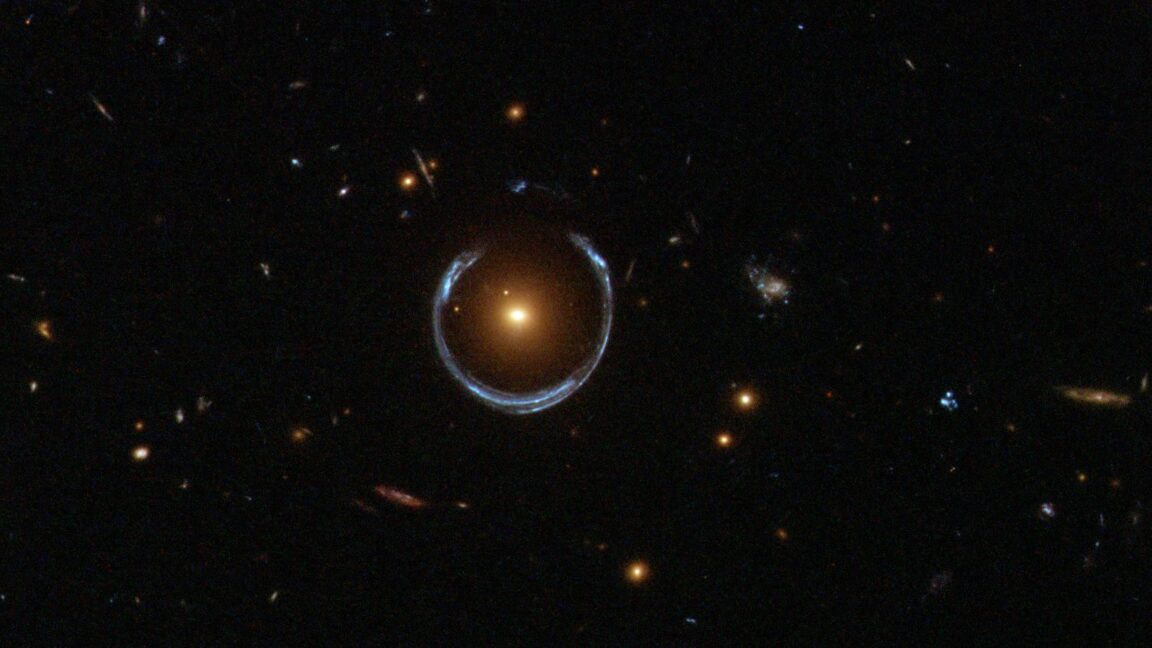
However, a different approach, called gravitational microlensing, allows us to detect planets much further afield. Imagine a distant star. Now, picture another object – a planet, or even another star – passing directly between us and that distant star. The gravity of the intervening object bends the light from the distant star, acting like a cosmic magnifying glass and briefly brightening it.
This “lensing” effect is incredibly sensitive and can reveal planets at enormous distances, even those not orbiting a star. Crucially, unlike other detection methods, microlensing can detect planets at virtually any distance along the line of sight, making it ideal for finding rogue planets – those ejected from their star systems or formed independently.
The Einstein Desert and a saturn-Sized Revelation
The “Einstein desert” refers to a specific range of separations between Earth and the lensing object where the lensing effect is predicted to be extremely rare.It’s a region where the alignment needed to produce a detectable signal is statistically unlikely. Finding a planet within this desert is therefore a meaningful event.
Recently, a team of researchers utilized microlensing data, combined with precise astrometric measurements from the European Space Agency’s Gaia telescope, to identify a Saturn-mass planet residing in this previously barren zone. This discovery,published in Nature Astronomy (link to a relevant article: https://www.nature.com/articles/s41586-023-06889-8), is the first of its kind and provides a unique opportunity to study the characteristics of isolated planets.
How Do Rogue Planets Form? Two Competing Theories
The existence of rogue planets raises a fundamental question: how do they come to be? There are two leading hypotheses:
1. Ejection from Star Systems: This scenario suggests that planets can be gravitationally kicked out of their original star systems due to interactions with other planets or a passing star. Imagine a chaotic game of cosmic billiards, where a well-placed collision sends a planet hurtling into interstellar space. This process would likely produce rogue planets of varying sizes and compositions, mirroring the diversity of planets found orbiting stars – from rocky worlds to gas giants.
2. failed Star Formation: The second theory proposes that some rogue planets form much like stars, through the gravitational collapse of gas clouds. Though, in this case, the cloud doesn’t have enough mass to ignite nuclear fusion and become a star. Instead,it collapses into a massive gas giant,potentially bridging the gap between planets and brown dwarfs (objects too massive to be planets but too small to be stars). Recent simulations, like those conducted by researchers at the University of Zurich (link to relevant research: https://phys.org/news/2023-11-rogue-planets-formed-stellar-nurseries.html), support the idea that many rogue planets originate in stellar nurseries.
The discovery of a Saturn-sized planet in the Einstein desert lends weight to the failed star formation theory. Gas giants are less likely to be ejected from star systems, suggesting this particular planet may have formed independently.