
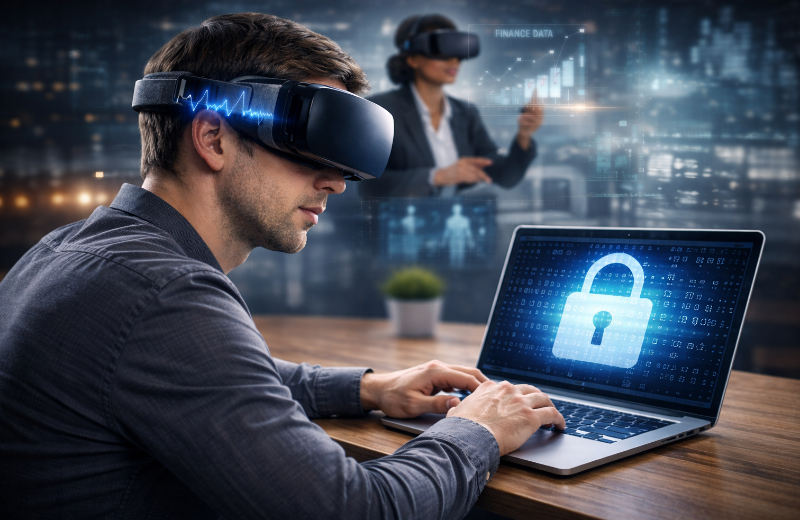
The future of digital security may lie within our own skulls. Researchers are developing a novel authentication system, dubbed VitalID, that uses the unique vibrational patterns generated by physiological processes – like heartbeat and breathing – within the skull to verify identity. This technology promises a more secure and seamless login experience, potentially replacing traditional passwords and even biometric scans that raise privacy concerns. The development comes as extended reality (XR) technologies, encompassing virtual, augmented, and mixed reality, rapidly expand beyond gaming into critical sectors like finance, healthcare, and remote function, increasing the urgency for robust security measures.
For years, the quest for secure and convenient authentication has driven innovation. Passwords, while ubiquitous, are notoriously vulnerable to hacking and phishing. Biometric methods, such as fingerprint and facial recognition, offer improved security but aren’t without drawbacks, including potential privacy violations and susceptibility to spoofing. VitalID, presented at the 2025 ACM Conference on Computer and Communications Security, offers a potentially groundbreaking alternative by leveraging the inherent uniqueness of an individual’s skull and the subtle movements within it. The system aims to provide “secure, continuous and effortless” authentication, according to Yingying Chen, a computer engineer at Rutgers University and a co-author of the study.
How VitalID Works: Mapping the Skull’s Subtle Vibrations
VitalID doesn’t rely on external sensors or cameras. Instead, it utilizes the existing capabilities of many modern extended reality (XR) headsets – devices like the Viture, Meta Quest, and Oculus Rift – to detect minuscule vibrations traveling through the skull. These vibrations, generated by the rhythmic expansion and contraction of the heart and lungs, create a unique “signature” for each person. The system analyzes these patterns, which are influenced by the individual’s facial tissue and bone structure, much like a fingerprint.
According to research published by Rutgers University, the team discovered this new biometric based on the tiny vibrations generated by breathing and heartbeat. The software program, VitalID, then uses this data to authenticate the user. This approach offers several advantages. It’s passive, meaning it doesn’t require conscious effort from the user, and it’s continuous, providing ongoing authentication rather than a one-time check at login. It’s difficult to spoof, as replicating the complex vibrational patterns of an individual’s skull would be extremely challenging.
The Rise of Extended Reality and the Need for Enhanced Security
The development of VitalID is directly tied to the growing prevalence of extended reality (XR) technologies. XR encompasses virtual reality (VR), augmented reality (AR), and mixed reality (MR), blending digital content with the physical world. While initially popular in gaming, XR is rapidly finding applications in diverse fields. For example, surgeons are using VR for training and surgical planning, while engineers are employing AR to visualize designs in real-world contexts. Remote work is also being transformed by XR, enabling more immersive and collaborative virtual workspaces.
As XR systems grow more integrated into daily life, the need for robust security measures becomes paramount. “Extended reality will play a major role in our future,” Chen stated. “If immersive systems are going to become woven into daily life, authentication has to be secure, continuous and effortless.” Traditional security methods may not be well-suited for XR environments, where users are often fully immersed and interacting with digital content using hand gestures or voice commands. VitalID offers a potential solution by providing a seamless and secure authentication method that doesn’t disrupt the user experience.
Beyond Gaming: XR’s Expanding Applications
The expansion of XR beyond gaming is driving the demand for enhanced security. In the financial sector, XR is being explored for virtual trading floors and remote financial advising. In healthcare, XR is used for patient rehabilitation, pain management, and medical training. Educational institutions are leveraging XR to create immersive learning experiences, while remote work environments are becoming more collaborative and engaging through virtual workspaces. Each of these applications requires secure authentication to protect sensitive data and prevent unauthorized access.
The Rutgers University research team highlights the importance of addressing security concerns as XR technology matures. The passive and continuous nature of VitalID makes it particularly well-suited for XR environments, where traditional authentication methods can be cumbersome or disruptive. By leveraging the unique vibrational patterns within the skull, VitalID offers a promising path towards a more secure and user-friendly future for extended reality.
Privacy Considerations and Future Development
While VitalID offers a compelling security solution, privacy considerations are crucial. The system relies on collecting and analyzing physiological data, raising questions about data storage, access, and potential misuse. Researchers emphasize the importance of implementing robust privacy safeguards to protect user data and ensure responsible use of the technology. Further research is needed to address these concerns and establish clear ethical guidelines for the deployment of VitalID.
The current research focuses on demonstrating the feasibility and accuracy of VitalID in controlled laboratory settings. Future work will involve testing the system in real-world XR environments and evaluating its performance under various conditions. Researchers are also exploring ways to improve the system’s robustness and resilience to potential attacks. The team is working to refine the algorithms used to analyze skull vibrations and enhance the system’s ability to distinguish between authorized and unauthorized users.
The development of VitalID represents a significant step towards a more secure and seamless future for digital authentication. By harnessing the power of subtle physiological signals, this innovative technology has the potential to revolutionize the way we verify our identities in an increasingly interconnected world. As XR technology continues to evolve, solutions like VitalID will be essential for ensuring the security and privacy of users in immersive digital environments.
The next steps for the VitalID project involve broader testing in diverse XR environments and addressing potential privacy concerns. Researchers are expected to publish further findings on the system’s performance and security in the coming months. Readers interested in learning more about the research can follow updates from Rutgers University’s Computer Engineering department. Share your thoughts on this innovative technology in the comments below.