
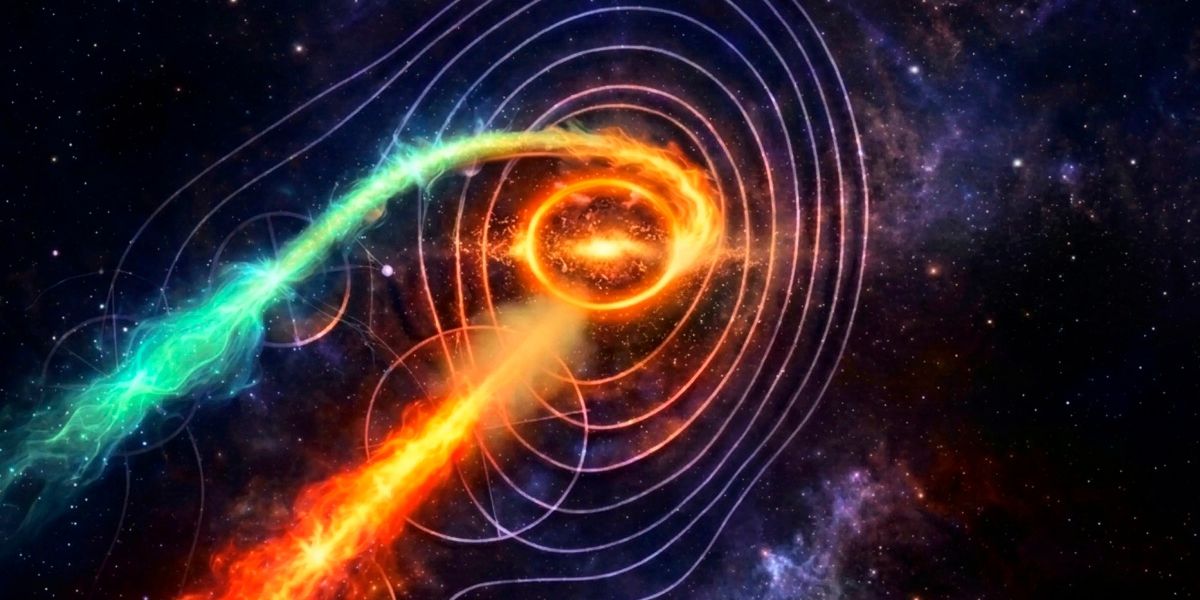
Astronomers have detected a rare and unprecedented phenomenon in the deep reaches of space: the first close pair of supermassive black holes locked in a tight death spiral. This discovery provides a glimpse into one of the most violent processes in the universe, as two gravitational behemoths orbit one another, destined for an eventual collision.
The observation reveals a binary system where the two supermassive black holes are positioned remarkably close to each other. This proximity suggests they are in the final stages of a long cosmic dance, a phase that typically precedes a massive merger. While such pairs are theorized to exist, capturing a pair in such a tight configuration is a significant milestone for astrophysics.
This discovery is particularly noteworthy because it allows scientists to study the dynamics of supermassive black hole binaries in real-time. As these objects spiral inward, they warp the fabric of spacetime, creating ripples known as gravitational waves. The detection of such a close pair offers critical data on how galaxies evolve and how their central black holes eventually merge into a single, even more massive entity.
The Mechanics of a Cosmic Death Spiral
In the center of most large galaxies lies a supermassive black hole. When two galaxies collide—a common occurrence over billions of years—their central black holes eventually find one another. They begin to orbit each other, gradually drawing closer as they lose energy through the emission of gravitational radiation. This process is what astronomers describe as a “death spiral.”
The pair recently detected is described as the first “close pair” of its kind, meaning the distance between the two objects has shrunk to a point where their interaction is intensified. According to reports from Phys.org, this observation is an unprecedented look at the final stages of this orbital decay.
As these black holes orbit, they create an immense gravitational pull that affects everything around them. In some cases, this can result in the formation of an “Einstein ring,” a phenomenon where the gravity of the black holes bends the light from a distant galaxy behind them, creating a circular halo of light. This optical effect serves as a powerful tool for astronomers to identify and study double-systems that would otherwise be invisible.
Why This Discovery Matters for Science
The detection of a tight binary system of supermassive black holes helps resolve several long-standing questions in astronomy. One of the primary challenges has been the “final parsec problem,” which questions how two black holes actually manage to bridge the final gap to merge, as some theories suggested they might stall before colliding.
By observing a pair already locked in a tight spiral, researchers can better understand the mechanisms that drive these giants together. The data gathered from this pair will likely refine models of galaxy formation and the growth of black holes over cosmic time. It provides a roadmap for future gravitational wave detectors, which aim to sense the low-frequency hum produced by such massive collisions.
The scale of these events is nearly incomprehensible. Supermassive black holes can be millions or even billions of times the mass of our Sun. When two such objects merge, the energy released is staggering, momentarily outshining entire galaxies in the form of gravitational energy and radiation.
Key Takeaways from the Observation
- Unprecedented Proximity: Scientists have identified the first close pair of supermassive black holes in a tight orbital decay.
- The Death Spiral: The two black holes are losing orbital energy and moving toward an inevitable collision.
- Gravitational Mapping: The system allows researchers to study the warping of spacetime and the emission of gravitational waves on a massive scale.
- Galaxy Evolution: This discovery supports theories regarding how galaxy mergers lead to the growth of central supermassive black holes.
What Happens Next?
The final merger of these two supermassive black holes will result in a single, larger black hole. This event will send a massive surge of gravitational waves across the universe. While the collision may not happen tomorrow in human terms, on a cosmic scale, these two objects are in the endgame of their journey.
Astronomers will continue to monitor the system to track the rate of the spiral and look for signs of the final merger. This ongoing observation will provide a rare opportunity to witness the transition from a binary system to a single singularity, offering a real-world test of General Relativity in the most extreme environment possible.
As we refine our ability to detect these systems—using both traditional telescopes and new gravitational wave observatories—we can expect to find more of these “colliding giants” across the observable universe.
For those interested in the latest developments in astrophysics and deep-space exploration, we encourage you to share this article and join the conversation in the comments below. What fascinates you most about the mysteries of black holes?