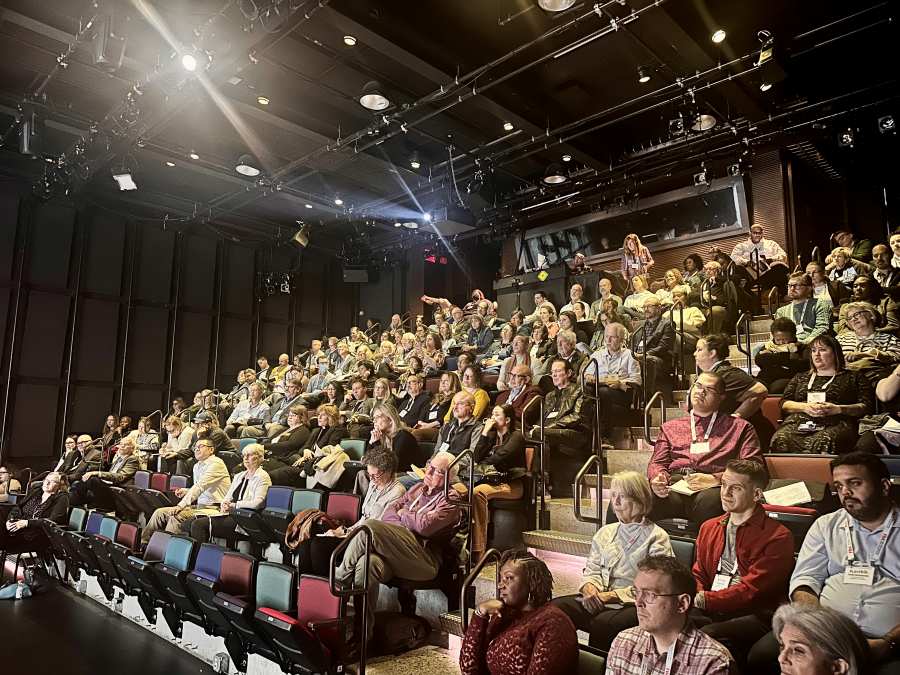
Change—how to navigate it thoughtfully, how to ignite it courageously, and how to fund it sustainably—was a major topic of discussion at this year’s Theatre Communications Group (TCG) Fall Forum on Governance, Leadership for the Long Arc. Held Nov. 7-9 at New York Live Arts in Manhattan, the most recent convening of theatre leaders and trustees marked a rejuvenation of the Fall Forum, which has taken place virtually or as a hybrid event elsewhere since its last NYC gathering in 2019. As Emilya Cachapero, TCG’s co-executive director for national and global programming, noted in her welcome remarks on Friday evening, the return of the Fall Form program was highly requested, and forum attendees were eager to connect in person to discuss and strategize how to “sustain our field for the long arc ahead.”
Cachapero also highlighted one major change at her own organization since the last convening in the city: She currently serves as one of three executive directors of TCG, which last year shifted to a co-leadership structure, alongside the co-executive director of national engagement, LaTeshia Ellerson, and co-executive director of national operations and business development, Alisha Tonsic. The shift reflects a growing adoption of the shared leadership model across performing arts organizations in recent years. After her welcome remarks, Cachapero introduced Indigenous artists DeLanna Studi and Ty Defoe to ground attendees in the history and ongoing stewardship of the land on which the forum took place.
“Native stories are not relics of the past—they are here, they are here now,” Studi remarked to attendees, following a glowing introduction from Defoe. A Cheerokee artist and the artistic director of Native Voices, the only Equity theatre in the U.S. dedicated to developing new works by Indigenous playwrights, Studi spoke to the necessity of hiring Indigenous “actors, directors, designers, dramaturgs, administrators, educators, and storytellers of every kind,” and moving beyond acknowledgment into action.
It was especially eye-opening when Studi hesitantly asked if any Native theatremakers in attendance that evening could stand or raise their hand, and there was, disappointingly, no movement within the audience whatsoever. “That’s why I was afraid to ask that question,” Studi said. “There’s two of us, and we are on the stage invited to speak to you tonight.” Studi then addressed the audience of artistic leaders directly: “This is your moment of truth…This is where you need to ask yourself what needs to change.” Studi’s remarks were a stark reminder of at least one change for the field that remains long overdue.
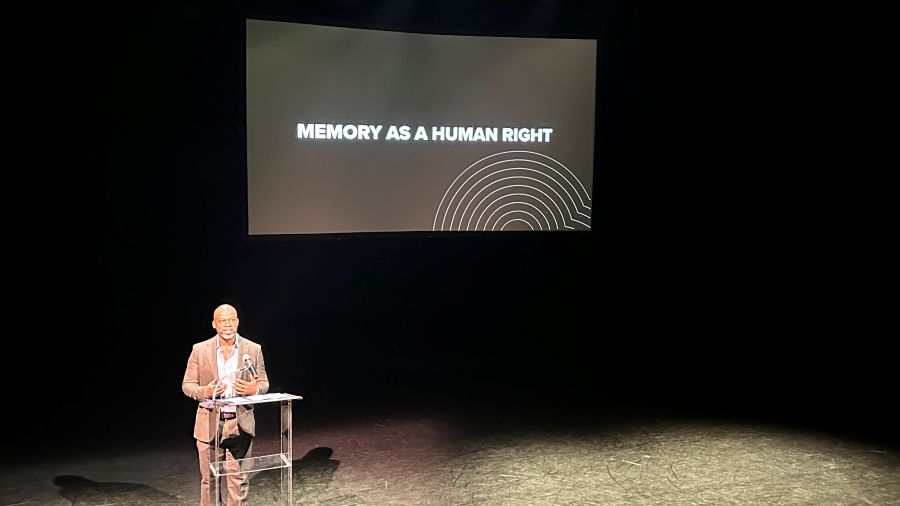
Cachapero then returned to the stage to introduce the forum’s keynote address, delivered by multihyphenate artist and cultural strategist Marc Bamuthi Joseph. Joseph offered a series of poetic provocations in an address titled “Artistic Intelligence, Empathy, and the Other Side of Fear.” Reflecting on a meeting he had with Jill Sonke, director of research initiatives in the Center for Arts in Medicine at the University of Florida, in his position as leader of the now-eliminated Social Impact team at the Kennedy Center, Joseph emphasized the value of art and artists not just for social impact, but for “social health and social cohesion,” and noted that these values are “not politically agnostic.”
“On a meter between zero and Harriet Tubman, how courageous is my work?” Joseph challenged every attendee to ask themselves that evening. He made it clear that, in a “national landscape with tenuous or inconsistent mental, emotional, and financial health,” courageous artistry is both a critical health indicator and a powerful catalyst for social healing and repair. Throughout his address, Joseph continued to invite attendees to consider questions, such as:
How do we create the conditions for artists to guide us forward to the other side of fear?
Can we use art to manufacture empathy as an intentional aspect of our economy?
What if dignity were currency?
How many artists does it take to make America great?
His questions illuminated the interconnectedness of the artistic, political, and material dimensions of our current reality. Before concluding the Friday evening session of the forum, Joseph spoke to the courage required to envision and enact the kind of changes he proposed throughout. “The line between bravery and foolishness is the width of a fingernail crescent moon in the dark winter night,” he said. “Bravery is the only thing that makes this American endeavor practical, or even possible.”
The second day of the forum kicked off with a morning plenary session on “Capitalization in a Time of Crises” led by Susan Nelson, executive vice president of nonprofit management consulting and research firm TDC. In her presentation, Nelson offered an accessible, in-depth, and data-driven analysis of the current state of the industry, and of changes to the fiscal environment facing theatre organizations today and in recent years.
She started by defining the different categories of capital that arts organizations were (or were not) resourcing within their budgets, such as working capital, operating reserves, facilities reserves, endowments, and recovery capital. She also emphasized the urgent need to securely fund what she called “risk capital” and “change capital,” i.e., the money required to experiment with new models and ideas and fund dramatic changes to how an organization operates. She noted that, with the temporary windfall of government-sponsored grants for the arts during the COVID-19 pandemic, “for five minutes, everybody had money…but business model issues were not addressed.” Most organizations, she continued, used that infusion of funds to maintain operations or cover deficits, without taking significant steps to adapt to increasing inflation, changes in audience and donor behavior, and the “death of sweat equity” that relies on the passionate labor of underpaid theatre workers to keep companies afloat.
The idea of “change capital” proved a powerful one for attendees. One group I spoke to at lunch mentioned that they would be reframing some of their fundraising asks around that idea. They highlighted that other sectors fund and staff entire research and development departments for their work, yet there aren’t many examples of similar concepts in the performing arts world. I was reminded of the fact that a quarter of the $8 million budget of this year’s Williamstown Theatre Festival was to “cover one-time transformational costs” related to their new producing model, and wondered where else one might be able to apply the concept of change capital to performing arts organizations. As Nelson insisted, “change capital must be a bridge to something,” rather than just funding for the same model operations as before.
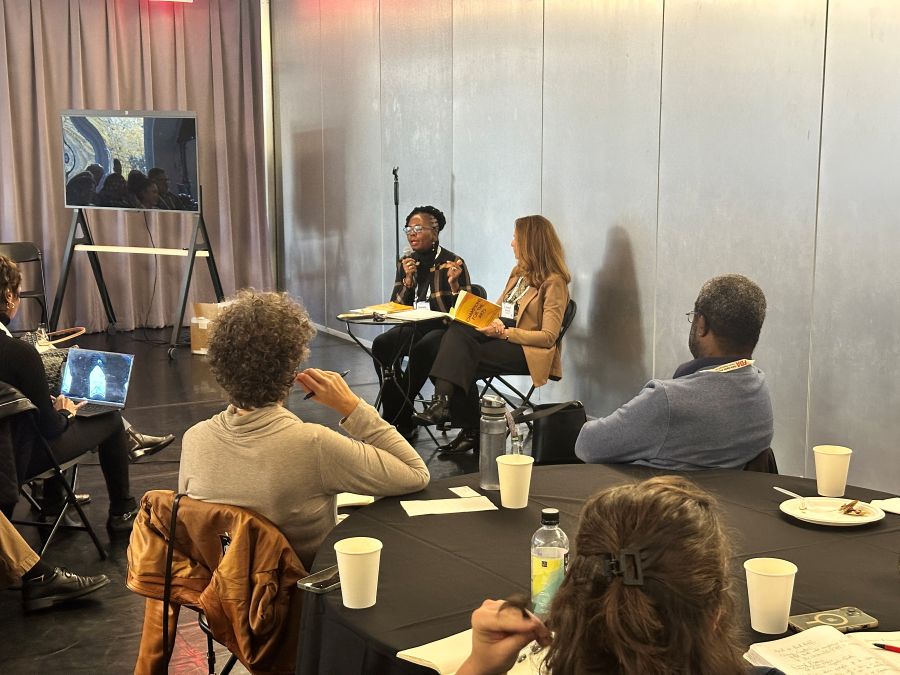
Saturday also featured two blocks of smaller breakout sessions on a variety of topics and their governance. In the first block, Todd Ahrens of Arts Consulting Group gave a presentation on governance and capital campaigns, Donna Walker-Kuhne and Cheryl Rosario gave a presentation on governance and audience-building (drawing on learnings from Walker-Kuhne’s new book, Champions for the Arts), and Jorge B. Merced and Rosalba Rolón of Pregones/PRTT discussed governance and mergers.
As I attended the latter session, I thought about the fact that New York Live Arts is the result of a 2011 merger between Dance Theater Workshop and the Bill T. Jones/Arnie Zane Dance Company, and that there’s an increasing interest in such organizational unions, including among three Pittsburgh theatres earlier this year. While the presenters of the mergers session requested that most of the content remain confidential, they did make clear that the 2014 merger between the Pregones Theater and the Puerto Rican Traveling Theater (PRTT) came after multiple years of close collaboration in mission-aligned work, but that merger processes are circumstance-specific and not one-size-fits-all.
In the second block of breakout sessions, Andrea Nellis and Belina Mizrahi of Arts Financial Management Services (Arts FMS) discussed governance and deficit budgets, Paul Epner of Illinois’ Northlight Theatre and Cynthia Huffman of Seattle’s Union Arts Center (also the result of a recent merger) discussed the effectiveness of governance structures, and leadership from NYC’s Pink Fang (formerly Ping Chong and Company) gave a presentation on governance and succession.
I attended the latter session, led by Pink Fang’s board president Amy Chin, managing director Jane Jung, artistic director of new work Mei Ann Teo, and artistic director of engagement Sara Zatz. The group dove into the three-year transition process for the company after long-running founding artistic director Ping Chong and executive director Bruce Allardice announced their retirements after decades of leadership at the company. Jung, Teo, and Zatz remain with the company after being part of the five-person artistic leadership team (which also included Nile Harris and Talvin Wilks) that helped create the new vision for Pink Fang during the transition period.
Teo noted how crucial it was to the process that “every single person did not think of the transition period as a way to secure their own future,” but rather as an open exploration of all possibilities to determine the best future for the company. Throughout their presentation, the group discussed the courage to develop something new while keeping a legacy in mind, the challenges and victories that occurred throughout the transition, the board’s response to proposed changes, and how the board itself underwent changes to better support the new vision for the company. Chin likened the transition process to making a devised theatre piece, emphasizing the interplay between the “script” of the new model being developed and the “actors” within the artistic leadership team working to shape it: “We don’t always use the artistic approach to our administrative work, but it works!”
Other plenary sessions throughout the weekend included a presentation on “The Paths to Intentional Board-Staff Relationships,” facilitated by Calida N. Jones and Douglas R. Clayton of Creative Evolutions, and “Scenario Planning for Theatres and Our Theatre Ecology,” featuring Daniel Payne of AEA Consulting. Jones and Clayton highlighted how many indicators of a healthy board relationship are just like any other relationship: Communication, consideration, and clear expectations are key. Payne emphasized the importance of future thinking and outlined a series of broader trends that will impact the performing arts over the next decade, including demographic change, disciplinary blur, and the loneliness epidemic, along with strategies for theatre companies to adapt to these changes.
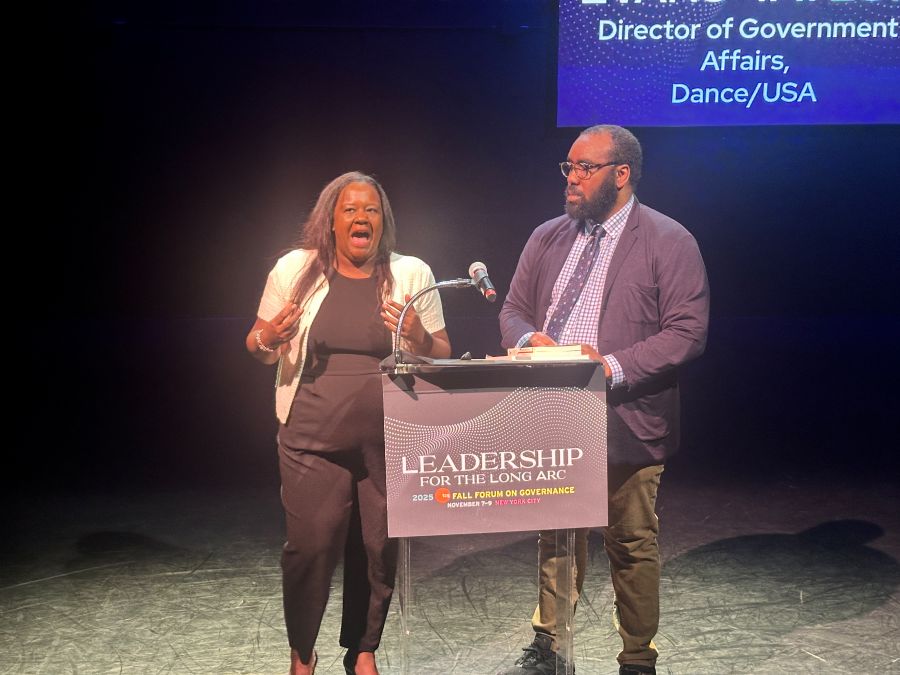
The vibe of the forum through Sunday morning had generally been casual and presentational, so I was delightfully surprised by the entrance of TCG’s advocacy and governance programs lead, Erica Lauren Ortiz, who took the stage clad in red boxing gloves with music blaring to kick off the final plenary session of the forum, “Avenger Advocacy: Assembling Coalitions and Power for Theatre Futures.” She described an experience she had as a teenager advocating for change within the NAACP, including an interaction with its former president, Hazel Dukes, in which Dukes imparted on Ortiz the value of “Sticktuity” when it comes to matters of long-haul activism and advocacy. It was a fitting concept to introduce at “Leadership for the Long Arc,” and one I continued to reflect on as Dance/USA’s director of government affairs Bertrand Evans-Taylor walked through a power-mapping exercise outlining the steps and stakeholders involved with securing legislative and other government support for the arts.
Cachapero returned to the stage at the end to introduce Annalisa Dias, one of four co-directors of NYC’s HERE Arts Center, who had been tasked by TCG to share her reflections on the forum at its close on Sunday morning. After recapping her main takeaways, Dias led attendees in singing a song from an upcoming project. After a weekend of hearing about shared leadership, new forms of collaboration, and the need to chart new paths for the long arc of theatrical leadership, Dias’ lyrics rang especially true: “We are all connected, we’re finding our way.”
Adam Wassilchalk (he/him) is a Harlem-based arts writer, stage manager, and production manager from Austin, Texas. Learn more at https://linktr.ee/adamwassilchalk