
Beyond Files: A New foundation for Terraform State Management
For years, managing terraform state has felt like a necessary evil.You’ve likely experienced frustrating lock contention, agonizingly slow refresh times, and the general anxiety of a shared state file becoming a bottleneck. But what if the essential approach to storing Terraform state was the problem, not Terraform itself? ItS time to move beyond the limitations of file-based state and embrace a solution designed for the complexities of modern infrastructure.
The Core Issue: Impedance Mismatch
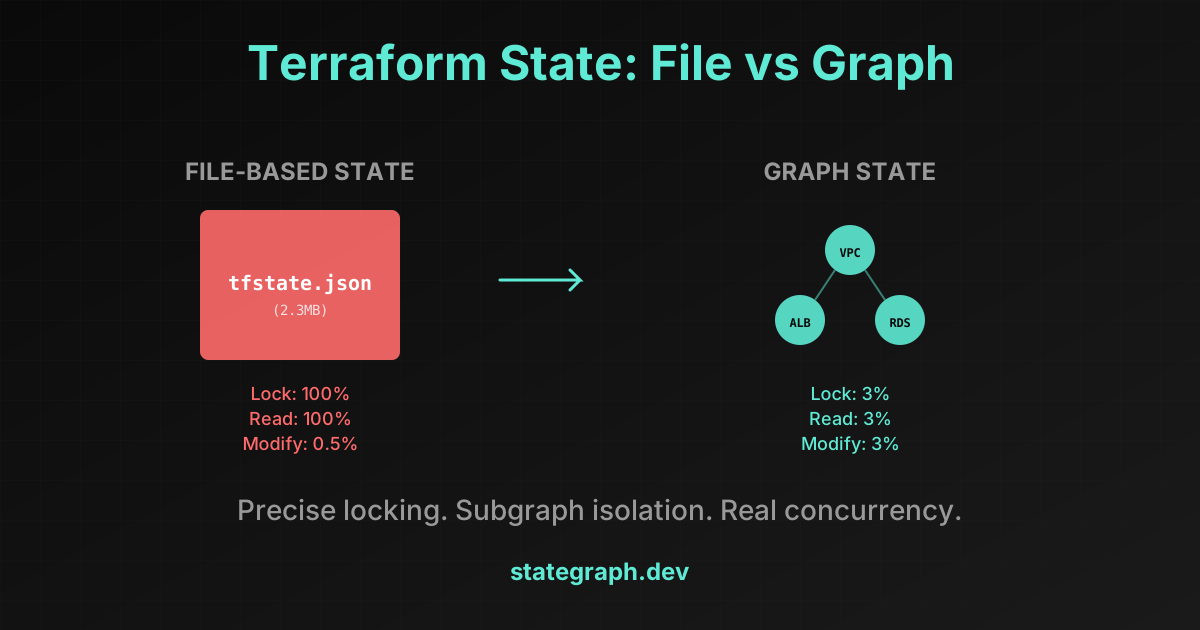
The current reliance on files to store Terraform state is a historical accident, not an inherent requirement. Terraform state, at its heart, is a graph. it represents the intricate relationships between your infrastructure components. Trying to force this graph structure into a flat file creates a notable impedance mismatch,leading to performance issues and operational headaches.
Consider how you interact with your state: traversing dependencies, updating specific resources, and collaborating with teams concurrently. These actions demand a storage layer capable of handling graph traversal, partial updates, and concurrent access with robust integrity. A graph database,with ACID transactions and fine-grained locking,is the natural fit.
For too long,the industry has accepted file-based state as unavoidable. This is a misconception. It’s a choice, and one that hinders scalability and efficiency.
Introducing a Graph-Native Approach
We’ve built a solution that directly addresses these challenges by reimagining the storage layer for Terraform state. This isn’t a wrapper or an orchestrator; it’s a complete replacement for the existing storage mechanism,preserving Terraform’s execution model while resolving its inherent coordination problems.
This new approach is built on PostgreSQL, leveraging its proven scalability, robust Multi-Version Concurrency Control (MVCC), and widespread operational familiarity. The state is normalized into three core relations:
* Resources: Each resource is represented by a single row, containing its type, provider, and associated attributes.
* Dependencies: An edge table meticulously maps the relationships between resources,forming the dependency graph.
* Transactions: An append-only log captures every state mutation, providing complete auditability and attribution.
Furthermore,the backend extends Terraform’s protocol with graph-aware operations. Lock acquisition and state queries operate directly on the database depiction of the graph, enabling unparalleled precision and concurrency.
A Seamless Adoption Path
You might be wondering about the effort required to switch. The good news is, it’s minimal. this solution reads existing tfstate files and automatically constructs the graph representation. no changes to your Terraform configurations are necessary.
From Terraform’s perspective, it simply interacts with another backend – just like S3 or GCS. However, from an operational standpoint, the transformation is profound.
Here’s what you can expect:
* Eliminated Lock Contention: Concurrent operations are handled efficiently, removing frustrating blocking scenarios.
* Dramatic Refresh Time Improvements: Queries operate directly on the graph database,reducing refresh times by orders of magnitude.
* Enhanced Collaboration: Teams can work independently without interfering with each other’s progress.
* Increased Visibility: State becomes queryable, auditable, and easily comprehensible.
we aren’t asking you to rewrite your infrastructure. We’re simply offering a better way to store it.
The Future of Terraform State
The question isn’t whether Terraform state should be a graph. It already is. The real question is whether we’ll continue to pretend it’s a file, sacrificing performance and scalability in the process.
this new approach represents a fundamental shift in how we think about Terraform state management. It’s a move towards a more robust, efficient, and collaborative future for infrastructure as code.
Stay Informed
we are currently in active progress and working with select partners to validate this approach at scale.
Get Updates and be among the first to experience the benefits of a graph-native Terraform state management solution.





