
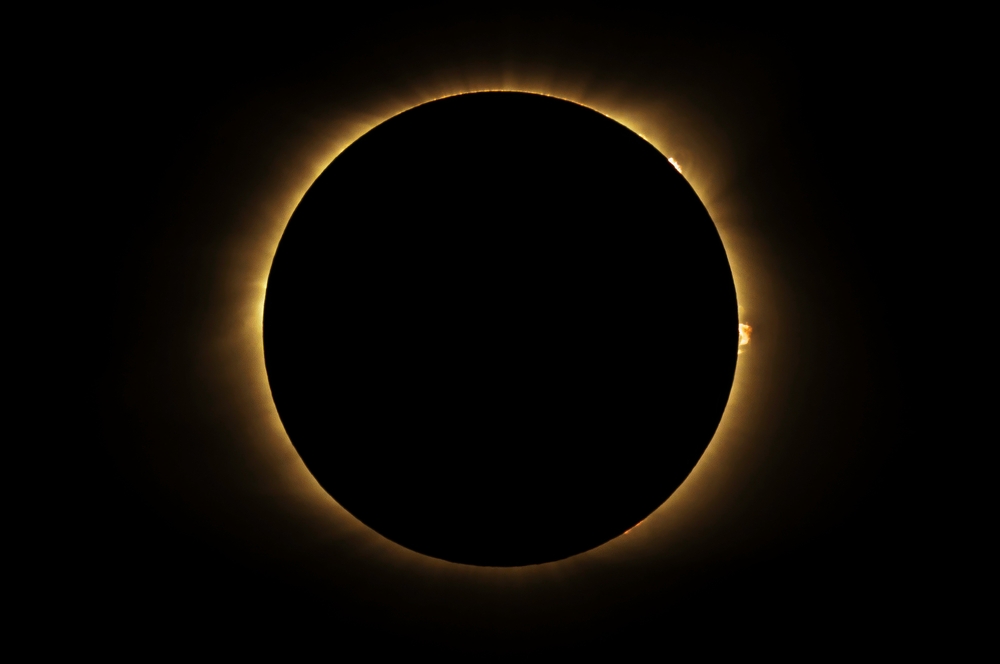
Astronomy enthusiasts and global travelers are already preparing for a rare celestial alignment that will define the decade. While the world has witnessed several impressive solar events in recent years, a truly extraordinary phenomenon is on the horizon: the longest total solar eclipse of the century.
Scheduled for August 2, 2027, this event is distinguished not only by its scale but by its extraordinary duration. For those positioned within the path of totality, the moon will obscure the sun for a length of time that far exceeds typical eclipses, creating a window of darkness that will offer scientists and observers an unprecedented opportunity to study the solar corona.
According to data provided by NASA and the National Geographic Institute (IGN), the event will span approximately 313 minutes from the first point of contact to the final disappearance of the moon’s shadow via Meteorologia en Red. While millions across Europe, Africa, and Southwest Asia will witness a partial eclipse, only those in a specific narrow band will experience the full transition into totality.
The Path of Totality: Where to Experience the 2027 Eclipse
The “path of totality”—the region where the moon completely blocks the sun—will start over the Atlantic Ocean before crossing the Strait of Gibraltar from west to east. From there, the shadow will sweep across North Africa, passing through Morocco, Algeria, Tunisia, Libya, and Egypt via Meteorologia en Red.
The journey continues across the Red Sea into Saudi Arabia and Yemen, eventually touching the northeastern tip of Somalia before concluding in the Indian Ocean. Spain, particularly the southern part of the peninsula, is noted as having a privileged position for observation.
The absolute peak of the event will occur in Egypt. In this region, the moon will completely hide the sun for 6 minutes and 23 seconds via Meteorologia en Red. This duration makes it one of the longest totalities ever recorded in modern history.
Comparing the Great Eclipses: A Century of Darkness
To understand why the 2027 event is so significant, it helps to compare it to other famous solar eclipses. Total solar eclipses vary in length based on the moon’s distance from Earth and the observer’s position relative to the center of the moon’s shadow.

The duration of 6 minutes and 23 seconds in Egypt puts the 2027 eclipse in an elite category of celestial events. For context, the widely watched 2024 eclipse in North America lasted 4 minutes and 28 seconds via Meteorologia en Red. Other historical benchmarks include the July 2009 eclipse, which reached approximately 6 minutes and 39 seconds, and the July 11, 1991 event, which lasted 7 minutes and 2 seconds.
Experts suggest that the world will not observe another phenomenon of comparable duration until July 2186, when a total solar eclipse is projected to last approximately 7 minutes and 29 seconds via Meteorologia en Red.
| Date of Eclipse | Maximum Duration of Totality |
|---|---|
| July 11, 1991 | 7 minutes 2 seconds |
| July 2009 | ~6 minutes 39 seconds |
| August 2, 2027 | 6 minutes 23 seconds |
| April 2024 | 4 minutes 28 seconds |
| July 2186 (Projected) | ~7 minutes 29 seconds |
Immediate Outlook: The August 2026 Eclipse
While the 2027 event is the “longest of the century,” observers in Europe do not have to wait long for their first major experience. A total solar eclipse is scheduled for August 12, 2026 via Allt om Vetenskap.
This 2026 event will bring totality to western Iceland and northern regions of Portugal and Spain. Specific Spanish cities highlighted as being in the path of totality include Valencia, Zaragoza, Palma de Mallorca, and Bilbao via Wikipedia. For those in other parts of Europe, including Sweden, the August 12 event will be visible as a partial solar eclipse.
Understanding Total vs. Partial Eclipses
A solar eclipse occurs when the moon moves precisely between the Earth and the sun. However, the experience differs wildly depending on where you are standing:
- Total Solar Eclipse: This happens when the moon completely blocks the sun’s disk, causing sunlight to disappear entirely for a few minutes. Here’s only possible because of a “cosmic coincidence”: the sun is roughly 400 times larger than the moon, but it is similarly roughly 400 times further away, making them appear nearly the same size in the sky via Allt om Vetenskap.
- Partial Solar Eclipse: This occurs when the moon only covers a portion of the sun. This is visible to a much larger geographical area (the penumbra) but does not result in total darkness.
Safety and Observation Guidelines
Whether witnessing a partial or total eclipse, safety is paramount. Looking directly at the sun, even during a partial eclipse, can cause permanent eye damage. Observers are urged to use appropriate eye protection, such as certified solar filters or eclipse glasses.
For the 2027 event, NASA and the National Geographic Institute (IGN) have provided maps and safety recommendations to ensure that the millions of people expected to follow the phenomenon can do so securely via Meteorologia en Red. Only during the brief window of total totality—when the sun is 100% obscured—is it safe to look at the corona without filters, though this window is short and requires precise timing.
Key Takeaways for Future Observers
- The 2027 Event: Occurs on August 2, 2027, with a maximum totality of 6 minutes and 23 seconds in Egypt.
- The 2026 Event: Occurs on August 12, 2026, with totality passing through Iceland, northern Spain, and northern Portugal.
- Global Visibility: While totality is limited to a narrow band, partial eclipses will be visible across most of Europe, Africa, and parts of North America and Asia.
- Safety: Always use approved solar protection; do not look directly at the sun outside of the total totality phase.
As we approach the August 12, 2026 eclipse, travelers and astronomers should begin monitoring official NASA and regional astronomical updates for precise timing and coordinates for their specific locations.
Do you plan on traveling to Egypt or Spain for these upcoming celestial events? Share your travel plans or questions in the comments below.