[email protected] (Dani Ostanek)
2026-01-16 18:16:00
The 2026 edition of Tirreno-Adriatico will pose as challenging a course as ever, despite the lack of a big summit finish.
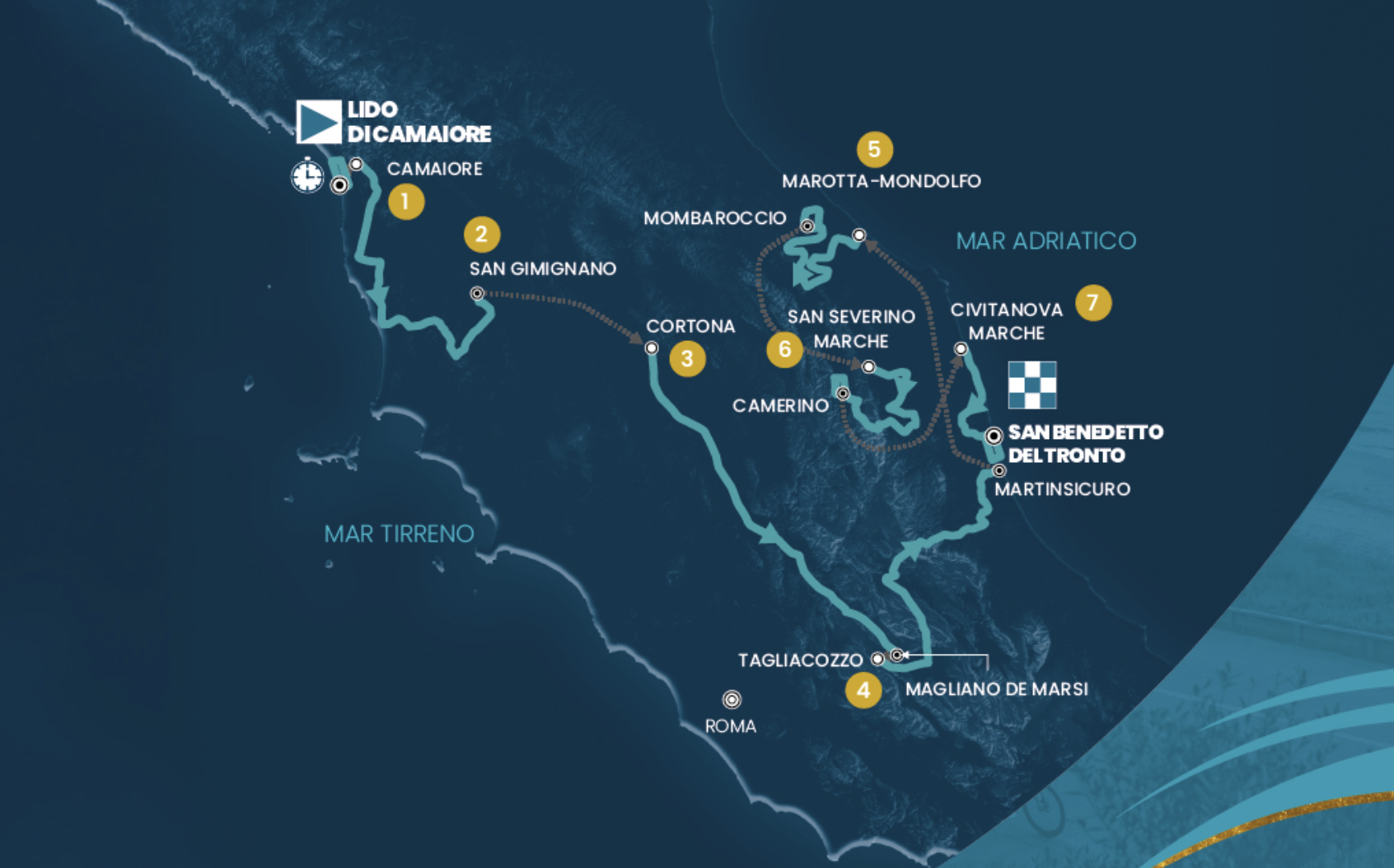
Unveiled on Friday, January 16, the 2026 route – run over seven days from March 9 to March 15 – will feature 15,550 metres of climbing, up 950 metres on the 2025 edition of the race.
“We’ve built a tough course, with stages exceeding 3,500 – 4,000 meters of elevation gain and requiring a great deal of thoroughness. In this sense, the Marche region once again represents a central element of the Corsa dei Due Mari, offering an ideal setting for the decisive stages of the race.
Stage 1: Lido di Camaiore ITT, 11.5km
Image 1 of 2

The race commences with its now-customary pan-flat time trial in Lido di Camaiore. The 11.5km stage follows an out-and-back route up and down the seafront with a U-turn in the middle providing the only real technical challenge of the day.
Stage 2: Camaiore – San Gimignano, 206km
Image 1 of 2


Stage 2 brings a day which gets progressively harder after a sedate start with a flat run down the coast.
After heading south through Tuscany, passing by Pisa and Livorno, the race then hits the hills for the first time with plenty of ups and downs, even if there’s only one classified climb before the end.
The finale holds the real difficulty of the day. There, a 5.3km gravel road towards the finish concludes with a short, sharp 15% kick to the line in San Gimignano.
Stage 3: Cortona – Magliano de’ Marsi, 225km
Image 1 of 2


The third stage of Tirreno-Adriatico 2026 is the longest and, frankly, probably the least interesting on paper. The stage features one small climb after 83km, but from there it should be plain sailing for the sprinters, who’ll do battle on a slight uphill run to the line.
Stage 4: Tagliacozzo – Martinsicuro, 210km
Image 1 of 2


Stage 4 takes the race south to the Apennines via L’Aquila and two major passes of Ovindoli and the Valico della Capannelle.
A long descent from the latter leads into a tricky final 60km filled with several short, sharp climbs. At 49km from the line, the climb at Castellatlto features stretches at 12%, while several unclassified hills lie between it and the final test of the day.
12.6km out, the muro at Tortoreto will provide a late launchpad for any hopeful attackers. The gradient on the way up reaches 20% in places, while a flat run to the finish line awaits.
Stage 5: Marotta-Mondolfo – Mombaroccio, 186km
Image 1 of 2


On a race without a set piece summit finish, it’s tougher to call any one day the queen stage, though stage 5 is certainly in the running for that title alongside stage 6.
There are four classified climbs packed into the latter half of the 186km run to Mombaroccio, though the undulating stage features barely a metre of flat from the start.
RCS Sport say there are “at least 10” major climbs along the way, though the biggest tests will come late on. The Monte delle Cesane features several kilometres at a 15% gradient, while the stage concludes with two laps of a hilly circuit including an ascent of the Santuario Beato Sante.
The final ascent of that climb comes 1.6km from the finish, meaning a late attack into the short descent to the line could win the way.
Stage 6: San Severino Marche – Camerino, 189km
Image 1 of 2


Stage 6 features Sassotetto, a climb which has hosted past summit finishes at Tirreno-Adriatico. This time, however, it features after 66.8km of racing, and so is unlikely to have a major bearing on the final result.
From there, a descent will take what’s left of the peloton to three laps of a challenging and hilly 29.1km circuit in Camerino. The Muro della Madonna delle Carceri is the main difficulty on this circuit, featuring gradients up to 18%, with the finish line coming at the top of the final of three full ascents of the hill.
Stage 7: Civitanova Marche – San Benedetto del Tronto, 143km
Image 1 of 2


Almost all of the climbing is done and dusted by this point, with one last climb lying between the peloton and the finish line of stage 7 in San Benedetto del Tronto.
The early hill on the final stage is something for the breakaway to battle over rather than the GC hopefuls, however. Instead, the stage is one for the sprinters, who’ll get five laps of a flat 15km city circuit to prepare for the race’s grand finale – the closing sprint finish.