
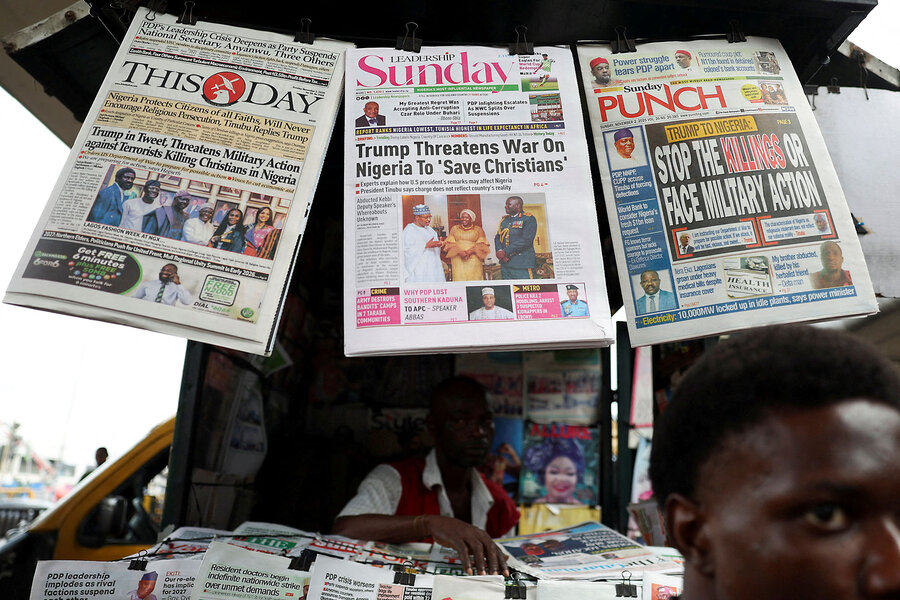
Beyond Religious Lines: Unpacking the Complex Security Crisis in Nigeria
Nigeria is grappling with a deeply unsettling surge in violence, often – and inaccurately – framed as a conflict between Christians and Muslims. While the visible fault lines frequently enough appear religious, a closer examination reveals a far more complex crisis rooted in weakening governance, resource scarcity, and the proliferation of armed groups impacting all faiths. This article delves into the multifaceted nature of the insecurity plaguing Nigeria, moving beyond simplistic narratives to explore the underlying drivers and the human cost of this escalating situation.
A state ceding Control: The Root of the Problem
The recent attacks, tragically commonplace across Nigeria, are symptomatic of a broader breakdown in security affecting all communities. “What’s happening in Nigeria is tragic,” states James Barnett, a research fellow specializing in African security and politics at the Hudson Institute, a respected conservative think tank in Washington D.C.”But it’s rooted in weak governance – not religion.”
For decades, the Nigerian state has gradually lost control over notable portions of its territory, allowing various armed groups to flourish. This vacuum of authority has created a fertile ground for violence,leaving both Christians and Muslims vulnerable. This isn’t a religious war; it’s a security crisis where religion is often exploited or misconstrued.
The Human Cost: Stories from the Front Lines
The impact of this insecurity is devastatingly personal. Terungu Aondoakula,a farmer from Benue State,recounts a harrowing experience. On April 16th, her village, Ityuluv, was raided by masked gunmen. She fled with her young child, enduring an 11-mile trek to safety, only to return to scenes of utter devastation: burned homes, slaughtered livestock, destroyed farms, and the bodies of her neighbors. “I lost everything,” she says, her voice barely a whisper.
The residents of Ityuluv, predominantly Christian, suspect the attackers were linked to fulani militias. Traditionally nomadic pastoralists, the Fulani have increasingly been pushed southward by desertification and drought, leading to clashes with farming communities over dwindling resources. These conflicts, often mislabeled as religious violence, have resulted in thousands of deaths and the displacement of entire villages. The core issue isn’t faith, but competition for survival in a changing environment exacerbated by a lack of effective resource management and conflict resolution mechanisms.
Boko Haram’s Indiscriminate Violence: A Further Complication
The situation is further complicated by the ongoing threat posed by Boko Haram in the northwest. For years, Nigerian security forces have struggled to effectively patrol the vast territory where the group operates. Boko Haram’s stated goal is the establishment of a strict Islamic caliphate, but their violence is far from religiously selective.
Data from the U.S.’s Council on Foreign Relations’ nigeria Security Tracker reveals a shocking truth: between 2011 and 2020, Boko Haram attacked 72 mosques, killing thousands of Muslims. As Samuel of good Governance Africa points out, Boko Haram’s “violence does not discriminate.” This underscores the fact that the group targets anyone perceived as an enemy, regardless of their religious affiliation.
The Danger of a Divisive Narrative
Local faith leaders recognize the danger of framing the conflict solely through a religious lens. Bishop Matthew Hassan Kukah, a highly respected Catholic cleric in Nigeria, recently urged the U.S. government to reconsider designating Nigeria a “country of particular concern” over religious freedom. He argued that such a designation would be counterproductive, exacerbating tensions and providing opportunities for criminals to exploit existing divisions.
“it will increase tensions, sow doubt, open windows of suspicion and fear, and allow criminals and perpetrators of violence to exploit divisions,” Bishop Kukah warned. Despite his plea, the U.S. ultimately placed Nigeria on a “special watch list,” a decision that highlights the international community’s concern but also the potential for unintended consequences.
Finding Common Ground: Stories of Resilience and Shared Suffering
Despite the pervasive violence and mistrust, glimmers of hope emerge from the shared experiences of Nigerians from all walks of life.Mr. Abubakar, a commercial motorcycle driver in Minna, fled a Boko haram attack in 2018. Today,he transports passengers from diverse backgrounds – a pastor’s son,a Muslim trader displaced by bandit raids from Zamfara State.
“If you come here,” he says, “everyone has their stories.” These stories,while frequently enough heartbreaking,reveal a common thread: a shared vulnerability and a desire for peace.
**Moving Forward: A Holistic approach to


