
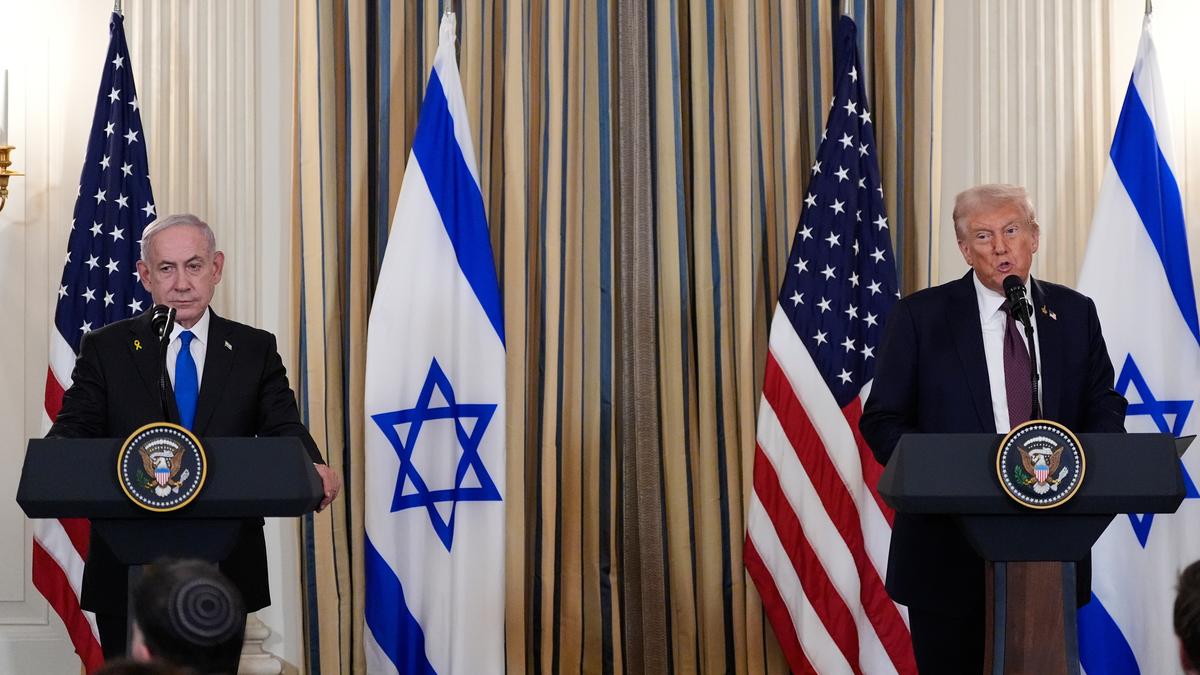
The trump Gaza Plan: A Critical Analysis of Control, Not Resolution
(Published September 30, 2025, 1:10 PM IST)
The recent unveiling of Donald Trump’s 20-point plan for post-conflict Gaza has sparked debate, but a close examination reveals a strategy focused on control and the removal of Hamas, rather than a genuine pathway to lasting peace or Palestinian self-determination. While presented as a ”major peace breakthrough” and garnering support from Israeli Prime Minister Benjamin Netanyahu and elements within the Arab world, the plan falls critically short of addressing the fundamental political issues driving the Israeli-Palestinian conflict and raises serious concerns about Palestinian sovereignty. this analysis will dissect the plan’s key components, assess its feasibility, and highlight its potential implications for the future of Gaza and the broader region.
Deconstructing the Trump Plan: Hamas, Security, and governance
The core tenet of the Trump plan centers on the complete dismantling of Hamas’s influence in Gaza. It demands the group’s decommissioning,the destruction of its weapons production facilities and tunnel networks,and offers a conditional amnesty – including safe passage out of Gaza – to Hamas leaders who comply. This demand, while understandable from an Israeli security perspective, ignores the complex socio-political realities that led to Hamas’s rise and the legitimate grievances of the Palestinian population it represents.
The plan proposes a temporary transitional governance committee to manage day-to-day affairs, overseen by a “board of Peace” chaired by Mr. Trump himself, alongside figures like former British Prime Minister Tony Blair. This structure promptly raises questions about legitimacy and accountability. A board dominated by external actors, notably those with vested political interests, risks imposing solutions that do not reflect the needs and aspirations of the Palestinian people.
Crucially, the plan acknowledges a continued Israeli security presence within Gaza, framing it as a “buffer zone.” However, Prime Minister Netanyahu has explicitly ruled out a full withdrawal, suggesting a long-term, potentially indefinite, occupation under a different guise.This contradicts assurances that Palestinians will not be forced to leave Gaza or that Israel will annex the territory, creating a fundamental tension at the heart of the proposal.
The International stabilisation Force (ISF): A Security-Focused Approach
To provide immediate security, the U.S. intends to collaborate with Arab and international partners to deploy a temporary International Stabilisation Force (ISF). Details remain scarce, but the plan envisions the ISF training Palestinian police officers in consultation with Jordan and Egypt. while security stabilization is a necessary component of any post-conflict scenario, relying solely on external forces to provide long-term internal security is a flawed strategy. Sustainable peace requires building robust, accountable Palestinian security institutions capable of independently maintaining order and protecting the population.
The plan’s assertion that Palestinians will not be forced to leave Gaza is a welcome statement, but it lacks concrete mechanisms to prevent displacement resulting from ongoing violence or economic hardship. Similarly, the promise that Israel will not occupy or annex Gaza rings hollow given the proposed indefinite security perimeter and the lack of a clear timeline for full Israeli withdrawal.
The Missing Piece: A Viable Path to Palestinian Statehood
Perhaps the most glaring omission in the Trump plan is a concrete roadmap for the establishment of a Palestinian state. The plan vaguely states that “conditions may finaly be in place” for Palestinian self-determination once the proposed measures are implemented. this conditional phrasing, coupled with the lack of specific commitments, effectively postpones the issue of statehood indefinitely.
The plan also conspicuously avoids addressing the situation in the West Bank, where Israeli settlements continue to expand, displacing Palestinian communities and undermining the possibility of a contiguous, viable Palestinian state. This silence is particularly troubling, as the West Bank remains a critical component of any just and lasting resolution to the conflict.
A Convenient Arrangement or a Genuine Opportunity?
The Trump plan, as it stands, appears less a genuine peace proposal and more a strategically convenient arrangement designed to achieve specific objectives: removing Hamas from power and placing Gaza under external control.
* If Hamas rejects the plan: Mr. Trump and Mr. Netanyahu can leverage this rejection to justify the continuation of the war, potentially escalating the conflict and further devastating Gaza. the plan allows for the establishment of a temporary governance structure in “terror-free” areas, even amidst ongoing hostilities.
* If Hamas accepts the plan: The group will be forced to demobilize and relinquish control of Gaza to a foreign-controlled body, effectively surrendering its political and military power. Israel will maintain a permanent security presence, and the Palestinian Authority will be sidelined, lacking any meaningful role in governing Gaza.
Expert Perspective & Long-Term Implications
Having followed the Israeli-Palestinian conflict


