
Dominique Soguel
2026-01-16 21:58:00
Russian attacks against Ukraine’s energy infrastructure have left Svitlana Tarasenko and her son, Bohdan, literally powerless since Jan. 9.
“This is the most difficult winter we’ve had in the war,” says the Kyiv resident, bundled up in a puffy jacket as her phone charges at an emergency relief center near her apartment. “We have to store our food on the balcony because the fridge is not working.”
Thousands of Ukrainians across the country are in similar situations. But the capital has felt the impact of Russian attacks against energy infrastructure extra hard this winter. The situation has sparked finger-pointing over failure to prepare and has left everyone struggling to stay warm.
Why We Wrote This
Russian air attacks are hitting Ukrainian energy infrastructure hard, leaving residents without power and heat during one of the coldest winters of the war to date. It’s putting citizens’ resilience to the test.
A massive Russian bombardment on Jan. 9 hit three of the capital’s five combined heat and power facilities. That caused outages of both necessities in half the households in the city. A second attack days later on a thermal power plant in the region aggravated the situation, further disrupting energy flows from the western Ukraine to the rest of the country.
Russia’s choice of targets point to a concerted effort to leave major cities – particularly Kyiv, as well as Odesa, Dnipro, and Zaporizhzhia – disconnected from the national energy grid. Generators large and small are insufficient to close the gap.
The situation is dire enough that President Volodymyr Zelenskyy this week declared a state of emergency in the energy sector. He singled out authorities in Kyiv for failing to do more to prepare. Simultaneously, the energy ministry has a new head after the Cabinet was reshuffled in the wake of a corruption scandal.
In the cold, under siege
Ukrainians are rising to the challenge by banding together and drawing on well-honed emergency workflows in the country’s fourth full winter in wartime conditions.
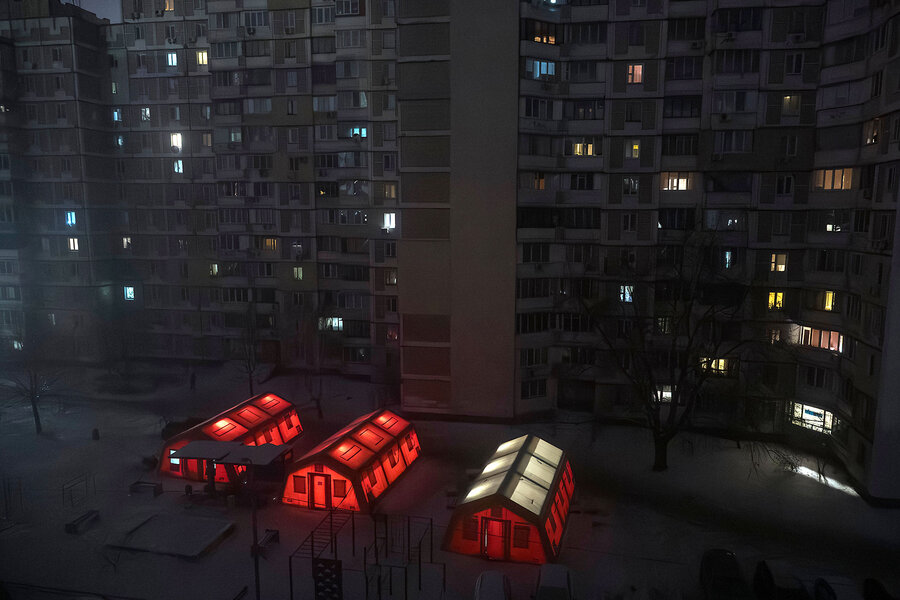
Ms. Tarasenko was among those seeking support at an “invincibility point” in an orange tent. A common sight in front-line regions, these pop-up relief centers allow people to charge their phones, get a cup of hot tea or coffee, even a warm meal in an emergency.
But such solutions are not enough for the scale of the situation. Experts say the crisis in Kyiv has been amplified by the cumulative effect of ever larger Russian attacks that penetrate air-defense systems and the impact of abnormally cold weather on energy infrastructure.
“We knew that Russian attacks would come when it is cold, but we were not ready for this,” says Red Cross volunteer Michael Demyanenk. “You just don’t know when the weather will be this cold.”
Electricity access remains short and unpredictable, particularly in the capital, front-line regions, and the port city of Odesa. In Kyiv, hundreds of households are still without hot water and heating because of damage to boiler houses and district heating substations. These remain a focal point of drone attacks.
The bakery where Ms. Tarasenko works still has power thanks to a giant backup generator. But she has no electricity at home and the personal power banks that she usually uses to fill in during power outages are depleted. She won’t invest in costlier alternatives without the counsel of her husband who is serving at the front.
Families who have gas stoves share them with friends whose electric stovetops are dead. “We’ve had four years to learn,” says Kateryna Yermachenko, a mother of twins. “Morally, it is easier than in 2022 [when all-out war started] but physically, it is much harder.”

That’s due to bone-biting temperatures barely above 0 degrees Fahrenheit. Ms. Yermachenko is furious at Russia for the attacks against her country’s energy infrastructure. She calls it “inhumane” to attack civilians who are facing the coldest winter since the start of the full-scale invasion in February 2022.
But she is also critical of the Ukrainian government – particularly the energy ministry, which is being investigated for corruption.
“I don’t think the government and city authorities did enough to prepare,” Ms. Yermachenko says. “If we did not have corruption in the energy sector, we would be better prepared.”
“We have to change our strategy”
The gravity of the situation in Kyiv city and region, in the assessment of experts, surpasses that of the November 2022 blackouts. After this month’s attacks, about 80% of the households were left without heating or power as temperatures plummeted. One week on, they get three to five hours of electricity per day without a sense of schedule.
Repair work is complicated by freezing conditions and air raids that force repair teams to take shelter.
“It is abnormal weather,” says Mariia Tsaturian, energy expert at the Ukraine Facility Platform think tank. “The other negative effect of such weather is that [energy] consumption rises highly all over Ukraine, which is hard to cover with generation remaining after Russian attacks.”
She adds that Russia has expanded the scope of its attacks. Starting in 2025, it has targeted not only big power plants and ultra-high-voltage substations, but also gas-powered cogeneration facilities in the cities, boiler stations in the municipal districts, and middle-voltage substations in the distribution grid.

In many cases, the thermal power plants were already worn down by the decades and damaged in earlier Russian attacks. Since autumn 2022, Russia has executed more than 40 large-scale bombardments, combining the use of drones and missiles targeting the energy sector.
The scale of massive attacks has also evolved significantly. In 2022 and 2023, Russia typically deployed up to 70 missiles and around 100 drones per strike on an energy facility. By 2025, the number of drones used in a single attack had surged dramatically – to as many as 400. And Ukrainian air defenses are running low on ammunition, as President Zelenskyy affirmed on Friday.
While Ukrainians are proud that, since 2023, the pace of their restoration has outpaced the damage done by Russia, and that they have built protective steel and cement defenses against drones over critical elements of power infrastructure, Russian missiles still punch through.
“We can find problems in our preparation, of course, but I can’t say we are unprepared,” says Ms. Tsaturian. “We have to change our strategy for preparation to the winter season, and for restorations trying to upgrade our energy resilience, not only for the upcoming winter but several next.”
One solution, in her view, would be to decentralize power generation and move to smaller constellations of power plants that are harder to take out than the large, Soviet-era structures. That approach is being tested with some success in different Ukrainian cities. Others require a complete overhaul of the energy market and regulations.
Moments of distraction
Temperatures are so low in the Ukrainian capital that the Dnieper River, which bisects the city, has frozen. Residents put on a brave face and find ways to navigate the blankets of snow and slippery streets on their way to work.

Some just go ice fishing. Others, such as university student Anfisa Tkachenko and her mother, Oksana, turn to nighttime sledding to escape the cold darkness engulfing their apartment.
“In the morning, it is OK but at night, it is hard,” says the student, stomping her feet to stay warm. “Being here helps to see things differently.”
Her mother concurs: “You start to come up with ways to distract yourself.”
The cold and fairy-tale snow might bring moments of joy but they also kill. A man with dementia froze to death in Kyiv. Homeless shelters and social workers scramble to help the most vulnerable so they don’t suffer similar fates while facing dire conditions in their own homes.
“We have to use our strength to help those who are weaker than us,” says Viktoriia Seliverstova, director of a shelter for the homeless.
Serhii, a shelter resident who survived Russian occupation in Izyum, puts the current hardship into perspective. “Winter lasts just three months,” he says. “The war is entering its fifth year.”
Oleksander Naselenko supported reporting for this article.


