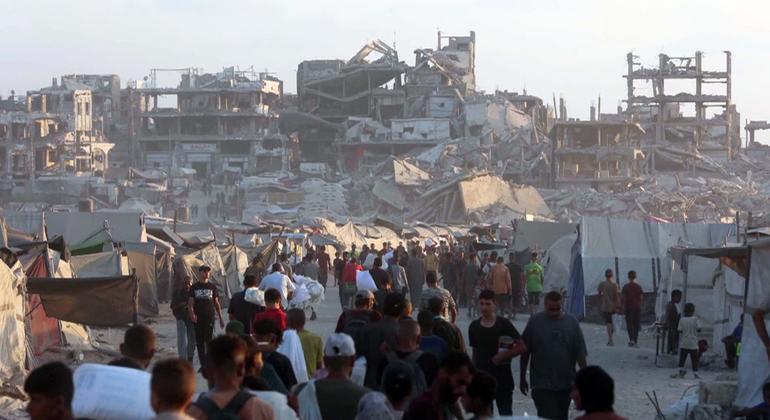
Gaza on the Brink: UN Demands Halt to Potential Full-Scale Israeli Takeover Amidst Humanitarian Crisis
The situation in Gaza is rapidly deteriorating, prompting urgent calls from the international community – most notably the United Nations – for an immediate de-escalation of conflict and a dramatic increase in humanitarian aid. Recent approval by the israeli security cabinet of a plan signaling a potential full-scale military takeover of the gaza strip has ignited fears of further devastation and widespread human suffering.
UN High Commissioner for Human Rights, Volker Türk, unequivocally stated, “A complete military takeover of the occupied Gaza Strip must be immediately halted.” This strong condemnation underscores the growing international concern that Israel’s actions are not only exacerbating the existing humanitarian catastrophe but also contravening international law. Türk specifically referenced a landmark ruling by the international Court of Justice (ICJ) demanding an end to the occupation and a commitment to a two-State solution that guarantees Palestinian self-determination.
The ICJ’s ruling, and Türk’s subsequent statement, highlight a basic principle: lasting peace and security cannot be achieved through military force, but through adherence to international law and a genuine pursuit of a just and equitable resolution to the Israeli-Palestinian conflict.
A Humanitarian Crisis of Catastrophic Proportions
The current conflict,ignited by the Hamas-led attacks on Israel in October 2023,has already wrought unimaginable destruction upon Gaza. beyond the immediate casualties – numbering in the tens of thousands – the enclave is facing a rapidly unfolding humanitarian crisis. Aid agencies have consistently warned that Israeli bombardment, mass evacuation orders, and stringent restrictions on relief efforts have created conditions bordering on uninhabitable.
The situation is so dire that even UN staff operating within Gaza are struggling to secure basic necessities like food. UNRWA, the UN agency for Palestinian refugees, reports these firsthand experiences, painting a grim picture of daily life for civilians. While israel announced daily military pauses in western Gaza on July 27th, ostensibly to facilitate humanitarian responses, aid workers on the ground report that the volume of assistance reaching those in need remains woefully inadequate.
The statistics are harrowing. According to the UN human rights office (OHCHR), at least 1,373 Palestinians have been killed while attempting to access food since may 27th. A significant portion of these deaths occurred in the vicinity of aid distribution points, like those operated by the Gaza Humanitarian Foundation (GHF), and along routes used by food convoys. This tragically illustrates the immense risk civilians face simply trying to survive.
Malnutrition and Disease: A Looming Threat
The lack of adequate food and basic services is fueling a surge in malnutrition, especially among children. Dr. Tedros adhanom Ghebreyesus, head of the World Health Organization (WHO), delivered a stark warning: “In July, nearly 12,000 children under five years were identified as suffering from acute malnutrition, the highest monthly figure ever recorded.”
The consequences are already being felt. As of this year, 99 people have died from malnutrition, including 29 children under five. Dr. Tedros cautioned that these figures are likely underestimates, suggesting the true scale of the crisis is even more alarming. Widespread malnutrition weakens immune systems, making populations more vulnerable to disease outbreaks, further compounding the humanitarian emergency.
Calls for Immediate action: A Path Forward
The UN’s message is clear: the cycle of violence must end. Volker Türk emphasized the urgent need for the Israeli government to prioritize the lives of Gazan civilians by “allowing the full, unfettered flow of humanitarian aid.”
However, aid alone is not enough. The High Commissioner also stressed the imperative of the immediate and unconditional release of all hostages held by Palestinian armed groups, alongside the release of Palestinians arbitrarily detained by Israel.
Ultimately, Türk concluded, “The war in Gaza must end now. And Israelis and Palestinians must be allowed to live side by side in peace.”
Achieving this vision requires a fundamental shift in approach – one that prioritizes diplomacy, respect for international law, and a genuine commitment to a two-State solution. The international community must redouble its efforts to facilitate negotiations, ensure the protection of civilians, and address the root causes of this protracted conflict. The future of Gaza, and the prospects for lasting peace in the region, depend on it.