
[email protected] (Andy Turner)
2026-01-20 15:20:00
You can trust Cyclingnews
Our experts spend countless hours testing cycling tech and will always share honest, unbiased advice to help you choose. Find out more about how we test.
Van Rysel D100 Trainer with Zwift Cog
Price: £279.99 / €299.99 / $NA
Max Power: 600 watts
Max Grade: 6%
Power accuracy: 5%
Weight: 10.5kg
Connectivity: Bluetooth
As some of the best smart trainers jump above the £1500 mark and smart bikes are often in excess of £3000, the Van Rysel D100 aims to go the other way, becoming the first direct drive trainer to include the Zwift Cog for under the price of £300.
Design and specifications
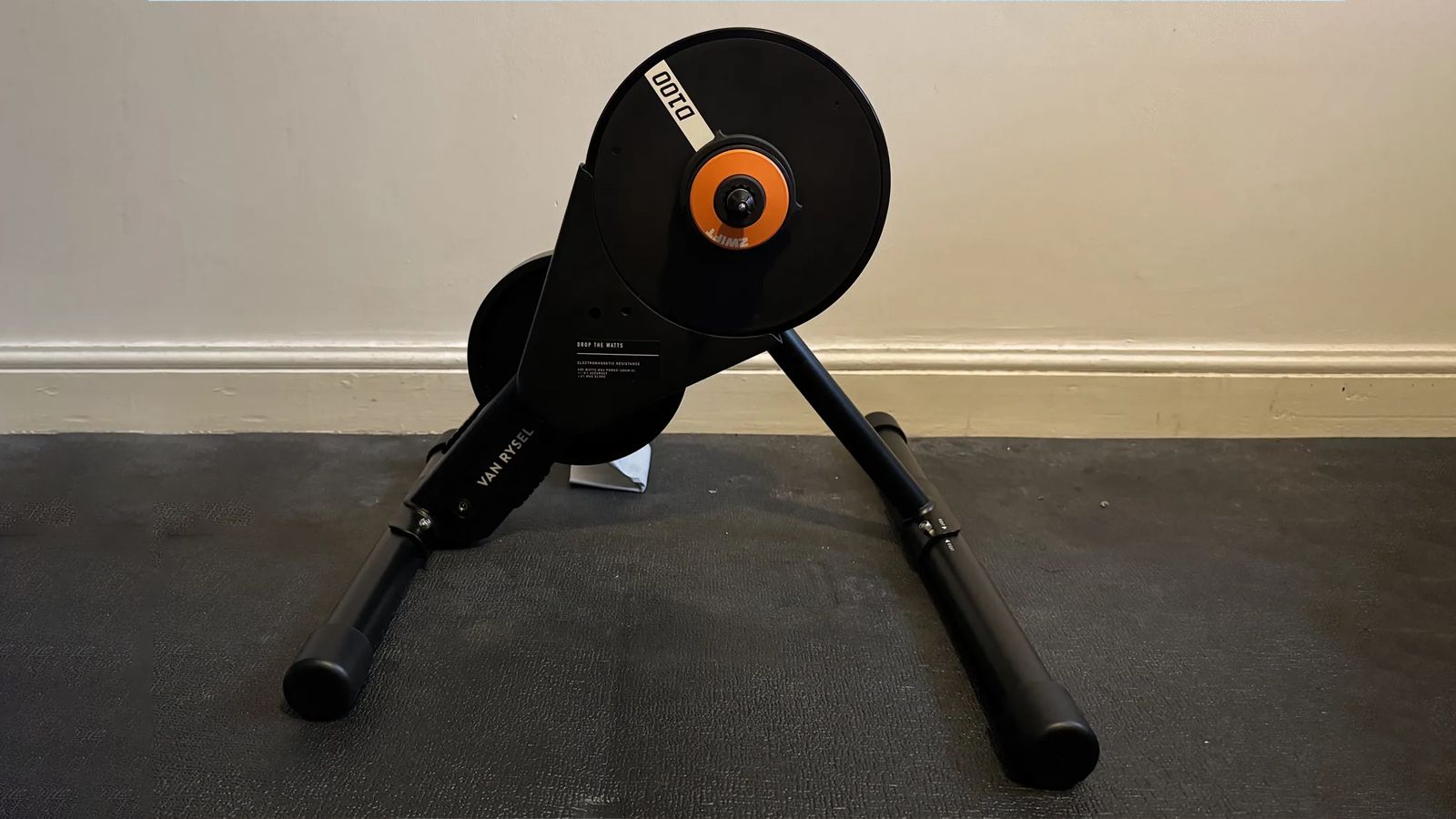
The Van Rysel D100 smart trainer is the entry-level model in the brand’s lineup. At present, it is the cheapest direct drive smart trainer readily available on the market.
The design looks quite similar to the Wahoo KICKR Core or JetBlack Victory, using two wide bars for feet with a wider one at the front and a narrower one at the rear. This gives a footprint of 490 x 450mm with a 600mm height. The front leg can, however, be folded up for storage to give measurements of 280 x 540 x 600mm. Total weight for the unit is 10.5kg.
Interestingly, the D100 uses only Bluetooth, rather than the industry standard of ANT+ and Bluetooth options.
Specifications-wise the D100 has a maximum resistance of 600 watts and a maximum simulated gradient of 6%. Power accuracy is 5%, well below the required 1% necessary for high-level Eraces, but then so are the max power readings.
Of course, this version of the D100 comes pre-fitted with the updated Zwift Cog, which allows for virtual shifting. This updated Cog allows for adjustments to position the chainline with a total of 10 different settings. This allows for virtually any 8-13-speed bike to be used on the D100 without the need to change cassettes or freehub bodies.


Performance
Initial setup of the unit was incredibly easy and very promising. The feet require attachment, but all tools are supplied, and the relatively low weight of 10.5kg for a smart trainer makes this process all the more simple. Simply put it in place, and plug it in.
Or it would be that easy had my floor not been so uneven. Given the lack of adjustable feet, this required a careful folding of some errant cardboard in my office to try and get the D100 levelled perfectly. There is also some adjustment of the Zwift Cog to get the correct chainline, but again, this is incredibly easy.
Connecting to the likes of Zwift or TrainingPeaks Virtual was also simply done, just search for the device in the Bluetooth connection settings, and there it is. The Zwift Cog shifter also connects once it’s been clicked. However, the Zwift Cog will not work with any app other than Zwift.

Starting the ride and the ride feel is very promising. It’s not got the largest flywheel, but if anything, this actually helps the D100 feel a bit more reminiscent of smaller gear pedalling out on the road. Sometimes the large flywheels can give a false inertia. Power was able to be maintained consistently with resistance applied reliably across steady riding. Clicking up a gear or two, the resistance was applied a bit more gradually that made it less jarring
To test out power accuracy, I dual-recorded a few rides with a pair of Wahoo Powrlink dual-sided pedals to see how they compared. The Wahoo generally reads a bit higher than smart trainer,s given the power reading is at the pedal rather than the hub, so fewer watts are wasted on drivetrain efficiency and the kinetic chain. Interestingly, though, the D100 read about 10-20w higher across most intensities. The good news here is that it was consistent in its slope. So at 200w on the Wahoo, the D100 read around 220w, and at 300w it read 320w. This means it followed a consistent slope rather than increasing by a percentage as the wattage increases. From my experience, this does at least mean it can be used as a consistent training tool even if the numbers are not necessarily correct.


The problem, however, lies in the max power reading. 600w is quite a low max power. I coach a lot of riders, including junior women riders, and they all produce in excess of 600 watts in sprints. For larger and more powerful riders, this rules the D100 out for things like short-duration efforts below 1 minute in length. It’s quite a large limitation in my view.
Not as limiting as the frankly nonsensical cadence readings. Dual recording, I could see that when I was riding at a consistent 90 RPM, the D100 was recording between 30-70 RPM. This seemed to change based on the virtual gradient in Zwift, going to 30 RPM on climbs and 70 RPM on the flats. Given that cadence drills are a useful element of training, and monitoring cadence for efforts is, I think, essential, this is a big flaw of the D100 for those wanting to conduct accurate training sessions.
I’d go into the 5% power accuracy not being suitable for Eracing, but frankly, the cadence readings and low peak power rule the D100 out from being useful for competitive events. This trainer is certainly a very accessible point when it comes to smart training, but it doesn’t really offer training that is particularly smart if I’m to be honest.

Value
The Van Rysel D100 with Zwift Cog is undeniably cheap in the smart trainer market, but that doesn’t necessarily mean it is good value.
The likes of the Wahoo KICKR Core 2 is £499.99, which is nearly twice the price. However, this also includes a Zwift Cog, but far more importantly, it is far more accurate, reads higher power outputs, simulates climbs better, and has accurate cadence measurements. It can also be folded up, but it still lacks adjustable feet.
Now the Wahoo KICKR does have the adjustable feet, but it is £899.99. At that point, you are getting more marginal returns on investment. This means really that the likes of the Wahoo KICKR Core 2 is the sweet spot, and I would say it represents better total value than the D100.
Yes, the D100 is cheaper, but the lack of features means it misses out on a lot of smart training components. It’s more akin to a wheel on resistance trainer, which was perhaps less accurate for power readings, but similar in terms of cadence and maximum power readings.
The D100 does the job as a direct drive smart trainer that can be used for doing indoor training on the likes of Zwift. But it misses the accuracy and features required to be a truly SMART trainer, and I think that the extra money for a KICKR Core 2 is well worth the investment for smarter indoor training.
Image 1 of 3


Verdict
The Van Rysel D100 with Zwift Cog is easily the cheapest direct drive trainer on the market at present, and the addition of the Zwift Cog makes it a great value option for getting the hours in on Zwift over the winter months. However, low max power readings, not the most accurate power readings, and downright incorrect cadence measurements mean that it lacks the overall accuracy to really be a smart trainer. A Wahoo KICKR Core 2 is well worth the extra investment for the greater functionality it comes with, and will be a genuinely better training platform than the D100.
|
Attributes |
Notes |
Score |
|---|---|---|
|
Setup |
Incredibly easy set up with setting up fitments, Zwift Cog, and connectivity. |
10/10 |
|
ERG Mode |
It’s fine, but that’s it. Changes in resistance can take a little more time than smart trainers such as the KICKR Core 2. |
7/10 |
|
Ride feel |
All in all pretty good, but for anything such as sprints the resistance cuts out above 600 watts and feels like sprinting in the little ring, while climb simulation is also quite low. |
7/10 |
|
Accuracy |
At powers below 600w the accuracy is okay, but does fall behind more accurate power meters and smart trainers. Cadence readings however are just plain wrong. |
5/10 |
|
Practicality |
I love the Zwift Cog for ease of use and the updated version is easily adjusted. However, non-height adjustable feet means using stacked cardboard under them to get the level correct. |
7/10 |
|
Value |
This misses out on a perfect score as although it’s the cheapest smart trainer I’ve come across to perform at this level, the likes of the KICKR Core 2 may be more expensive but are so much better that the added investment is well worth it in the short and long run. |
7/10 |
|
Overall |
Row 6 – Cell 1 |
72% |
![>From Lab to Launch: How [VC Firm Name] Funds Scientific Breakthroughs](https://i0.wp.com/images.fastcompany.com/image/upload/f_webp%2Cq_auto%2Cc_fit/wp-cms-2/2026/01/05-91474945-5050-scientific-inventions.jpg?resize=150%2C150&ssl=1 ">From Lab to Launch: How [VC Firm Name] Funds Scientific Breakthroughs")




![>From Lab to Launch: How [VC Firm Name] Funds Scientific Breakthroughs](https://i0.wp.com/images.fastcompany.com/image/upload/f_webp%2Cq_auto%2Cc_fit/wp-cms-2/2026/01/05-91474945-5050-scientific-inventions.jpg?resize=150%2C100&ssl=1 ">From Lab to Launch: How [VC Firm Name] Funds Scientific Breakthroughs")