
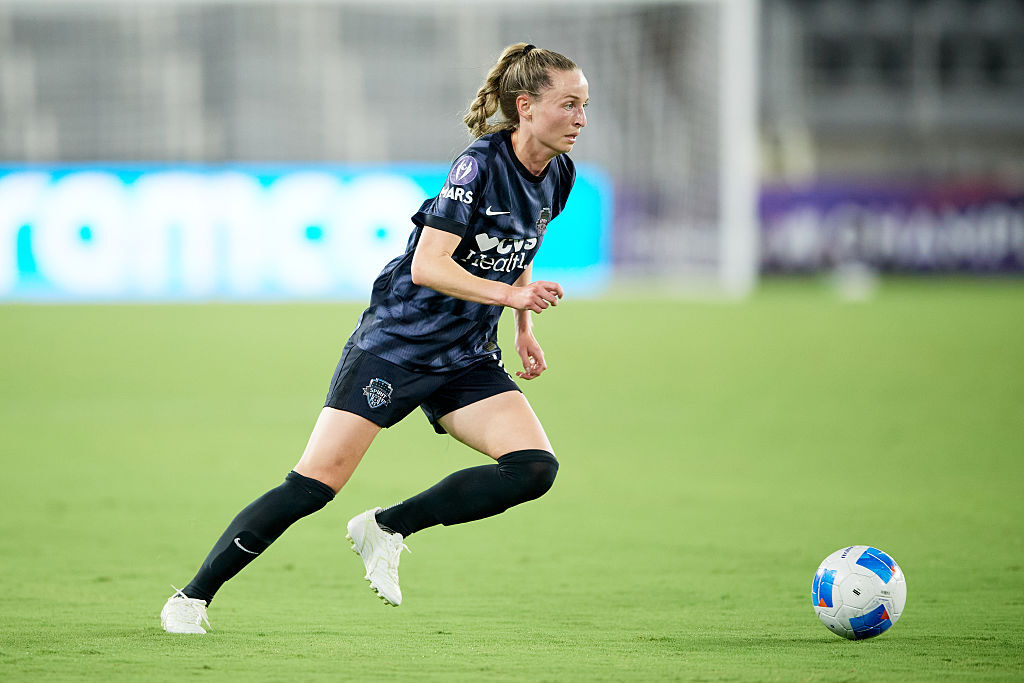
For professional athletes, the window of peak physical performance is often viewed as a singular focus, leaving academic or professional ambitions to wait until retirement. Still, Gabrielle Carle, a standout defender for the Washington Spirit, is challenging that narrative. Carle recently balanced the rigorous demands of the National Women’s Soccer League (NWSL) with the intense preparation required for the Medical College Admission Test (MCAT), ultimately achieving a score high enough to qualify for medical school.
The achievement was celebrated in mid-March 2026, when Carle walked into a team meeting to find her teammates cheering and balloons spelling out “congrats.” The surprise served as a culmination of a year-long journey of discipline, where the Canadian international integrated high-level STEM study into a professional sports schedule. For Carle, the success is not just a personal milestone but a realization of a lifelong interest in medicine, inspired by her father, Jean, who is a physician.
Carle’s path to this moment was a calculated decision to reunite two disparate passions. Having graduated from Florida State University in 2021 with a 4.0 grade-point average in exercise physiology, she initially prioritized her soccer career over medical school, noting that while medical education can wait, the opportunity to play professional soccer cannot. Now, as a key member of the Washington Spirit and the Canadian national team, she has proven that the two can coexist, albeit through a grueling process of time management.
The celebration of her success was captured by the team and shared via social media, highlighting the supportive environment within the Spirit locker room.
Balancing the Pitch and the Textbook
Preparing for the MCAT while competing in the NWSL required a rigid structure. Carle utilized a Kaplan course to navigate the exam’s four primary sections: Chemical and Physical Foundations; Critical Analysis and Reasoning Skills; Biological and Biochemical Foundations; and Psychological, Social and Biological Foundations. Her study routine typically began after morning training sessions, where she would spend two to three hours in her apartment or at a local coffee shop.
The mental load was significant, particularly during the Washington Spirit’s run to the NWSL Championship. To maintain her preparation, Carle split her seven-hour practice sessions into smaller segments, allowing her to fit in study blocks. Even during the Christmas holiday, she continued a “sprint” to the exam, focusing on practice tests and review. She described the experience as a “grind,” emphasizing that total commitment and focus were the only ways to avoid the temptation to stop.
Her teammates played a role in her success, often accompanying her to coffee shops. While they provided company, they respected her need for concentration; Carle often wore AirPods to block out distractions, only chiming into conversations when the topic was particularly compelling. This balance of social support and strict isolation allowed her to re-learn college-level material while mastering new subjects.
Overcoming Exam-Day Adversity
Despite her preparation, the day of the exam in January brought unexpected challenges. Carle reported waking up with a migraine, which, combined with the inherent stress of the high-stakes test, left her feeling on edge upon arrival at the testing center.

The initial moments of the test were particularly daunting. Upon reading the first chemistry passage, Carle felt the questions were too complex to answer, leading to a moment of intense doubt. She described the sensation as feeling like she had been “put in the spin cycle in the washing machine.” To recover, she utilized deep breathing techniques and made the strategic decision to skip the first passage and move forward with the rest of the exam.
The period following the test was marked by anxiety as she waited for her results, using the Spirit’s preseason training as a necessary distraction. In February, Carle learned she had scored high enough for medical school admission. While she chose not to disclose her specific final score, she shared the news first with her boyfriend before informing her family and teammates.
Future Outlook: Soccer and Medicine
While the MCAT results are valid for three years, Carle does not intend to apply to medical schools immediately. Her current priority remains her professional soccer career. This commitment was solidified by her recent contract extension with the Washington Spirit, which keeps her with the club through the 2029 season .
Looking ahead, Carle expressed a preference for staying in the “DMV” (District of Columbia, Maryland, and Virginia) area for her future medical studies, though she remains open to the possibility of returning to Canada. Her journey serves as a blueprint for other athletes pursuing off-the-field goals, encouraging them to put in the perform to see if their ambitions are worth pursuing, noting that the reward of accomplishment outweighs the risk of failure.
Key Milestones in Gabrielle Carle’s Academic and Athletic Journey
| Year | Achievement/Event |
|---|---|
| 2021 | Graduated from Florida State University with a 4.0 GPA in Exercise Physiology |
| 2022 | Began professional career with Swedish club Kristianstad |
| 2023 | Joined the Washington Spirit |
| January 2026 | Completed the MCAT exam |
| February 2026 | Received qualifying scores for medical school admission |
| March 2026 | Celebrated MCAT success with Washington Spirit teammates |
With her contract secured through 2029, Carle will continue to compete as a defender for the Spirit and the Canadian national team before eventually transitioning into the medical field. We welcome your thoughts on athletes pursuing dual careers in the comments below.