
In an era of instant digital access, the quest for reliable medical guidance has become a critical component of personal well-being. A recent commentary in Nature Medicine argues that quality health information for all is a fundamental determinant of health, suggesting that access to accurate data is as vital to patient outcomes as clinical care itself.
However, this accessibility comes with significant risks. Lawrence Gostin, a Distinguished University Professor at Georgetown University and an expert in global health law, warns that society is at a turning point. According to Gostin, the proliferation of misleading guidance through digital and social media—now amplified by generative AI—is corroding trust in science and fueling social and political polarization Lawrence O. Gostin – Georgetown Law.
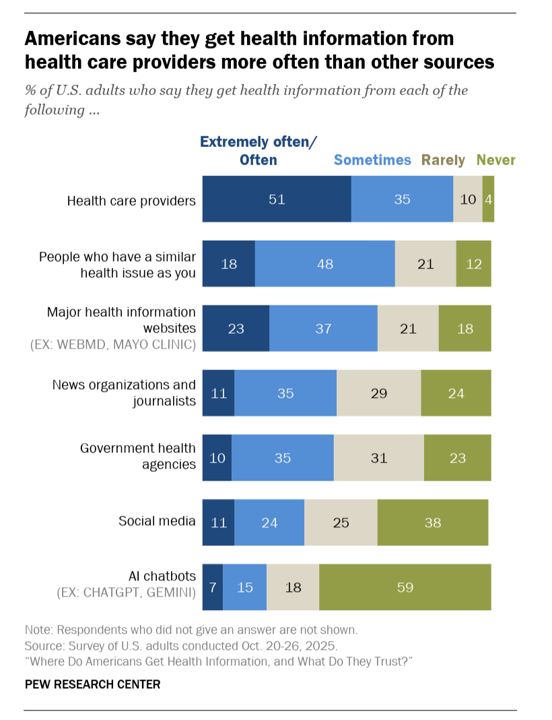
Despite the noise of the digital age, a new report from the Pew Research Group reveals a steadfast preference among Americans: when it comes to health information, the human expert remains the gold standard. Even as digital “on-ramps” are increasing, health care providers are the most highly valued and trusted sources of medical knowledge.
This tension between the convenience of AI and the necessity of medical expertise creates a complex landscape for patients. As more individuals turn to chatbots for everything from self-diagnosis to managing medical bills, the gap between “straightforward to find” and “accurate” becomes a primary challenge for public health.
The Hierarchy of Trust: Where Americans Turn for Health Data
The Pew Research Group’s analysis highlights a clear divide between where people seek information and whom they actually trust. While many Americans utilize a variety of sources, the level of perceived accuracy varies wildly across different platforms.
Health care providers sit at the top of the trust hierarchy. Nearly all Americans who receive health information from their providers report that the information is extremely or very accurate, with two-thirds of these consumers expressing high confidence in the data.
Following providers, Americans frequently turn to two other main avenues: people who share similar health conditions and major health information websites, such as the Mayo Clinic portal or WebMD. However, the trust levels for these sources are significantly lower. Only 22% of those seeking information from peers with similar conditions believe the information is extremely or very accurate.
Major health websites fare better than peer-to-peer sharing, with twice as many users viewing them as highly accurate compared to those relying on personal anecdotes. In contrast, trust in government health agency sites is surprisingly low, with only one in four users reporting high accuracy. Even lower is the trust in general media, where only 13% of seekers believe the information is highly accurate.

The Anatomy of Credibility: What Makes a Source Trustworthy?
For the modern health seeker, credibility is not about the aesthetic of a website or the charisma of a spokesperson. According to the Pew data, three specific factors grant a source credibility:
- Medical Training: The source must have formal medical training on the specific topic.
- Transparency: The source must be open about potential conflicts of interest.
- Understandability: The information must be presented in a way that is easy to comprehend.
Interestingly, superficial traits such as whether a source is “physically fit” or generally likeable are considered less important when seeking credible medical data. However, personal experience still holds weight; one-half of respondents believe that a source having personal experience with a health issue is extremely or very important. This explains why 87% of Americans have, at some point, sought health information from others sharing a similar condition.

The AI Paradox: Convenience vs. Confidence
Generative AI is rapidly changing how patients interact with health data. AI chatbots like ChatGPT and Gemini are becoming increasingly common tools for those attempting to navigate the complexities of the healthcare system, including efforts to dispute medical bills.
However, adoption is gradual. As of late October 2025, 3 in 5 Americans reported they had “never” accessed an AI chatbot for health information. While this number is likely rising, a separate study from Ohio State University’s Wexner Medical Center suggests that public comfort with AI in healthcare has actually fallen.
The appeal of AI and social media lies primarily in convenience. Social media sources score high on convenience but low on personalization and accuracy. Only one-third of users perceive health information on social media as easy to understand. AI chatbots perform slightly better in terms of understandability than social media, while still offering high levels of convenience.

Lessons for the Future of Health Tech
The disconnect between the convenience of AI and the trust placed in medical professionals provides a roadmap for developers. To bridge this gap, there is a pressing need to involve health care providers, patients, and caregivers in the design and conception of AI tools.
Since trust in government and traditional media has eroded, medical experts have a unique competitive advantage. By integrating clinical expertise into the architecture of consumer-facing AI, developers can create “trust-working on-ramps” that bolster the doctor-patient relationship rather than replacing it.
the goal is to improve digital and health literacy, ensuring that the agency provided by AI tools is balanced by the accuracy provided by medical training. This shared-decision approach is essential for optimizing both individual and community health outcomes.
Key Takeaways on Health Information Trust
- Providers are Paramount: Health care providers remain the most trusted source of medical information, with two-thirds of users viewing their data as highly accurate.
- The “Experience” Gap: While 87% of Americans seek info from peers with similar conditions, only 22% view that information as highly accurate.
- Credibility Pillars: Medical training, transparency regarding conflicts of interest, and ease of understanding are the primary drivers of trust.
- AI’s Hurdle: AI chatbots offer high convenience and better understandability than social media, but overall public comfort with AI in healthcare is declining.
As the integration of AI into self-care regimes continues, the next critical checkpoint will be the development and release of new, provider-led frameworks for AI health tools aimed at increasing accuracy and transparency.
Do you trust AI for medical queries, or do you stick exclusively to your doctor? Share your thoughts in the comments below.