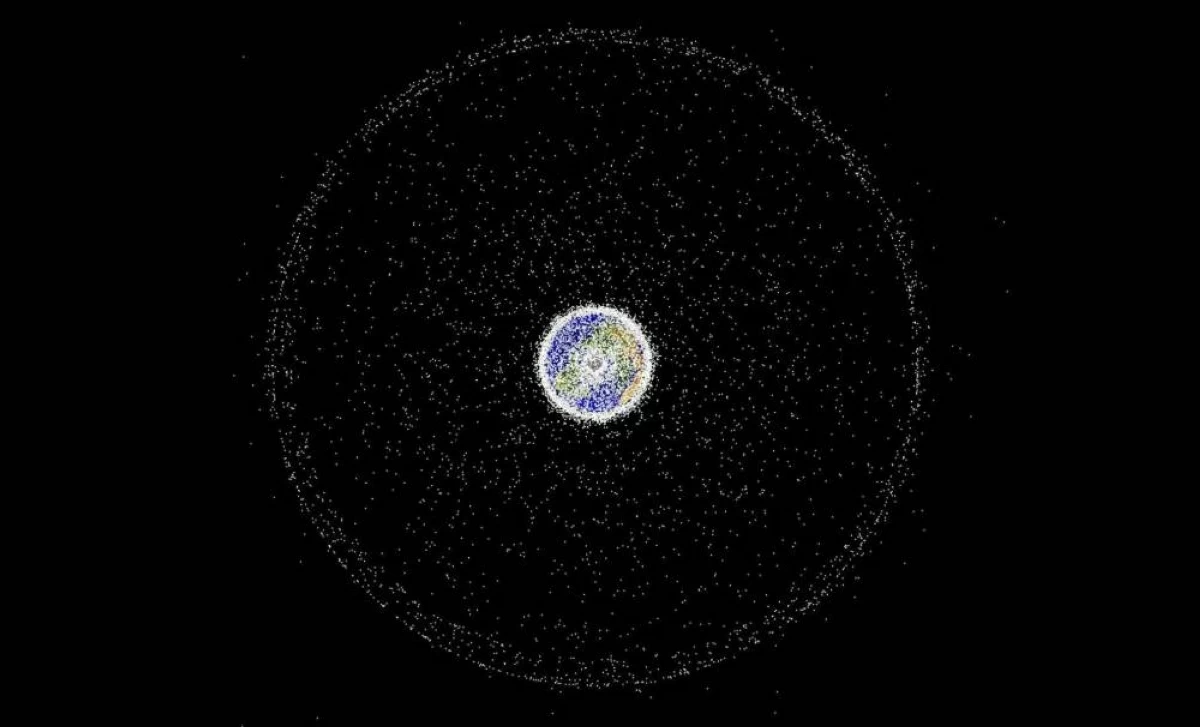
The accumulation of orbital debris, specifically objects measuring approximately 5 centimeters in diameter, has emerged as a significant threat to global satellite infrastructure. According to the European Space Agency (ESA), there are an estimated 1 million objects between 1 cm and 10 cm currently orbiting the Earth, each possessing enough kinetic energy to disable or destroy a functional satellite upon impact.
This escalating density of space junk presents a complex operational challenge for both government space agencies and commercial satellite operators. Because these objects are often too small to be tracked reliably by ground-based radar systems, they represent a “blind” risk to expensive assets in Low Earth Orbit (LEO) and Geostationary Orbit (GEO), where collision avoidance maneuvers are becoming increasingly frequent.
The Physics of Orbital Impacts
The primary concern regarding 5-centimeter debris lies in the extreme relative velocities involved in space flight. Objects in LEO travel at approximately 7.5 to 8 kilometers per second. At these speeds, a collision with a 5-centimeter fragment creates an impact force equivalent to a high-velocity projectile, capable of shattering solar arrays, penetrating sensitive electronics, or causing a total loss of spacecraft functionality.
The National Aeronautics and Space Administration (NASA) maintains that even small fragments—often remnants of past satellite breakups, rocket body explosions, or discarded hardware—act as persistent hazards. Unlike larger debris, which can be tracked and avoided by maneuvering the spacecraft, 5-centimeter fragments frequently remain undetected until impact occurs, making them a primary driver of the “Kessler Syndrome,” a theoretical scenario where the density of objects in LEO becomes high enough that collisions trigger a cascade of further debris generation.
Operational Challenges for Satellite Operators
For commercial operators, the presence of untracked debris increases the cost of mission insurance and requires dedicated resources for space situational awareness (SSA). Operators must rely on probabilistic models to determine when to perform collision avoidance maneuvers. These maneuvers consume propellant, thereby shortening the operational lifespan of a satellite.
Data from the U.S. Space Command, which tracks thousands of objects in orbit, highlights the difficulty of cataloging smaller debris. While the network can effectively monitor objects larger than 10 centimeters, the 5-centimeter range falls into a gap where detection is sporadic. This creates a reliance on predictive modeling rather than real-time tracking, forcing operators to balance the risk of collision against the risk of depleting fuel reserves during unnecessary maneuvers.
Mitigation and International Policy
Addressing the threat of space debris is a focus of the United Nations Office for Outer Space Affairs (UNOOSA), which advocates for international guidelines on space traffic management. Current efforts focus on “post-mission disposal,” requiring operators to de-orbit satellites within 25 years of mission completion, though there is ongoing discussion regarding stricter enforcement and shorter timelines.
Technological solutions are currently in development, including active debris removal (ADR) missions. Companies and agencies are testing harpoons, nets, and robotic arms to capture defunct satellites and larger debris before they collide and fragment into the smaller, more dangerous pieces that currently threaten the orbital environment. However, these technologies remain in the pilot stage and have yet to be deployed at a scale sufficient to reduce the overall population of 5-centimeter fragments.
Future Outlook for Space Sustainability
The sustainability of the orbital environment remains contingent on international cooperation and the adoption of more rigorous debris mitigation standards. As more nations and private companies launch constellations of small satellites, the frequency of close-approach events is projected to rise. The Federal Communications Commission (FCC) has already moved to reduce the de-orbiting window for satellites from 25 years to five years for U.S.-licensed operators, signaling a shift toward more proactive space management.

The next major checkpoint for international space policy will be the ongoing discussions within the UN Committee on the Peaceful Uses of Outer Space (COPUOS), where member states continue to deliberate on legally binding frameworks for orbital traffic. Updates on these negotiations and technical advancements in debris tracking are expected throughout the coming year. Readers are encouraged to monitor official releases from national space agencies for updates on debris mitigation protocols and newly launched tracking initiatives.