
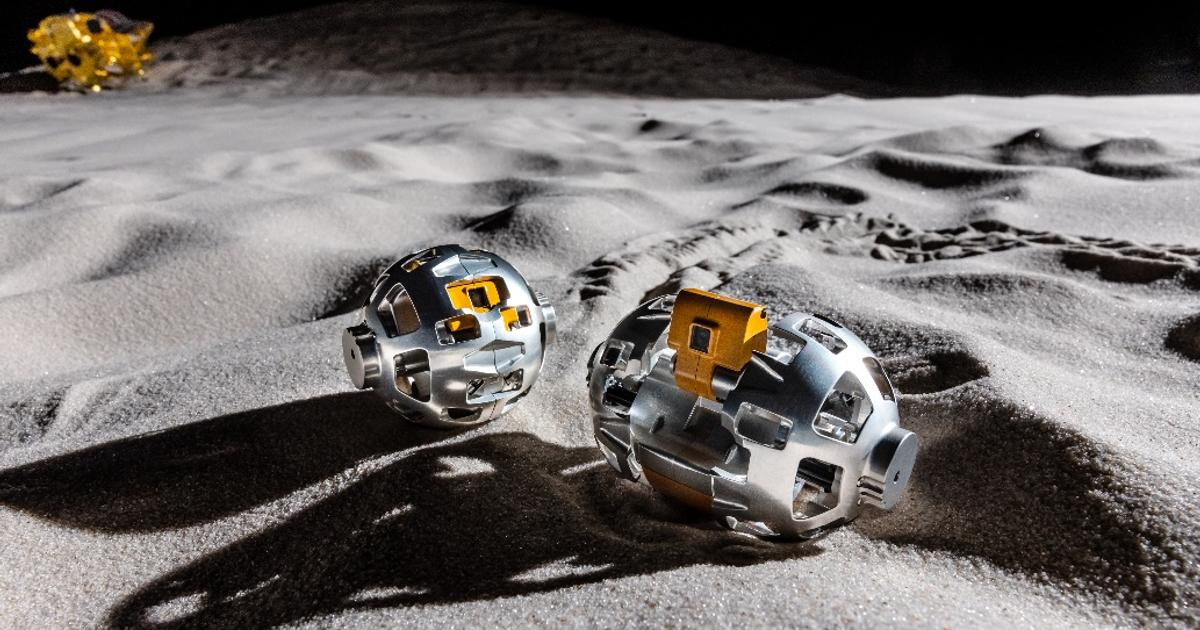
The Japan Aerospace Exploration Agency (JAXA) has successfully validated the autonomous operation and shape-shifting capabilities of the SORA-Q lunar robot, confirming that consumer-grade toy engineering can meet the rigorous demands of space exploration. According to the peer-reviewed findings published in Science Robotics, the ultra-compact rover, officially designated as LEV-2, successfully traversed the lunar surface and captured autonomous imagery during the Smart Lander for Investigating Moon (SLIM) mission.
This achievement marks a significant milestone in space robotics, demonstrating that lightweight, mass-produced mechanical principles—developed in collaboration with toy manufacturer Takara Tomy—can function reliably in the extreme thermal and vacuum conditions of the Moon. The mission, which saw the robot operate for 108 minutes on the lunar surface, provides a new template for low-cost, high-efficiency planetary exploration.
Engineering the SORA-Q for Lunar Environments
The SORA-Q, or LEV-2, is a sphere-shaped robot measuring approximately 80 millimeters in diameter and weighing roughly 250 grams. Its design utilizes a transformation mechanism that allows it to expand its wheels outward upon reaching the lunar surface, enabling it to navigate the regolith. This transformation process is critical, as it allows the robot to be stored compactly during launch and deployment while providing mobility once in the lunar environment.

According to official JAXA project documentation, the robot was developed to solve the challenge of weight constraints on small-scale landers. By leveraging the expertise of Takara Tomy—a company renowned for its “Transformer” series—engineers were able to create a durable, reliable folding mechanism that minimizes mechanical failure points. The rover’s ability to move autonomously and transmit high-resolution images back to the SLIM lander, which then relayed the data to Earth, proved that small-scale robotics could serve as an effective secondary payload for larger lunar missions.
Operational Success on the Lunar Surface
The mission objectives for the SORA-Q were centered on verifying the robot’s ability to transition from a stowed configuration to an operational state after being ejected from the SLIM lander. Once deployed, the robot operated for 108 minutes, during which it captured and transmitted images of the lunar surface and the lander itself. This data has been instrumental for mission control teams in assessing the status of the SLIM lander after its touchdown.
The Science Robotics study highlights that the robot’s performance exceeded initial expectations regarding its autonomous navigation and image capture reliability. The successful integration of these systems confirms that the “toy-to-space” development pipeline can reduce both the cost and the technical complexity of lunar surface reconnaissance. Researchers noted that the robot’s small size allowed for a higher degree of maneuverability in the uneven lunar terrain compared to larger, more traditional rover designs.
Future Implications for Planetary Exploration
The success of the SORA-Q program suggests a shift toward modular and miniaturized robotics in future space endeavors. By utilizing commercial off-the-shelf design philosophies, space agencies may be able to deploy “swarms” of small, autonomous robots to map larger areas of the Moon or Mars, effectively reducing the risk associated with relying on a single, expensive rover.

The validation of this technology provides a foundation for upcoming missions that require rapid deployment of sensor platforms. With the JAXA SLIM mission officially concluding its primary phase, the data harvested by LEV-2 remains a key reference point for engineers designing future lunar surface hardware. The ability to verify such complex mechanical transformations in a vacuum environment opens the door for more ambitious projects involving autonomous, multi-robot systems.

As the international space community looks toward the Artemis program and other lunar infrastructure initiatives, the role of small, agile robotics will likely grow. The SORA-Q project serves as a practical demonstration that innovation often stems from unconventional collaborations, bridging the gap between the toy industry and deep-space engineering.
Further updates regarding future JAXA lunar missions and the development of subsequent generations of the SORA-Q robot will be provided through the official JAXA news portal as project timelines are finalized. We welcome your thoughts on the future of miniaturized robotics in space—please share your comments or questions below.