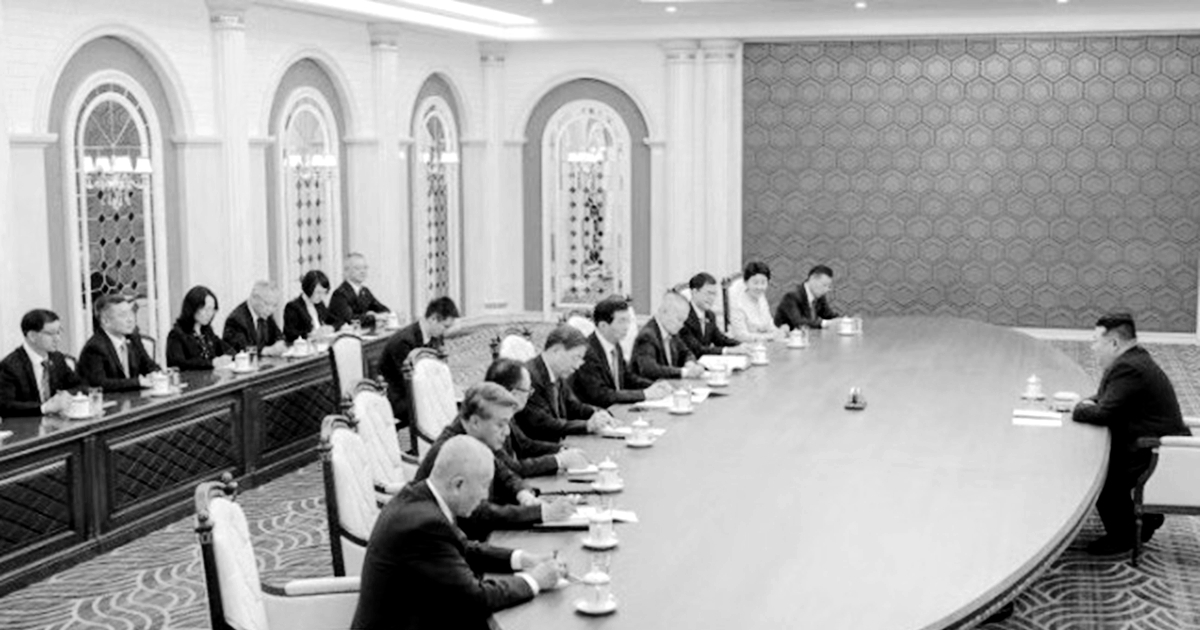
Wang Huning, a member of the Standing Committee of the Political Bureau of the Chinese Communist Party, visited North Korea in April 2023, an event that has since prompted significant international discussion regarding the diplomatic dynamics between Beijing and Pyongyang. While official state media reports from both nations emphasized the strengthening of bilateral ties, the visit—and the specific nature of the interactions between Wang and North Korean leader Kim Jong Un—has been subject to varied interpretations by international observers and geopolitical analysts.
The visit occurred during the 70th anniversary celebrations of the Korean War armistice, with Wang serving as the highest-ranking Chinese official to visit the country since the onset of the COVID-19 pandemic. According to the Chinese Foreign Ministry, the delegation aimed to demonstrate the “unbreakable” friendship between the two nations, a sentiment echoed by official North Korean outlets like the Korean Central News Agency (KCNA). However, the optics of the meetings, particularly the seating arrangements and the physical positioning of the officials during public events, have led to speculation regarding the power balance within this alliance.
Diplomatic Protocol and Public Perception
Analysts monitoring the visit noted the rigid adherence to protocol during public appearances, where Wang Huning was observed alongside Kim Jong Un at military parades and commemorative events. In the context of North Korean statecraft, seating and physical proximity to the leader are frequently scrutinized as indicators of status. Some observers have argued that the televised interactions reflected a deliberate attempt by Pyongyang to project an image of equality, or even superiority, over its larger neighbor, rather than the traditional hierarchical deference often expected in such high-level diplomatic exchanges.
The Council on Foreign Relations has long noted that the China-North Korea relationship is defined by a complex mix of mutual necessity and historical friction. While China provides essential economic support, Pyongyang frequently seeks to maintain autonomy, often utilizing high-profile diplomatic events to signal its independence to both Beijing and the international community. The speculation surrounding Wang’s visit highlights the ongoing tension between China’s desire for regional stability and North Korea’s focus on military posturing and sovereignty.
Contextualizing the China-North Korea Alliance
The visit must be viewed against the backdrop of rising geopolitical tensions in the Indo-Pacific. Since the beginning of 2023, North Korea has accelerated its missile testing program, a move that has historically complicated Beijing’s regional policy goals. According to reports from the Center for Strategic and International Studies (CSIS), China often finds itself in a precarious position: it seeks to prevent the collapse of the North Korean regime, which acts as a buffer state, while simultaneously avoiding the reputational and economic costs of being perceived as the primary enabler of Pyongyang’s nuclear ambitions.
Wang Huning, often described as an influential ideologue within the Chinese Communist Party, represents the central leadership in Beijing. His presence in Pyongyang was intended to reaffirm the 1961 Treaty of Friendship, Cooperation and Mutual Assistance. Despite the public displays of unity, the underlying strategic misalignment remains. As noted by the Brookings Institution, the relationship is transactional; North Korea relies on China for energy and food, while China relies on North Korea to keep the United States and its regional allies preoccupied.
What Happens Next in Bilateral Relations
The next major checkpoint for China-North Korea relations lies in upcoming high-level diplomatic summits and potential economic cooperation agreements. Observers are currently monitoring trade data and official statements from the Ministry of Commerce of the People’s Republic of China to see if there is any shift in the volume of aid or trade support following the 2023 visits. Any change in the frequency of these high-level exchanges will serve as a bellwether for the health of the alliance in the coming fiscal year.
As of the most recent updates, there have been no official changes to the long-standing defense treaty between the two nations. The international community continues to watch for further developments regarding North Korean nuclear policy and how Beijing chooses to exert, or refrain from exerting, its influence. Readers interested in following these developments can monitor official press releases from the Ministry of Foreign Affairs of the People’s Republic of China for the most accurate and verified information regarding future delegations and diplomatic meetings.
We welcome your perspective on these diplomatic developments; please join the conversation in the comments section below to share your thoughts on the shifting dynamics of East Asian geopolitics.
Related reading