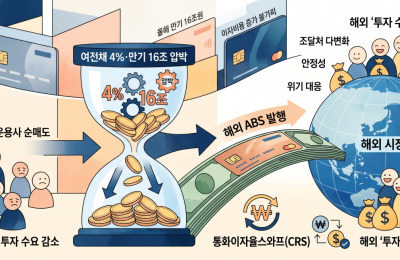
South Korean credit card companies are navigating a period of significant financial turbulence as the domestic market for credit finance bonds—often referred to as “Yeojeonchae”—faces a pronounced sell-off trend. For institutional investors and asset managers, the appetite for these debt instruments has cooled, driven by concerns over mounting maturity obligations and a broader shift in risk appetite within the capital markets. As these financial institutions look to stabilize their balance sheets, many are increasingly turning their gaze toward international markets to secure the liquidity necessary for continued operations.
This liquidity crunch is not merely a localized concern. it reflects the broader challenges facing the non-bank financial sector in South Korea. According to data from the Korea Securities Depository, the volume of maturing debt held by major issuers—including entities such as Samsung Card, Shinhan Card, and KB Kookmin Card—remains substantial. When a high concentration of debt matures simultaneously in a climate of lukewarm investor demand, the cost of refinancing naturally climbs, creating a “cost-of-funding” squeeze that directly impacts profitability.
The Mechanics of the Credit Finance Bond Sell-Off
The current instability in the credit finance bond market is underpinned by a combination of interest rate uncertainty and shifting institutional portfolios. Asset managers, who historically served as the backbone of demand for these corporate bonds, have been recalibrating their holdings to favor higher-quality assets or shorter-duration instruments. The Bank of Korea has maintained a cautious stance on monetary policy, leaving market participants to grapple with the reality of “higher-for-longer” interest rates that complicate debt servicing for non-banking financial institutions.
When credit card companies issue bonds, they rely on the stability of the local bond market to roll over existing debt. However, as the yield spread between these credit-sensitive bonds and risk-free government securities widens, investors demand higher premiums. This environment forces credit card issuers to choose between issuing debt at unfavorable rates—thereby eroding their net interest margins—or seeking alternative funding sources. For those companies with sufficient credit ratings and operational scale, the international market offers a viable, albeit more complex, path to diversification.
Seeking Relief Through Global Diversification
Facing domestic constraints, several major Korean card issuers have begun to explore cross-border financing and international expansion as a strategic hedge. By tapping into foreign currency bond markets or establishing footprints in emerging markets, these firms aim to decouple their funding profiles from the volatility of the domestic Won-denominated bond market. This shift is not entirely new, but the urgency has intensified as the domestic liquidity window tightens.
International debt markets, particularly those in the U.S. Or through Samurai bond issuances in Japan, provide access to a broader investor base that may view Korean financial institutions through a different risk lens. By expanding their business operations into Southeast Asian markets, these companies are attempting to build revenue streams that are less correlated with the saturated and highly regulated South Korean credit market. This international pivot serves a dual purpose: it mitigates the immediate pressure of domestic bond maturity and positions these firms for long-term growth in regions where credit penetration is still expanding.
Key Takeaways for Investors and Stakeholders
- Refinancing Pressures: A high volume of maturing credit finance bonds is forcing issuers to navigate a competitive and expensive refinancing environment.
- Market Sentiment: Institutional investors are increasingly risk-averse regarding non-bank corporate debt, leading to higher yield requirements.
- Strategic Pivots: Leading card companies are turning to overseas funding and regional business expansion to bypass domestic liquidity bottlenecks.
- Regulatory Oversight: The Financial Supervisory Service (FSS) continues to monitor the debt-to-equity ratios and liquidity coverage ratios of these institutions to ensure systemic stability.
Looking Ahead: The Path to Market Normalization
The situation remains fluid. Whether the current sell-off in Yeojeonchae represents a structural shift or a temporary market correction will largely depend on the trajectory of inflation and future interest rate decisions by the central bank. For credit card companies, the immediate priority remains the proactive management of maturity ladders to avoid a “liquidity cliff.”
Market participants should closely monitor upcoming quarterly earnings reports and filings with the Data Analysis, Retrieval and Transfer System (DART), where companies are required to disclose their funding strategies and debt maturity schedules. As these firms continue their international outreach, the transparency of their global risk management will be a critical indicator of their long-term resilience. We will continue to track these developments as they unfold, providing analysis on how these shifts impact the broader financial ecosystem. What are your thoughts on this shift toward global diversification? Join the conversation below.
Worth a look