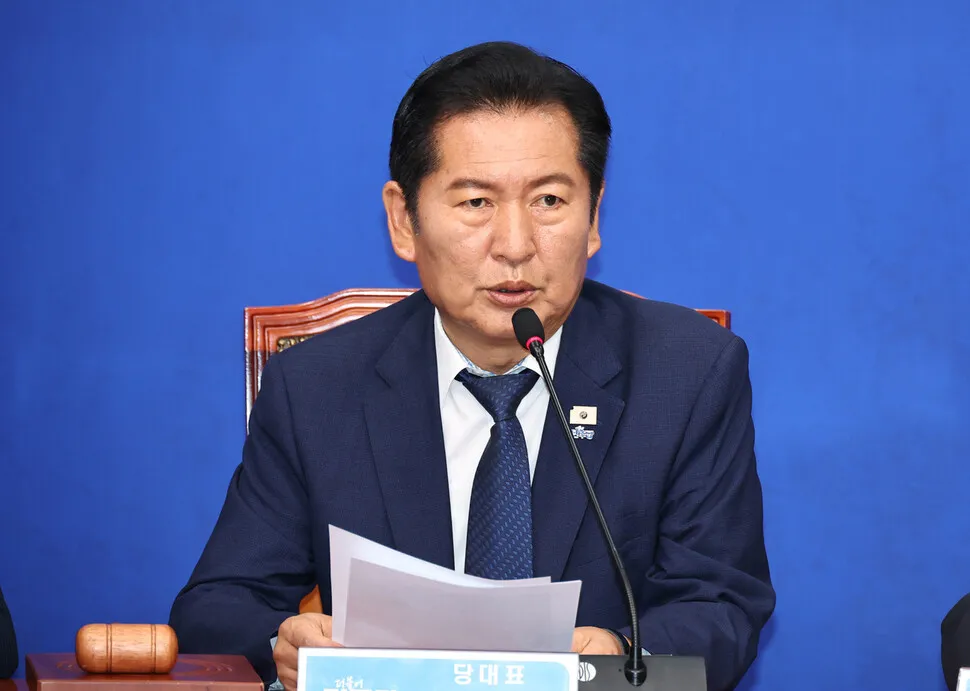
Representative Jung Chung-rae of the Democratic Party of Korea (DPK) asserted that the party’s internal structure has moved beyond traditional factionalism, characterizing all members as aligned with the party’s central leadership. Speaking on recent political discourse regarding internal divisions, Jung stated that the implementation of a “one-person, one-vote” system for party decision-making has effectively dissolved previous factional identities.
The remarks follow ongoing media speculation concerning internal alignments within South Korea’s main opposition party. According to reports from the Yonhap News Agency, Jung emphasized that the party’s power base now rests firmly with individual party members, rather than established political cliques. This shift, he argued, renders terms historically used to categorize members into competing groups obsolete.
Addressing Allegations of Internal Division
Jung specifically addressed labels circulating in the media, such as those categorizing members as either “pro-Cheong” (referencing Jung) or “pro-Seok.” He dismissed these classifications as “malicious attempts to divide” the party. In his view, such terminology serves only to create artificial friction within the organization.
“I am neither pro-this nor pro-that; I am a member-oriented, reformist politician,” Jung stated in comments reported by MBC News. By framing his identity around party membership and reform, he sought to move the conversation away from personality-driven politics. The DPK has historically faced challenges regarding factionalism, a common feature in South Korean party politics where groups often form around prominent figures or regional ties.
The push toward a more member-centric voting model is a significant departure from the party’s past reliance on delegate-heavy decision-making processes. As noted by the Hankyoreh, the transition to a system where each party member holds an equal vote is intended to diminish the influence of established power brokers who have traditionally commanded large blocs of delegates.
The Role of the Party Member
Jung’s argument centers on the principle that the “owner of the party is the party member.” This rhetoric aligns with the broader strategy of the current DPK leadership, which seeks to consolidate support among the party’s grassroots base. By emphasizing this direct link between the leadership and the general membership, supporters of the current direction argue that the party can maintain a unified front against the ruling People Power Party.
However, the transition has not been without criticism. Some analysts suggest that while the new system increases the influence of the rank-and-file, it may also lead to a more populist internal environment. According to political analysis provided by The Kyunghyang Shinmun, the disappearance of traditional factions does not necessarily guarantee the absence of dissent, but rather changes the platform upon which that dissent is expressed.
Political Context and Future Implications
The Democratic Party is currently preparing for upcoming legislative and internal party cycles. The National Election Commission of the Republic of Korea maintains strict regulations regarding party financing and internal campaign conduct, which often influence how parties structure their internal elections and delegate systems. The DPK’s move to expand the voting base is seen by observers as a method to ensure that internal candidates reflect the preferences of the broader party membership, which currently leans toward the party’s reformist wing.
Whether this shift will successfully suppress the emergence of new factions remains a subject of debate. Historically, South Korean political parties have struggled with the cyclical nature of factionalism, which often intensifies during candidate selection periods for general elections. As the party moves toward its next scheduled national convention, the effectiveness of the one-person, one-vote system will likely be tested by the level of competition for leadership positions.
The next major checkpoint for the party’s internal structure will be the upcoming party leadership elections. Further official updates regarding the party’s electoral rules and candidate registration processes are expected to be published on the Democratic Party of Korea’s official portal. As these processes unfold, the party leadership will be under pressure to demonstrate that the promised dissolution of factionalism is reflected in both policy decisions and the selection of candidates for public office.
This development remains a point of intense interest for political observers tracking the evolution of South Korea’s legislative landscape. Readers are encouraged to share their perspectives on these structural changes in the comments section below.