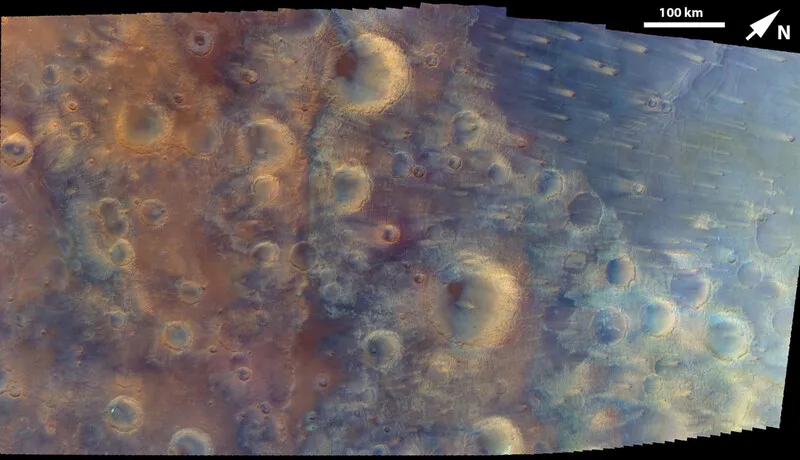
The European Space Agency’s (ESA) Mars Express orbiter has captured a high-resolution time-lapse of Mars, providing a unique perspective of the planet from approximately 4,600 kilometers away. This visual data, processed to highlight the atmospheric and surface features of the Red Planet, serves as a significant update for ongoing planetary observation efforts. The imagery demonstrates the continued utility of the High Resolution Stereo Camera (HRSC) aboard the spacecraft, which has been orbiting Mars since 2003.
According to official documentation from the European Space Agency, the Mars Express mission remains a cornerstone of orbital research. The spacecraft operates in a highly elliptical polar orbit, allowing it to capture varying perspectives of the Martian surface. The recent time-lapse release is not merely a visual demonstration but an opportunity for researchers to track cloud formations, dust activity, and seasonal changes in the planet’s thin atmosphere.
Mission Capabilities and the HRSC
The High Resolution Stereo Camera (HRSC) is the primary instrument responsible for these observations. As noted by the German Aerospace Center (DLR), which manages the camera’s operations, the device can capture images in both stereo and color, allowing for the creation of digital elevation models. By maintaining a distance of roughly 4,600 kilometers—a distance that fluctuates based on the orbiter’s position in its elliptical path—the camera provides a balance between broad-scale atmospheric monitoring and localized surface detail.
The ability to stitch together these images into a smooth time-lapse requires precise orbital mechanics and data processing. The mission team at ESA regularly releases these sequences to provide the public and the scientific community with a clearer understanding of the dynamic nature of the Martian environment. This data is critical for comparing current weather patterns with historical records maintained since the mission’s inception over two decades ago.
Why Orbital Monitoring Matters
Continuous observation from orbit is essential for understanding the long-term climate evolution of Mars. Unlike Earth, Mars lacks a strong magnetic field and has a very thin atmosphere, making its weather systems highly sensitive to solar radiation and seasonal shifts. The imagery captured by the Mars Express helps scientists map these changes, which in turn informs future exploration missions, including those aimed at potential human presence.
The National Aeronautics and Space Administration (NASA), which collaborates frequently with the ESA on Mars-related data, emphasizes that orbital assets are the primary source for global weather tracking. While surface rovers provide high-fidelity data from a single location, orbiters like Mars Express provide the context necessary to understand how global dust storms develop and migrate across the planet’s surface.
Technical Challenges of Martian Imaging
Imaging Mars from space involves significant technical hurdles. The distance between the orbiter and the surface is subject to constant change due to the planet’s gravity and the craft’s orbital parameters. Furthermore, the transmission of high-resolution image data back to Earth is limited by the bandwidth of the Deep Space Network. Scientists must carefully prioritize which regions to photograph, balancing the need for scientific research with the constraints of power and communication.
Data processing is the final, crucial step. The raw images are often affected by the angle of the sun and the presence of atmospheric haze. By applying sophisticated calibration techniques, the team at the Freie Universität Berlin, which leads the HRSC data analysis, can produce clear, scientifically accurate representations of the Martian landscape. This ensures that the visuals released to the public maintain their integrity as scientific tools.
Future of the Mars Express Mission
The Mars Express mission has been extended multiple times, with current funding and operational support confirmed through at least 2026, according to ESA mission updates. As the orbiter continues its flight, it will remain a vital asset for monitoring the planet during the upcoming Martian southern summer, a period typically associated with increased atmospheric activity. Researchers expect to continue receiving high-resolution updates, providing a longitudinal view of the planet that few other missions can match.
For those interested in following the mission, the ESA maintains an active portal for mission updates and image galleries. As Mars continues its orbit around the sun, the data gathered today will form the basis for future studies into the planet’s habitability and geological history. Please share your thoughts on the latest imagery or reach out with questions regarding the mission’s technical milestones in the comments section below.