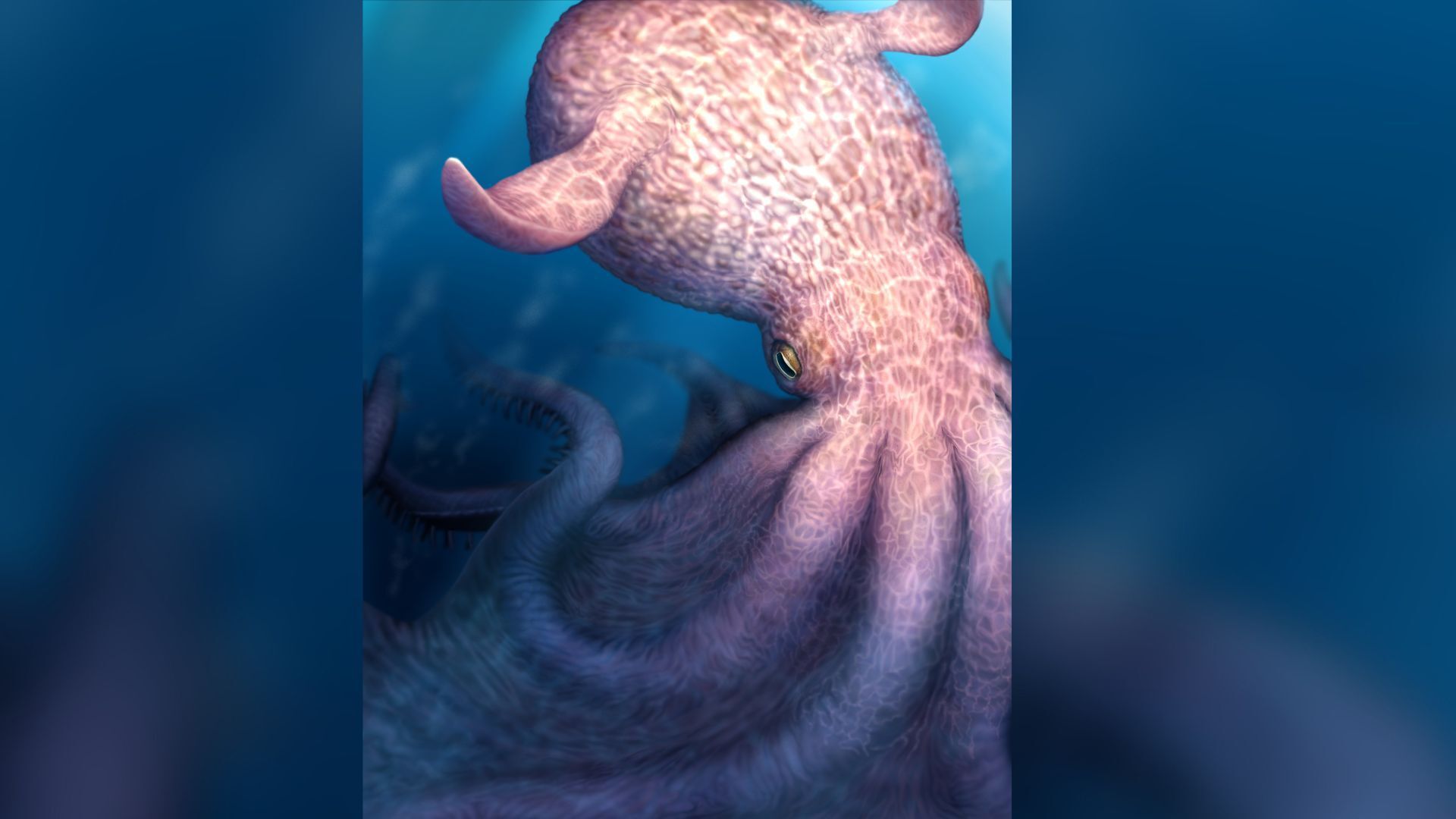
Recent research has revealed that giant octopuses, some reaching lengths of up to 19 meters (62 feet), were apex predators in the oceans during the Late Cretaceous period, challenging long-held assumptions about marine ecosystems of the dinosaur age. These findings, based on fossil evidence from multiple international studies, indicate that soft-bodied cephalopods occupied the top of the food web alongside marine reptiles like mosasaurs and plesiosaurs.
The discovery centers on two species of finned octopus, Nanaimoteuthis jeletzkyi and N. Haggarti, whose fossilized jaws were recovered from sediment deposits dating between 100 and 72 million years ago. Analysis of these remains shows extensive wear consistent with crushing hard shells and bones, indicating active predation rather than passive feeding. This evidence positions these ancient octopuses as formidable hunters capable of taking on large, well-armored prey.
According to paleontologists involved in the research, the size and predatory behavior of these creatures rival even the largest marine reptiles of their time. One researcher noted that encountering such an animal in the ancient oceans would have been a daunting prospect, underscoring their dominance in marine ecosystems during the Cretaceous period.
The study employed advanced digital fossil-mining techniques, using artificial intelligence to extract three-dimensional models from rock interiors. This method allowed scientists to identify 12 previously hidden octopus jaws that might have been missed through traditional approaches. Researchers suggest this technique could increase fossil discovery rates by more than 10,000 times compared to conventional methods.
Additional analysis revealed asymmetric wear patterns on the jaws, suggesting a preference for one side—akin to handedness in humans. This lateralized behavior, observed in modern octopuses through arm and eye preferences, may indicate a high level of intelligence in these ancient cephalopods. Such traits support the idea that they were not merely large invertebrates but sophisticated, active predators.
Despite their soft bodies, which typically decompose quickly and rarely fossilize, these octopuses left behind durable beaks and jaws—hard structures essential for biting and processing prey. These fossilized mouthparts provided the key evidence for reconstructing their size, diet, and ecological role. Scientists emphasize that without these resilient components, our understanding of ancient cephalopod diversity and behavior would be significantly limited.
The findings were published in the journal Science, with contributions from researchers at Hokkaido University in Japan. The team highlighted that their work shifts the perception of Cretaceous seas as being dominated solely by vertebrate predators, demonstrating that invertebrates like these giant octopuses played a central role in shaping marine food webs.
As new fossil analysis methods continue to evolve, scientists anticipate further discoveries about soft-bodied organisms from prehistoric oceans. For now, the image of a 62-foot-long octopus patrolling the ancient seas stands as a powerful reminder of the diverse and often surprising forms life has taken throughout Earth’s history.