
Researchers mapping three-dimensional DNA folding in rare human immune cells have linked Crohn’s disease risk variants to over 100 candidate genes, including an unexpected tie to the neurodegenerative disorder gene CLN3. The study, published on August 4, 2026, in Nature Genetics, overcomes previous limits by using a low-input mapping approach.
Scientists have long known that the majority of genetic variants tied to complex immune conditions like Crohn’s disease do not sit inside protein-coding regions or even on the genes nearest to them. Instead, these variants hide out in distant enhancer sequences that regulate gene activity across linear chromosomes. Because DNA folds tightly inside the cell nucleus, these remote regulatory regions are brought into direct physical contact with the promoters they control.
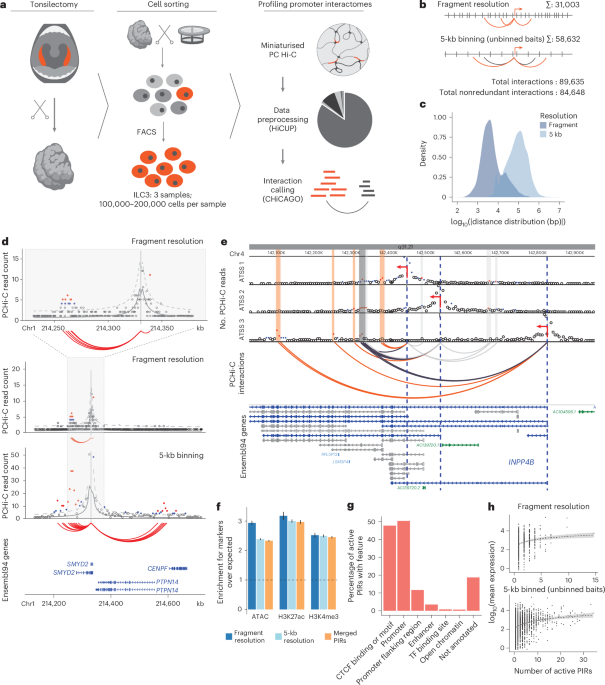
Mapping that complex 3D architecture has historically demanded millions of cells, locking researchers out of studying rare, tissue-resident populations. A joint research team from the Medical Research Council London Institute of Medical Sciences, Imperial College London, and Cincinnati Children’s bypassed that barrier by deploying a miniaturized version of Promoter Capture Hi-C (mini capture Hi-C).
Unlocking the 3D Architecture of Type 3 Innate Lymphoid Cells
The study specifically targeted type 3 innate lymphoid cells, known as ILC3s. These tissue-resident immune cells populate mucosal barrier tissues like the gut, where they regulate inflammation and help maintain barrier integrity. When their activity goes awry, they contribute to chronic inflammatory conditions.
Studying ILC3s has been exceptionally difficult because they are scarce and do not replicate well outside the living body. By applying their optimized low-input protocol to human tonsil-derived ILC3s, the researchers generated a high-resolution compendium of chromosomal contacts at single-fragment and 5-kilobase binning resolutions.
By pairing these spatial maps with data from large genome-wide association studies, the research team connected disease-associated genetic variants directly to the genes they govern in ILC3s.
Over 100 Candidate Genes Linked to Crohn’s Disease Risk
The integrated analysis successfully flagged more than 100 candidate genes linked to Crohn’s disease risk. While approximately half of these targets were already recognized players in inflammatory bowel disease, the remainder had never been associated with the condition.
Many of these newly uncovered genes regulate immune responses to tissue damage and infection. According to the research team, abnormal regulation of these specific loci could alter how inflammatory molecules are produced, potentially affecting disease development. The findings underscore why looking only at the nearest linear gene can lead investigators down the wrong mechanistic path.
Unexpected Intersections Between CLN3 and Immune Function
Among the most notable findings was the involvement of CLN3. Mutations in this gene cause Batten disease, a rare neurodegenerative disorder. It has not typically been studied in diseases driven by the immune system.
To test whether the gene held a genuine immunological role, investigators conducted follow-up experiments in mouse models.
Broader Autoimmune Implications and Future Therapeutic Paths
With high-resolution spatial mapping now accessible for scarce cell populations, researchers possess a framework to investigate genetic risk.
Worth a look