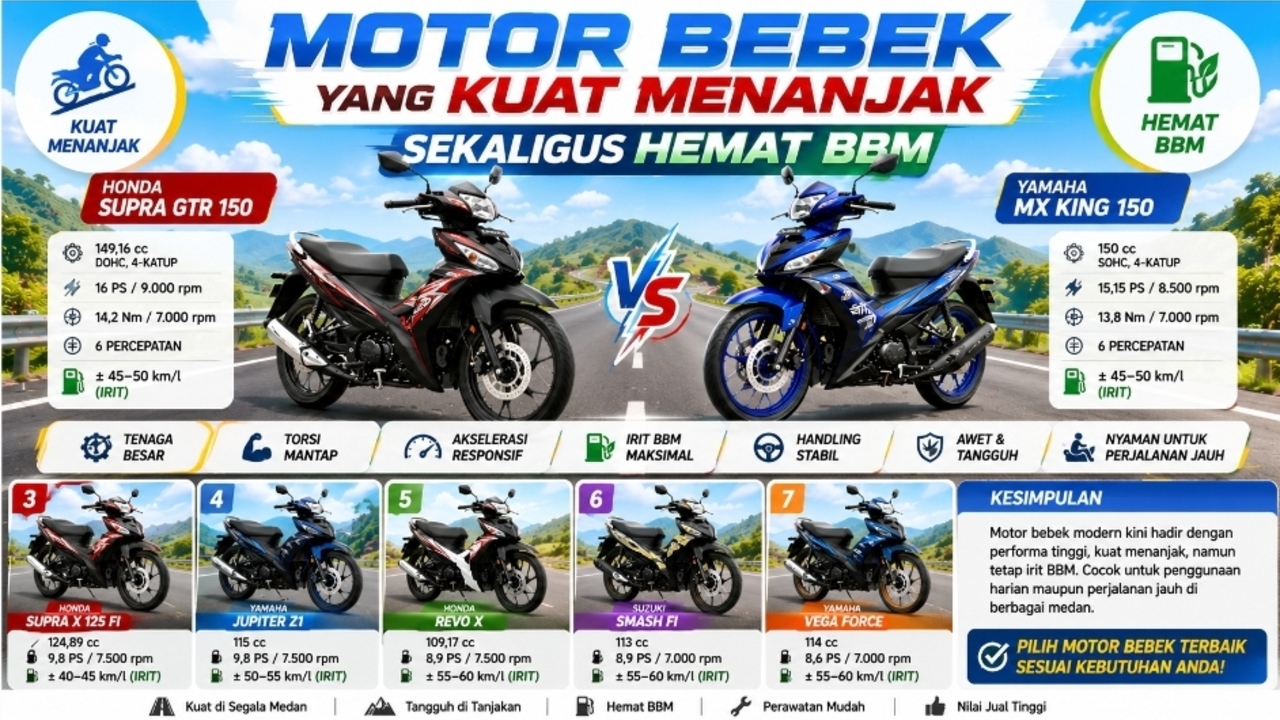
Motorcycle enthusiasts and daily commuters seeking reliable performance on steep inclines often prioritize engine torque and transmission durability when selecting a bike. Among the options in the underbone category, models such as the Honda Supra GTR 150 and the Yamaha MX King 150 are cited for their ability to handle challenging terrains. These motorcycles, often categorized as “bebek” or cubs, have maintained a market presence due to their versatility in both urban environments and rural landscapes where steep gradients are common.
Choosing a motorcycle for hilly terrain requires an evaluation of power-to-weight ratios and gear configurations. The Honda Supra GTR 150 utilizes a 150cc liquid-cooled engine. Similarly, the Yamaha MX King 150 features a 150cc fuel-injected engine. Both models are built on frames designed to balance agility with stability, which is essential when navigating winding uphill roads.
Engine Performance and Incline Capability
The efficacy of a motorcycle on steep roads is largely determined by its engine output and transmission system. Engines in the 150cc class, such as those found in the Supra GTR 150 and MX King 150, are found in models suitable for climbing. The Supra GTR 150 employs a six-speed manual transmission, allowing the rider to select the optimal gear to keep the engine in its power band during sustained climbs. This mechanical flexibility is a reason these models are favored for mountainous travel.
Yamaha’s approach with the MX King 150 also emphasizes the importance of manual gear selection. By allowing the rider to manage the engine speed, the bike avoids the heat buildup often associated with continuously variable transmissions (CVT) found in many automatic bikes. For commuters traveling through regions with significant elevation changes, the ability to downshift is a necessity for engine longevity and safety. Regular maintenance of the drive chain and sprocket remains critical for these models to ensure that power is efficiently transferred to the rear wheel without slippage.
Fuel Efficiency for Daily Utility
Beyond climbing capability, fuel economy remains a significant factor for daily riders. Many 150cc underbone motorcycles are engineered to balance performance with low fuel consumption. While fuel efficiency figures vary based on individual riding habits and road conditions, these engines are designed to maximize mileage through fuel injection systems. Riders often report that these bikes offer a cost-effective solution for long-distance commuting, provided that routine maintenance—such as air filter cleaning and oil changes—is performed.
For those looking to optimize their vehicle for daily use, keeping the bike within its recommended service intervals is the most effective way to maintain both power and efficiency. Official service guidelines from manufacturers suggest oil changes to prevent internal engine wear. By adhering to these standards, riders can ensure that their motorcycle remains “bandel,” or durable, even when subjected to the stress of daily climbing on steep roads.
Considerations for Long-Distance Travel
When planning for long-distance trips that include hilly terrain, weight distribution and tire selection become essential. Manufacturers design the frames of the Supra GTR 150 and MX King 150 to accommodate a rider and limited cargo, but overloading a bike can significantly reduce its climbing performance. Experts recommend that riders check their tire pressure before any trip, as under-inflated tires increase rolling resistance and force the engine to work harder than necessary on inclines.

Furthermore, safety on mountainous roads requires reliable braking systems. Both the Honda and Yamaha models typically come equipped with disc brakes on both the front and rear wheels. Ensuring that brake fluid is at the correct level and that pads are not worn thin is a vital component of pre-trip preparation. As these motorcycles are often used for diverse tasks, from commuting to light touring, their adaptability is a testament to the engineering focus on multi-terrain utility.
Maintaining Your Motorcycle for Longevity
The lifespan of a motorcycle used on steep terrain is linked to the owner’s commitment to maintenance. Key components to monitor include the clutch plates, which can wear prematurely if the bike is frequently ridden in a high-gear, low-speed state on hills. Using high-quality engine oil that meets the manufacturer’s viscosity specifications is essential for protecting the clutch and transmission. Consistent attention to these details helps prevent costly repairs and ensures the vehicle remains reliable.
For official updates on service schedules or technical specifications, owners should consult the owner’s manual provided at the time of purchase or visit the manufacturer’s official website. These resources contain the most accurate information regarding the specific needs of your motorcycle model. Manufacturers continue to emphasize that proper care is the method for extending the service life of high-performance underbone motorcycles.
Readers are encouraged to share their own experiences with these models in the comments section below. Do you have a preferred maintenance tip for climbing steep roads? Your insights contribute to a community of informed riders. For further updates on automotive trends and maintenance advice, ensure you follow our business section for regular reporting.