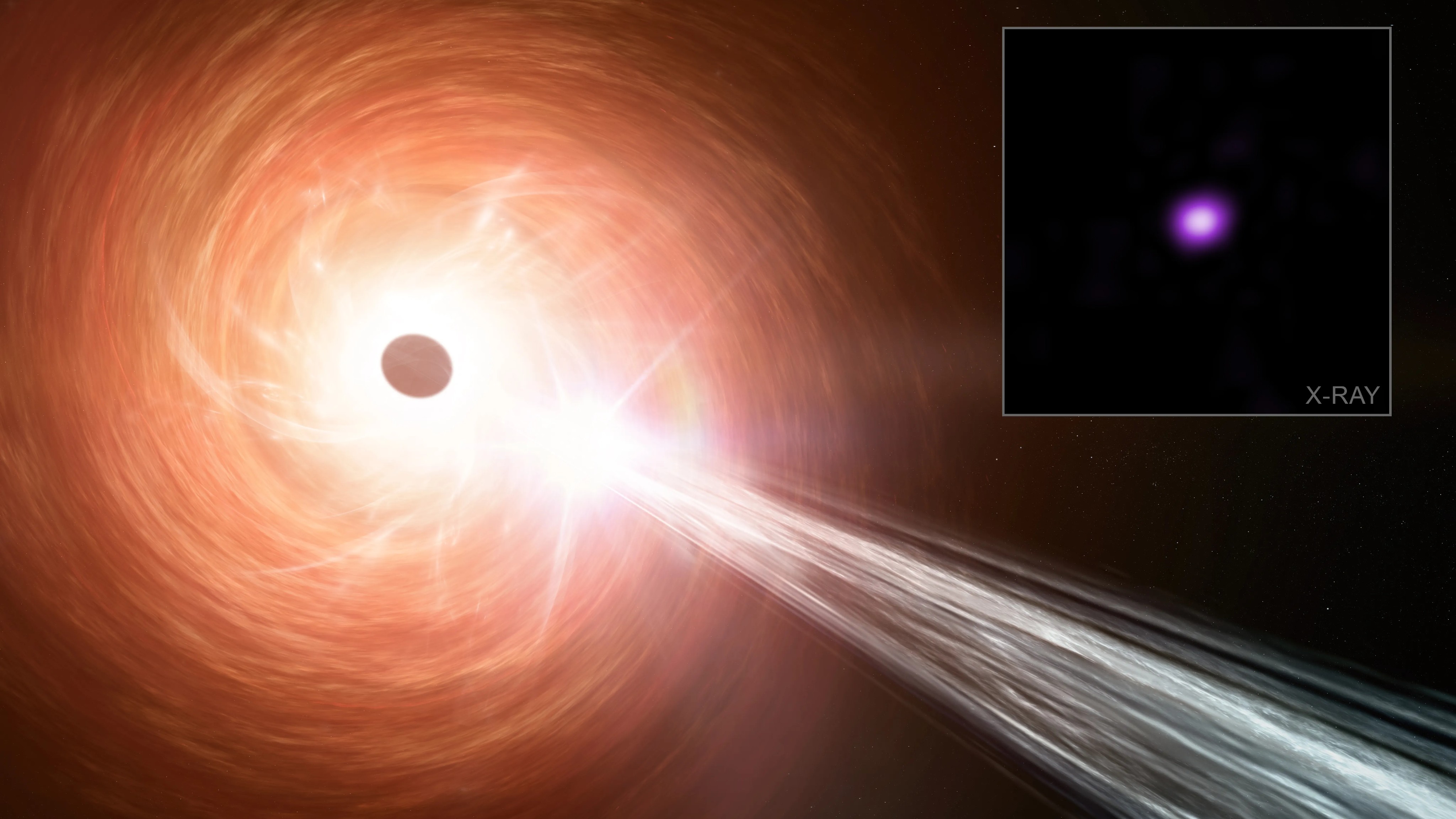
cosmic Jets from a Galactic Giant: Unlocking the Secrets of Black Hole Growth
Astronomers are peering into the heart of a distant galaxy, studying a black hole that’s defying expectations.This isn’t just any black hole; it’s blasting out enormous, lightsaber-like jets of energy, offering a unique opportunity to solve one of the biggest mysteries in astrophysics: how did supermassive black holes grow so rapidly in the early universe?
A Quasar’s Brilliant Glow
The black hole resides within a galaxy designated RACS J0320-35. It’s a type of active galactic nucleus known as a quasar – incredibly luminous objects powered by matter spiraling into a supermassive black hole. Quasars are so radiant they can outshine entire galaxies, making them ideal targets for detailed study.
This particular quasar was initially identified thru radio telescope surveys and then observed with the Chandra X-ray Observatory in 2023. Researchers quickly recognized its potential as a “perfect laboratory” for understanding black hole evolution.
Breaking the Limits of Growth
What makes RACS J0320-35 so intriguing? The team discovered it’s growing at an remarkable rate – consuming between 300 and 3,000 times the mass of our sun every year. This growth rate exceeds the Eddington limit, a theoretical boundary that dictates how quickly a black hole can accrete matter without becoming unstable.
How can it grow so fast without collapsing? That’s the central question driving this research.
Tracing the Black hole’s Origins
To understand this rapid growth, the researchers analyzed the intensity of X-ray emissions, comparing them to data from infrared and optical telescopes. This allowed them to estimate the black hole’s mass and growth rate.
Their analysis suggests a surprising origin story. The black hole may have begun its life like many others in the local universe: from the collapse of a single star, less than 100 times the mass of our sun. It then underwent a period of accelerated growth, fueled by an as-yet-unknown mechanism.
Implications for the Early Universe
This revelation isn’t isolated. The James Webb Space Telescope has also identified other black holes in the early universe exhibiting similar super-Eddington growth rates. These findings suggest that rapidly growing black holes may have been far more common in the ancient cosmos than previously thought.
Here’s what this means for our understanding of the universe:
* Rethinking Black Hole Formation: Current models may underestimate the frequency of these fast-growing black holes.
* Jet emission Connection: Black holes that consume matter at extreme rates might potentially be more likely to produce the powerful energy jets observed in RACS J0320-35.
* Early Universe Evolution: Understanding these black holes is crucial to understanding how galaxies formed and evolved in the early universe.
The Bigger Picture: Unraveling Cosmic Mysteries
further investigation into RACS J0320-35 and similar objects will be critical.Researchers hope to pinpoint the mechanisms driving this accelerated growth and determine how these black holes frist formed.
“How did the universe create the first generation of black holes?” asks Thomas Connor, a co-author of the study from the Harvard and Smithsonian Center for astrophysics. “This remains one of the biggest questions in astrophysics, and this one object is helping us chase down the answer.”
Ultimately, studying these cosmic giants will provide invaluable insights into the origins and evolution of the universe itself. It’s a thrilling time for black hole research, and RACS J0320-35 is leading the charge.