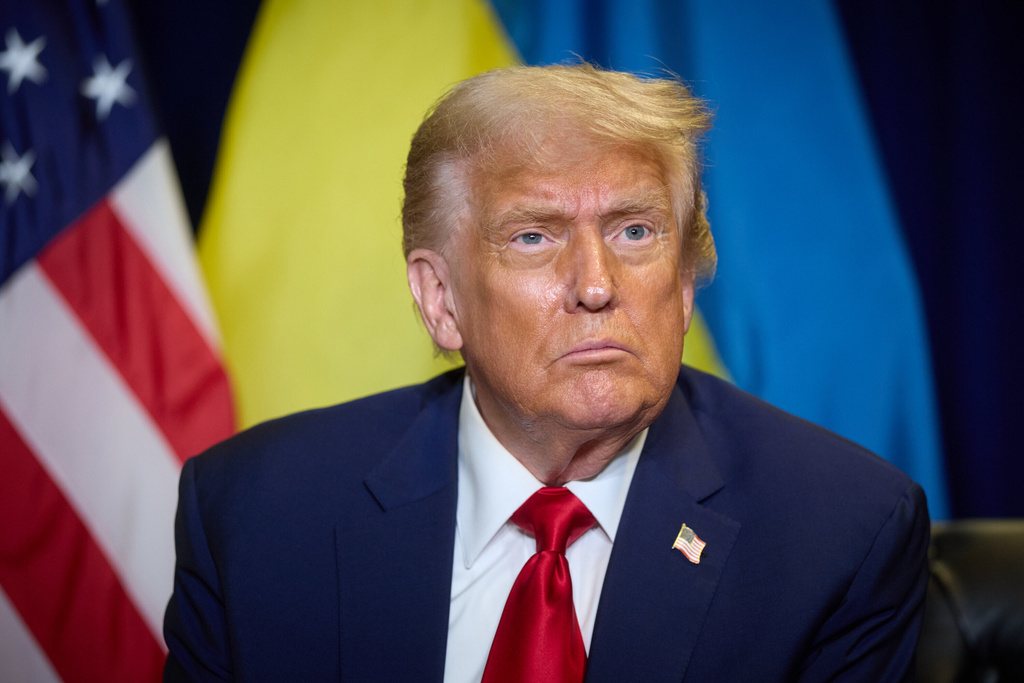
Trump Shifts Stance on Ukraine: From Concessions to calls for Total Victory – What’s Driving the Change?
For months, the international community has parsed every statement from former President Donald Trump regarding the conflict in ukraine, often finding ambiguity where clarity was desperately needed. But a meaningful shift appears to be underway. Following a meeting with Ukrainian President volodymyr Zelenskyy at the United Nations,trump has publicly declared his belief that Ukraine can reclaim all territory lost to Russia – a stark departure from previous suggestions that Kyiv should consider making concessions to achieve peace.
This dramatic turnaround raises critical questions: What prompted this change in viewpoint? what does it signal for the future of U.S. policy towards Ukraine? And how will this evolving stance impact the ongoing conflict and the broader geopolitical landscape?
A Complete Reversal: From Skepticism to Support
Trump’s recent pronouncements, shared via Truth Social, state that “Ukraine, with the support of the European Union, is in a position to fight and WIN all of Ukraine back in its original form.” This contrasts sharply with earlier rhetoric that hinted at a willingness to allow Russia to retain control of certain Ukrainian territories.
The shift extends beyond simply endorsing Ukraine’s territorial integrity. Trump has moved from publicly criticizing Zelenskyy to offering praise,describing him as a “brave man” who is “putting up one hell of a fight.” He’s also intensified his criticism of Vladimir Putin, stating the Russian leader has “let him down” and derisively labeling the Russian military a “paper tiger.”
“I think you are seeing the president’s frustration and disappointment frankly with Putin,” explained U.S. Ambassador to the U.N., Mike Waltz, in a FOX News interview. “He has made innumerable calls… Putin has to end this war; the president has made it very clear his intent.”
Understanding the Catalyst: What Changed?
Several factors likely contribute to this evolving position. The unexpectedly resilient Ukrainian defense,which defied initial predictions of a swift Russian victory,is undoubtedly a key element. As Steven Moore, with the Kyiv-based Ukraine Freedom Project, observed, “President trump is recognizing that Ukraine can win, which is something that, you know, if you’ve been in Ukraine… you understand that. everybody thought that russia was going to roll through Ukraine in 3 weeks in 2022, and they didn’t.”
Furthermore, the increasing frequency of Russian provocations – including repeated violations of NATO airspace – appears to be hardening Trump’s stance. When directly asked if NATO countries should shoot down Russian aircraft entering their airspace, Trump responded with a firm, “yes, I do.” Waltz echoed this sentiment,warning that Putin “should take the message from the president,he’s not messing around.”
Trump’s call for European nations, especially Turkey, to cease purchasing Russian oil underscores a growing frustration with perceived economic support for the Russian war machine. “I’d like to have him stop buying any oil from Russia while Russia continues this rampage against Ukraine,” Trump stated. “But it’s such a waste of human life. And so we ought to stop. Putin ought to stop.”
Zelenskyy’s Plea and the Stakes for Global Security
While Trump signaled a shift in perspective, President Zelenskyy delivered a stark warning to world leaders at the U.N.,questioning the future of global security if the international community fails to provide robust support for Ukraine. “If there are no real security guarantees except friends and weapons, and if the world can’t respond even to all threats… will there be any place left on Earth that’s still safe for people?” Zelenskyy asked.
His words highlight the broader implications of the conflict, extending far beyond the borders of Ukraine. The outcome of this war will undoubtedly shape the future of international order and the willingness of nations to uphold principles of sovereignty and territorial integrity.
Evergreen Insights: The Evolving Dynamics of Great Power Competition
The situation in Ukraine isn’t simply a regional conflict; it’s a critical juncture in the evolving dynamics of great power competition.For decades, the post-Cold War era was characterized by a relative decline in direct military confrontation between major powers. However, Russia’s actions in Ukraine have shattered that illusion, signaling a return to a more volatile and unpredictable geopolitical landscape.
This resurgence of great power competition necessitates a re-evaluation of conventional security alliances and a renewed focus on deterrence.The conflict also underscores the importance of economic leverage as a tool of statecraft, as evidenced by the ongoing debate over sanctions and energy dependence. Looking
Related reading