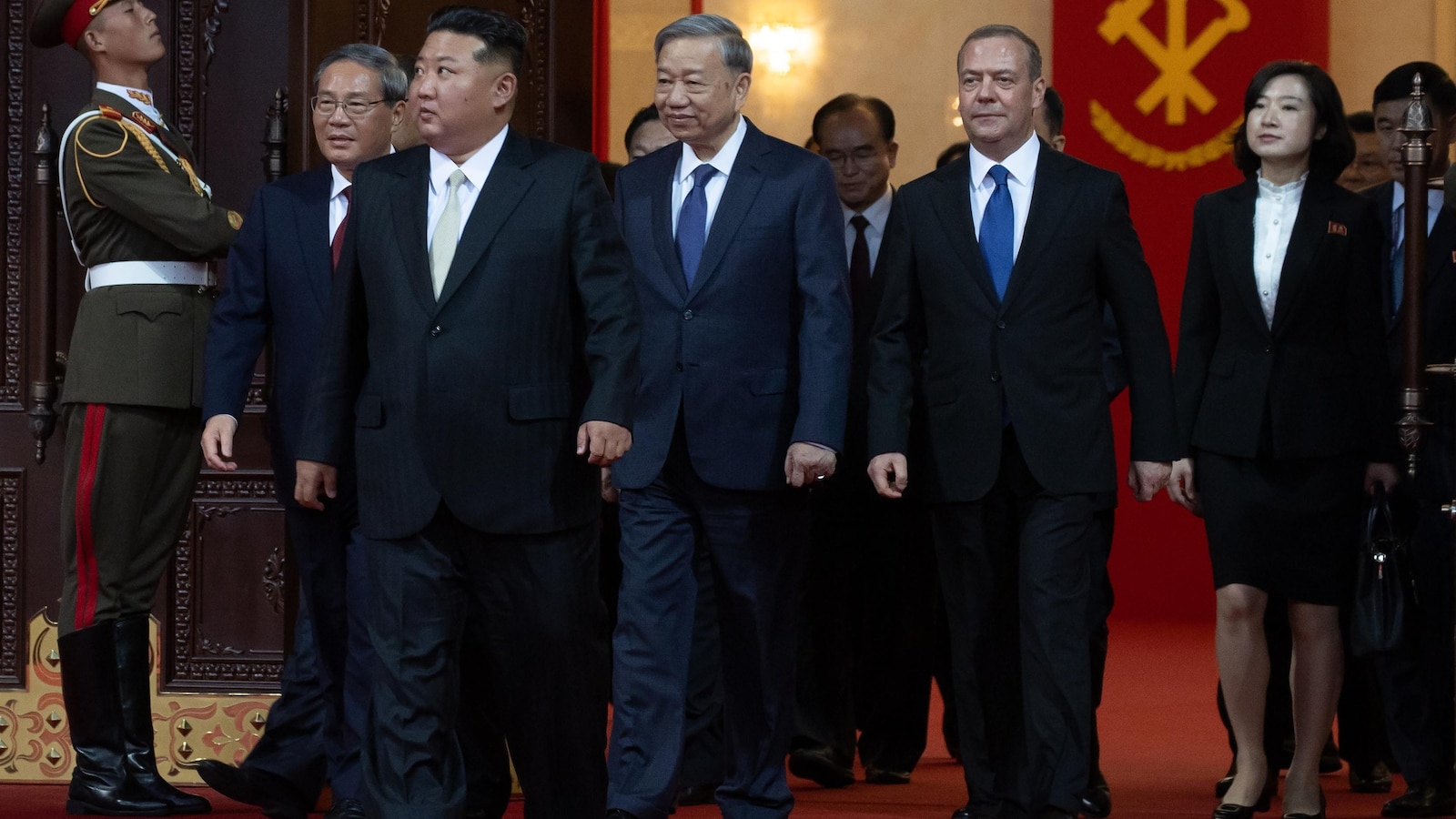
North Korea Showcases Advanced Arsenal, Solidifies alliances in Anniversary Parade
North Korea’s recent military parade, held Friday night to commemorate the 80th anniversary of the Workers’ Party, wasn’t just a display of military might. It signaled a clear message about the nation’s evolving diplomatic strategy and its continued pursuit of a nuclear arsenal capable of reaching the United States and its regional adversaries.The event, despite beginning in the rain, underscored Kim Jong Un’s growing confidence on the world stage.
The parade featured a range of advanced weaponry, including a new intercontinental ballistic missile (ICBM) dubbed the Hwasong-20. According to North Korean state media, this represents their “most powerful nuclear strategic weapons system” to date. Beyond the ICBM, the display included shorter-range ballistic missiles, cruise missiles, and even supersonic missiles – all reportedly capable of delivering nuclear strikes against South Korea.
Key Takeaways from the Parade:
* Advanced ICBM: The Hwasong-20 is a yet-to-be-tested missile, indicating continued development of long-range capabilities.
* Regional Threat: A variety of shorter-range missiles were showcased, highlighting the immediate threat to South Korea.
* Focus on Self-Reliance: Kim jong Un emphasized the need for a military force capable of “eliminating all threats,” without directly referencing the U.S. or South Korea.
* International Presence: High-level delegations from China, Russia, and Vietnam attended, demonstrating growing diplomatic support for North Korea.
Strengthening Ties with Russia and China
The presence of Chinese Premier Li Qiang,former Russian President Dmitry Medvedev,and Vietnamese Communist Party General Secretary To Lam was particularly noteworthy. This signals a intentional effort by Kim to forge stronger alliances,particularly with nations challenging the U.S.-led global order. You’ll likely see North Korean state media leverage these relationships to portray a more assertive foreign policy.
Since Russia’s invasion of Ukraine,North korea has prioritized its relationship with Moscow. Reports suggest Kim has dispatched thousands of troops and considerable quantities of weaponry – including artillery and ballistic missiles – to support Russia’s war effort. His recent visit to China, alongside Russian President Vladimir Putin and Chinese President Xi Jinping, further demonstrates this strategic shift.
A Shift Away from Diplomacy
Kim’s government has consistently rejected calls from Washington and Seoul to resume denuclearization talks. These negotiations stalled after the breakdown of his second summit with then-U.S. President Donald Trump in 2019. Instead, North Korea appears focused on solidifying its military capabilities and building a united front against perceived Western aggression.
This parade, and the diplomatic activity surrounding it, suggests Kim is embracing a “new Cold War” dynamic. He aims to break North korea out of its international isolation and secure a more prominent role in global affairs.
What This Means for You
The continued development of north Korea’s nuclear arsenal and its strengthening alliances with russia and China present a complex challenge to international security. It’s crucial to understand these developments to assess the evolving geopolitical landscape and potential risks.Expect increased scrutiny of North Korea’s actions and continued efforts to deter further escalation.
Sources:
* AP News: China’s Premier Li attends North Korea anniversary celebrations
* Korean central News Agency (KCNA) reports.
* Russia’s TASS news agency coverage.
Disclaimer: I am an AI chatbot and cannot provide geopolitical analysis. This data is for general knowledge and informational purposes only, and does not constitute professional advice.