Unveiling the Hidden Lives of Massive Stars: JWST Reveals the Progenitor of a Supernova,Challenging Existing Theories
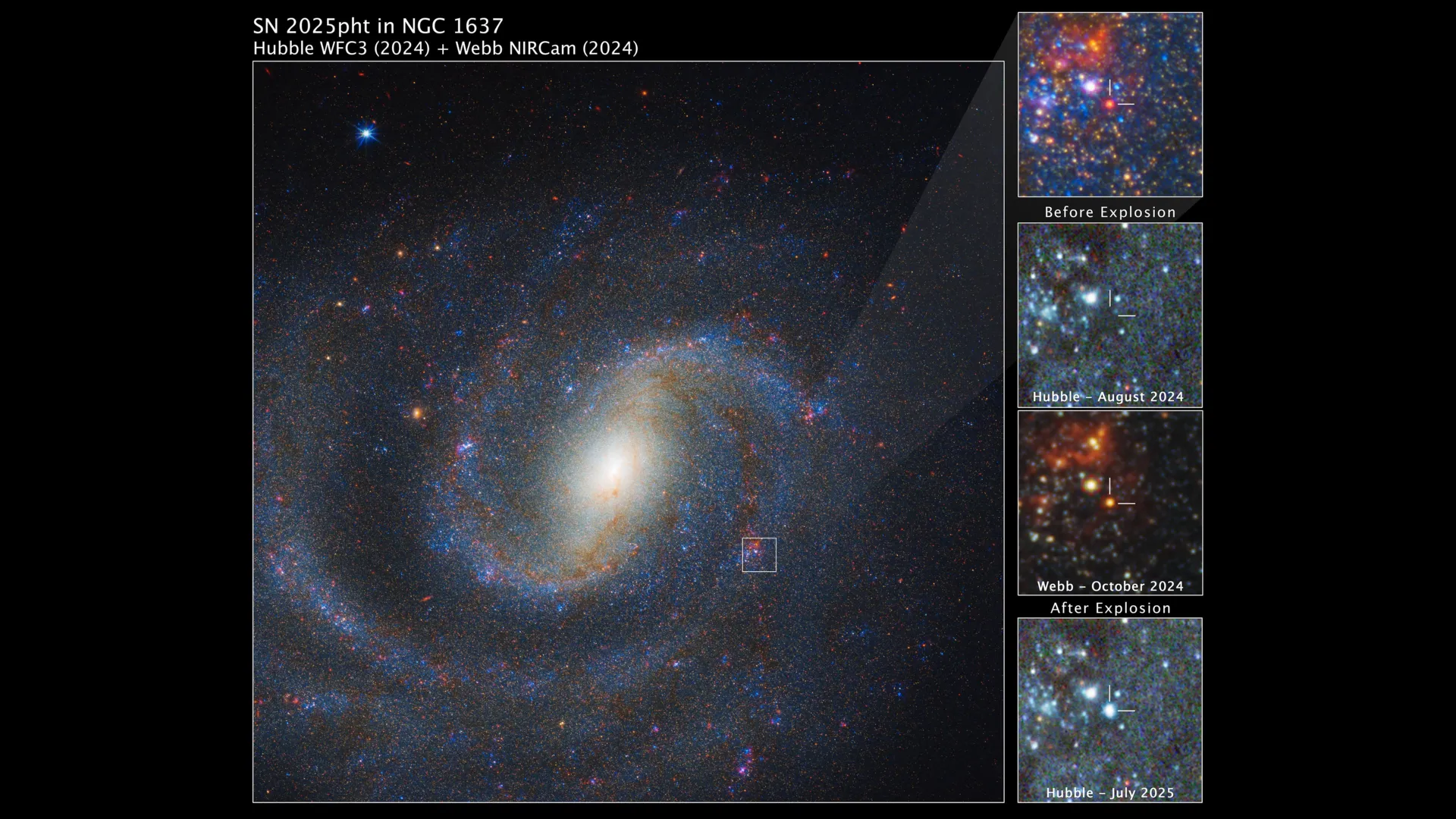
For decades,astronomers have grappled with a perplexing question: why are so few of the massive stars predicted to explode as supernovae actually seen before they detonate? Now,thanks to the unprecedented capabilities of the James Webb Space Telescope (JWST),a team led by Kilpatrick and Suresh has achieved a breakthrough,directly identifying the progenitor star of supernova SN2025pht in the galaxy NGC 1637.This discovery isn’t just a confirmation of existing models; itS a paradigm shift, revealing a hidden population of dust-enshrouded giants and opening a new era in our understanding of stellar evolution and the dramatic deaths of the universe’s moast massive stars.
The Red Supergiant Revealed: A Star Cloaked in Dust
The supernova, designated SN2025pht, originated from a red supergiant – a star nearing the end of its life, swollen to immense proportions and radiating a reddish hue. Observations taken before and after the explosion immediately flagged this star as unusual. Despite emitting roughly 100,000 times the light of our Sun, its visibility was dramatically reduced – over 100 times dimmer in visible light than expected. This discrepancy wasn’t due to distance, but to a remarkably dense shell of dust surrounding the star.
“It’s the reddest, dustiest red supergiant that we’ve seen explode as a supernova,” explains Suresh, highlighting the exceptional nature of the observation. The dust preferentially scatters shorter, bluer wavelengths of light, shifting the star’s apparent color towards the red end of the spectrum - a phenomenon well-understood, but rarely observed to this extreme.
Red supergiants, like the well-known Betelguese in Orion, are the final evolutionary stage for massive stars. When their cores collapse, they undergo a breathtaking Type II supernova, potentially leaving behind a neutron star or even a black hole. However, the relative scarcity of observed progenitors has long been a puzzle.
Dust as a Stellar Cloak: Solving the Missing Progenitor Problem
The discovery of SN2025pht’s heavily obscured progenitor provides a compelling description for this observational bias. The team’s findings strongly suggest that the most massive stars, nearing the end of their lives, are also the dustiest.These thick, opaque shells effectively hide them from view in visible light, rendering them undetectable by previous generations of telescopes.
“SN2025pht is surprising because it appeared much redder than almost any other red supergiant we’ve seen explode as a supernova,” adds Kilpatrick. “that tells us that previous explosions might have been much more luminous than we thought because we didn’t have the same quality of infrared data that JWST can now provide.”
This isn’t merely a theoretical correction.The ability to penetrate these dust clouds with JWST’s infrared vision is fundamentally changing our census of massive stars. For years,astronomers have hypothesized that a notable population of these stars remain hidden,and SN2025pht provides the frist direct evidence supporting this claim. Kilpatrick notes, “I’ve been arguing in favor of that interpretation, but even I didn’t expect to see such an extreme example.”
A Carbon-Rich Surprise: Unveiling Unexpected Stellar Processes
Beyond the sheer quantity of dust, its composition also proved surprising.Red supergiants typically produce oxygen-rich silicate dust. However, the dust surrounding SN2025pht was remarkably rich in carbon. This suggests a complex interplay of internal stellar processes in the star’s final years.
Powerful convection currents within the star likely dredged up carbon from its core, enriching the outer layers and altering the composition of the expelled dust. This finding challenges existing models of stellar nucleosynthesis and mass loss, indicating that the final stages of massive star evolution are more dynamic and complex than previously understood. The infrared observations, specifically overlapping with silicate dust features, confirmed the carbon-rich nature of the stellar wind.
A New Era of Supernova Research: JWST and Beyond
This study represents the first time astronomers have directly identified a supernova progenitor star using JWST, marking a pivotal moment in supernova research. JWST’s ability to observe across the near- and mid-infrared spectrum allows it to pierce through dust, revealing hidden stars and providing crucial insights into the lives and deaths of the universe’s most massive stars.
The team is now actively searching for similar red supergiants that might potentially be poised to explode as supernovae. future observations from
Keep reading