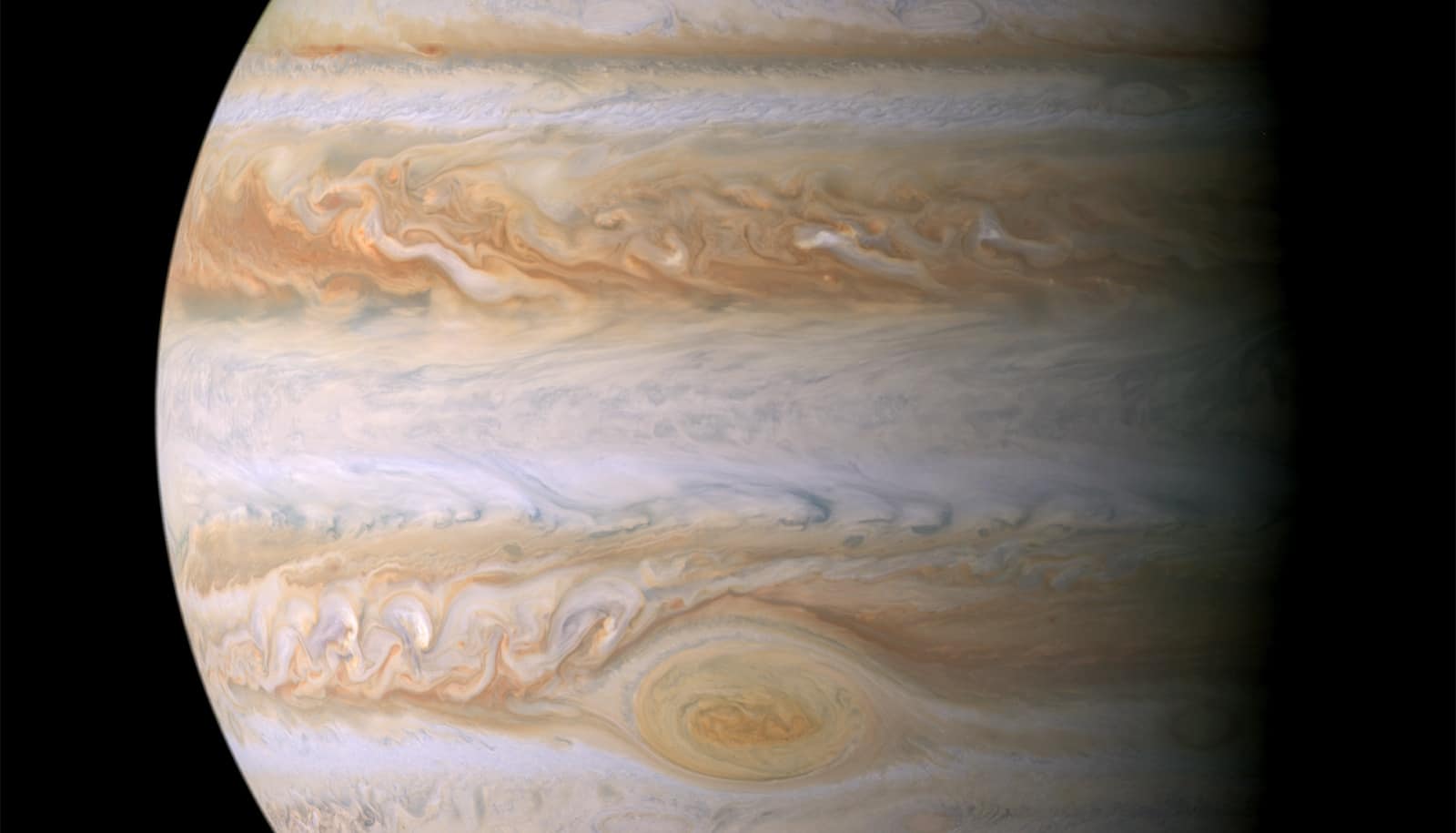
Jupiter: The Architect of Our Solar System – How the Gas Giant Shaped Earth’s Formation and Beyond
For decades, scientists have pieced together the story of our solar system’s birth, a complex narrative of swirling gas, dust, and gravitational forces. Recent research from planetary scientists at Rice University has unveiled a pivotal piece of this puzzle: Jupiter wasn’t just born into the early solar system, it actively shaped it, particularly influencing the formation of Earth and the unique architecture of our planetary neighborhood. This discovery, rooted in the analysis of ancient meteorites and bolstered by observations of young star systems, fundamentally alters our understanding of how our corner of the cosmos came to be.
the Second Generation of Planetary Building Blocks
The prevailing theory of planet formation posits that planets arise from the gradual accumulation of dust and gas within a protoplanetary disk surrounding a young star. However, a long-standing mystery has plagued this model: the existence of chondrites. These stony meteorites, considered some of the most primitive materials in our solar system, contain chemical and chronological signatures indicating they formed later - roughly 2 to 3 million years after the initial formation of solid materials. Why this delay?
The Rice University team, led by Assistant Professor of Earth, Environmental, and Planetary Sciences, Dr. Andrea Izidoro, proposes a compelling answer: jupiter. Their research demonstrates that the gas giant’s immense gravity created “cosmic traffic jams” within the protoplanetary disk. These disruptions prevented smaller particles from spiraling into the sun, instead forcing them to accumulate in dense bands. It’s within these bands that a second generation of planetesimals – the rocky seeds of planets – were born.
“Chondrites are like time capsules from the dawn of the solar system,” explains Dr. Izidoro. “They’ve fallen to Earth over billions of years,offering invaluable clues about our cosmic origins. Our results show that jupiter itself created the conditions for their delayed birth.”
Isotopic Fingerprints and the Preservation of Solar System Diversity
This isn’t just about timing. The research also elegantly explains the distinct isotopic signatures observed in meteorites. Isotopes are variations of elements, and their distribution can reveal the origin and history of materials. The team’s model suggests that Jupiter’s early growth and the resulting gap it carved in the gas disk effectively separated materials from the inner and outer solar system, preserving their unique isotopic compositions.
“Our model ties together two things that didn’t seem to fit before-the isotopic fingerprints in meteorites and the dynamics of planet formation,” says Srivastava, a graduate student involved in the research. “Jupiter grew early, opened a gap, and that process protected the separation of materials, preserving their distinct signatures. It also created new regions where planetesimals could form much later.”
Why Earth Isn’t a scorched world: Jupiter’s Protective Role
The implications extend far beyond the formation of meteorites.Jupiter’s influence also explains a crucial aspect of our solar system’s architecture: why Earth, Venus, and Mars orbit relatively close to the sun, rather than being pulled into it.
Many planetary systems observed around other stars exhibit a different pattern, with planets spiraling inward towards their host star. Jupiter, however, acted as a gravitational barrier, halting the inward migration of these young planets. By cutting off the flow of gas and material towards the inner solar system, Jupiter effectively trapped these growing worlds in the “terrestrial region,” allowing Earth and its neighbors to eventually form.
“Jupiter didn’t just become the biggest planet-it set the architecture for the whole inner solar system,” emphasizes Dr. Izidoro. “Without it, we might not have Earth as we certainly know it.”
Observational Evidence and Future Exploration
This theoretical framework isn’t just based on meteorite analysis. Astronomers using the Atacama Large Millimeter/submillimeter Array (ALMA) telescope are now observing similar ring-and-gap structures in young star systems.These observations provide compelling visual evidence of giant planets forming and actively reshaping their birth environments, mirroring the processes believed to have occurred in our own solar system.
“Looking at those young disks, we see the beginning of giant planets forming and reshaping their birth environment,” Dr. Izidoro notes. “Our own solar system was no different.Jupiter’s early growth left a signature we can still read today, locked inside meteorites that fall to Earth.”
This research, supported by the National Science Foundation and Rice University’s Centre for Research Computing, represents a significant leap forward in our understanding of planetary formation. It highlights
Worth a look