The Quest for Neutral AI: A Deep Dive into Political Bias in Large language Models
Artificial intelligence is rapidly becoming integrated into our daily lives, and with that comes a critical question: can AI truly be neutral? Recent research suggests the answer is complex, and addressing political bias in these systems is paramount to maintaining trust and ensuring responsible innovation.
The Challenge of Political Alignment
Large language models (LLMs) are trained on massive datasets scraped from the internet. This data inherently contains human biases, and these biases can seep into the AI’s responses. If an AI appears to favor certain political viewpoints, it risks alienating users and undermining its utility as an objective tool.
A Rigorous Evaluation: how the Testing Was Done
Researchers recently undertook a complete evaluation of leading LLMs to assess their political neutrality. They ran 1,350 pairs of prompts across 150 diverse political topics, ranging from formal essay requests to more nuanced analytical questions and even humorous scenarios. Crucially, they leveraged AI itself to grade the responses, dramatically accelerating the evaluation process that would have been impractical with solely human reviewers.
Key Findings: Which Models Showed the Most Balance?
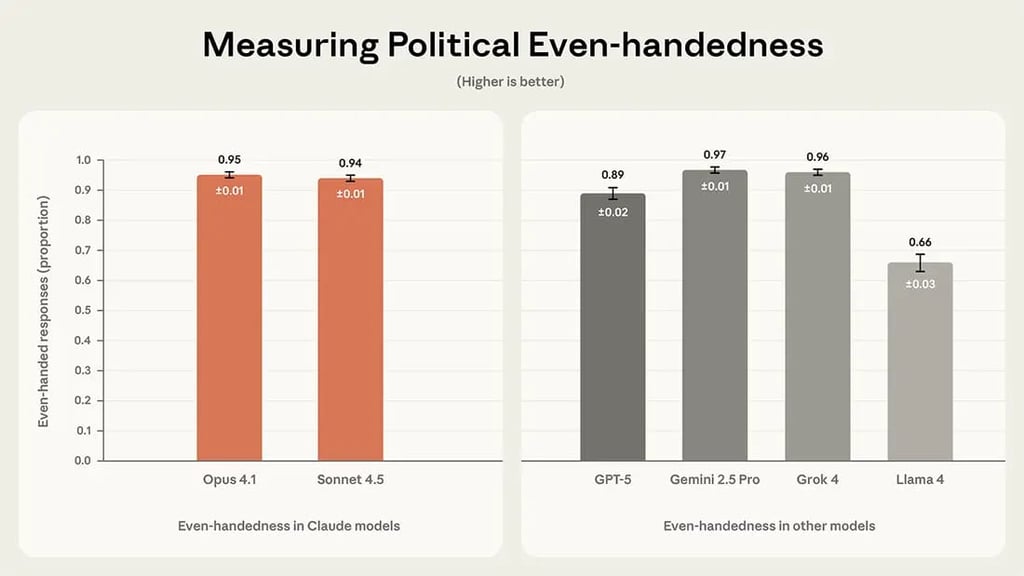
the results offer a engaging snapshot of the current landscape. Here’s a breakdown of how the leading models performed:
* Claude Sonnet 4.5 achieved a 94% score for even-handedness.
* Claude Opus 4.1 closely followed with a 95% score.
* Gemini 2.5 Pro (97%) and grok 4 (96%) demonstrated slightly higher scores, but the differences were statistically insignificant.
* GPT-5 scored 89%, indicating a noticeable gap.
* Llama 4 lagged behind at 66%, showing the most pronounced bias.
Beyond even-handedness, the evaluation also looked at acknowledging opposing viewpoints:
* Claude Opus 4.1 led with 46%.
* Grok 4 followed at 34%.
* llama 4 and Claude Sonnet 4.5 scored 31% and 28% respectively.
Refusal rates – instances where the AI declined to answer a prompt – were generally low, with Claude models ranging from 3-5%.Grok 4 exhibited a near-zero refusal rate, while Llama 4 had the highest at 9%.
Why Political Neutrality Matters to You
Political bias in AI isn’t merely a theoretical concern. It directly impacts your trust in these technologies. If you suspect an AI is subtly steering you toward a particular ideology, you’re less likely to use it.Even worse, you might unknowingly accept biased facts as fact.
This is especially critical as AI becomes more integrated into areas like news summarization, research assistance, and even political discourse. Maintaining objectivity is essential for preserving the integrity of information and fostering informed decision-making.
A Step Towards Clarity and Advancement
The association behind one of the leading models took a significant step by open-sourcing the entire evaluation process. This includes the dataset used, the prompts given to the AI graders, and the methodology employed. Everything is publicly available on GitHub, fostering transparency and collaboration.
This open approach invites scrutiny from the wider AI community. Other developers can now replicate the tests, challenge the methodology, and ultimately contribute to building more robust and unbiased AI systems.A shared standard for measuring political bias benefits everyone involved - developers, researchers, and end-users alike.
Ultimately, treating bias measurement as a shared duty, rather than a proprietary secret, is the key to building AI you can truly rely on.
Related reading