Unveiling the Sun’s Secrets: Scientists Observe Neutrinos Transforming Carbon into Nitrogen
Neutrinos, often dubbed “ghost particles” due to their elusive nature, remain one of the most captivating mysteries in modern physics. Trillions of these subatomic particles stream through our bodies every second, interacting with matter so rarely they typically leave no trace.Born from nuclear reactions – notably within the heart of the Sun – their incredibly weak interactions present a formidable challenge to researchers seeking to understand their properties and role in the universe.Now, a groundbreaking experiment has added a crucial piece to this puzzle, directly observing solar neutrinos converting carbon atoms into nitrogen within a massive, deeply-shielded detector.
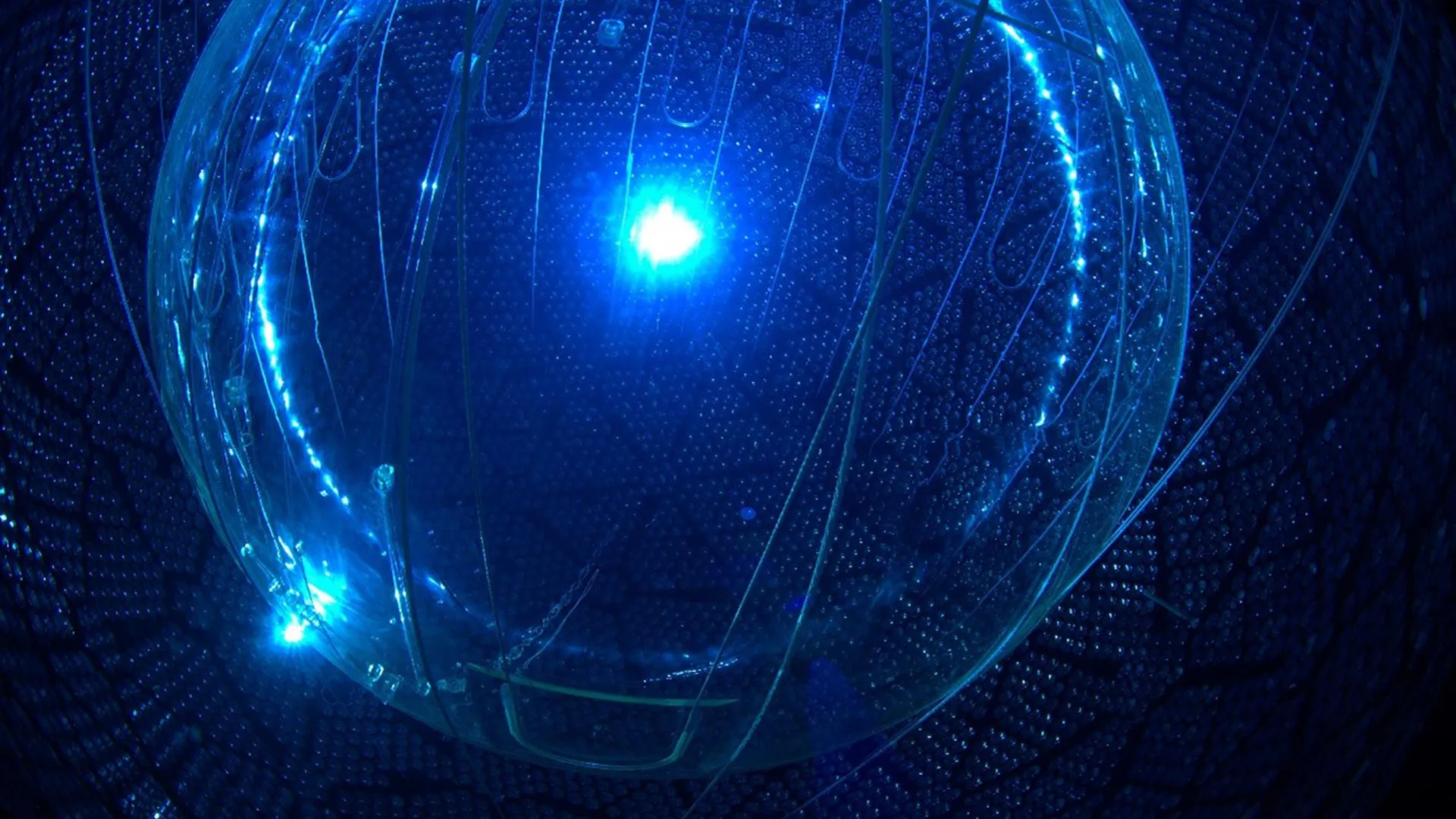
This landmark achievement stems from a collaborative effort spearheaded by researchers at the University of Oxford, utilizing the SNO+ (Sudbury Neutrino Observatory+) detector. Located two kilometers underground at SNOLAB in Sudbury, Canada, SNO+ benefits from the unique environment provided by an active mine. This subterranean location offers critical shielding against cosmic rays and background radiation – interference that would or else obscure the delicate signals generated by neutrino interactions.
The ’Delayed Coincidence’ Technique: Isolating a Fleeting Signal
The team focused on a specific, incredibly rare event: a high-energy neutrino colliding with a carbon-13 nucleus, transforming it into nitrogen-13, a radioactive isotope with a relatively short lifespan of approximately ten minutes. Detecting this transformation required a complex approach known as a ‘delayed coincidence’ technique. This method hinges on identifying two distinct,time-correlated bursts of light.
The frist flash occurs immediately as the neutrino strikes the carbon-13. The second appears minutes later, resulting from the radioactive decay of the newly formed nitrogen-13. This paired signal acts as a powerful filter, allowing scientists to confidently distinguish genuine neutrino interactions from the constant background ‘noise’ inherent in any complex experiment.
Over a 231-day period, spanning from May 4, 2022, to June 29, 2023, the SNO+ detector registered 5.6 instances of this carbon-to-nitrogen conversion. Remarkably, this observation aligns precisely with theoretical predictions, which estimated 4.7 such events would occur due to solar neutrinos during the same timeframe. This validation strengthens our understanding of both neutrino behavior and the nuclear processes occurring within the Sun.
A New era in Neutrino Physics and Stellar Understanding
This isn’t merely a confirmation of existing theory; it’s a significant leap forward.Neutrinos are uniquely positioned to reveal fundamental insights into the workings of the universe. Their behavior is anomalous, defying simple explanations, and they are intrinsically linked to stellar evolution, nuclear fusion, and the very fabric of cosmic progress.
As lead author Gulliver Milton, a PhD student at the University of Oxford, explains, “Capturing this interaction is an extraordinary achievement. Despite the rarity of the carbon isotope, we were able to observe its interaction with neutrinos, which were born in the Sun’s core and traveled vast distances to reach our detector.”
This new measurement unlocks exciting possibilities for future research, paving the way for investigations into other low-energy neutrino interactions. Co-author Professor Steven Biller emphasizes the transformative potential: “Solar neutrinos themselves have been an intriguing subject of study for many years, and the measurements of these by our predecessor experiment, SNO, led to the 2015 Nobel Prize in physics. It is remarkable that our understanding of neutrinos from the Sun has advanced so much that we can now use them for the first time as a ‘test beam’ to study other kinds of rare atomic reactions!”
Building on a Nobel Legacy: The SNO+ Evolution
SNO+ represents the next generation of research building upon the groundbreaking work of its predecessor, the original SNO experiment. SNO famously demonstrated that neutrinos oscillate – changing between three distinct “flavors” (electron, muon, and tau) – as they journey from the Sun to Earth. This discovery, led by Arthur B. McDonald, resolved the decades-long “solar neutrino problem” and earned the 2015 Nobel Prize in Physics.
“This discovery uses the natural abundance of carbon-13 within the experiment’s liquid scintillator to measure a specific, rare interaction,” explains Dr. Christine Kraus, a staff scientist at SNOLAB.”To our knowlege, these results represent the lowest energy observation of neutrino interactions on carbon-13 nuclei to date and provides the first direct cross-section measurement for this specific nuclear reaction to the ground state of the resulting nitrogen-13 nucleus.”
The SNO+ experiment continues to push the boundaries of neutrino physics, offering a unique window into the heart of the Sun and the fundamental forces governing our universe. This latest result is not just a confirmation of existing knowledge, but a powerful new tool for exploring the unseen world of
Keep reading