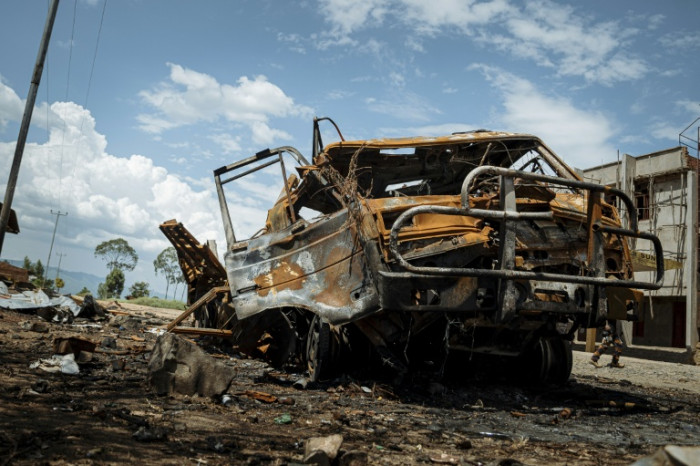
Escalating Conflict in Eastern DRC: M23 Advances Raise Fears of Regional War
The situation in the Democratic Republic of Congo (DRC) is rapidly deteriorating. Recent gains by the M23 rebel group, backed by Rwanda, have triggered a perilous escalation, threatening to engulf the region in a wider conflict. The capture of key cities and strategic locations, coupled with accusations of direct Rwandan military involvement, demands urgent attention and a nuanced understanding of the complex dynamics at play.
A Rapidly Shifting Battlefield
Just days ago, on December 4th, the M23 seized Uvira, a critical frontier city bordering Burundi. This strategic victory is notably alarming as it effectively cuts off the DRC from potential military support from its neighbor. Uvira’s fall isn’t just a territorial loss; it’s a logistical and strategic blow, allowing the M23 to consolidate control over a vital border crossing. The offensive, launched at the beginning of December in South Kivu province, continues to push westward. On Saturday, the administrative center of Kipupu fell without resistance following the withdrawal of Burundian troops stationed there.
This follows the earlier capture of Goma and Bukavu, major economic hubs in the DRC’s resource-rich eastern provinces. The speed and efficiency of these advances, coupled with the apparent lack of sustained resistance, point to notable external support for the M23.
Accusations of Rwandan Involvement & International Response
The international community is increasingly vocal in its condemnation of Rwanda’s role. U.S. Secretary of State Marco Rubio, in a statement on X (formerly Twitter), asserted that rwanda’s actions are a ”clear violation of the Washington Accords” signed under the previous management, promising a response to ensure commitments are upheld. While details of that response remain undisclosed, the statement signals a growing frustration with Rwanda’s destabilizing activities.
These accusations aren’t new. U.S. Ambassador to the United Nations, Mike Waltz, recently presented compelling evidence to the UN Security Council, alleging that the Rwandan Defense Forces (RDF) have been providing substantial support to the M23. This includes not only materiel,logistics,and training,but also direct participation in combat with an estimated 5,000 to 7,000 troops. Waltz specifically cited the deployment of complex weaponry, including surface-to-air missiles, drones, and artillery, further substantiating the claims of direct Rwandan involvement.
Burundi’s Retreat and the Risk of Regional Conflagration
The situation is further complex by the withdrawal of Burundian troops. Thousands of soldiers, deployed to support the DRC government, were forced to fall back towards Baraka after the fall of Uvira. This retreat is proving perilous, with Burundian forces facing harassment from both the M23 and allied Twirwaneho militia fighters along the challenging mountain terrain. Critically, they are reportedly cut off from ammunition resupply, exacerbating their vulnerability.
The potential for escalation is now extremely high. UN peacekeeping chief Jean-Pierre Lacroix has warned that the M23’s advances are “reviving the spectre of a regional conflagration with incalculable consequences,” even raising the possibility of the DRC fragmenting along ethnic and regional lines - a scenario reminiscent of the Balkan conflicts. The proximity of Uvira to Burundi’s economic capital, Bujumbura, across Lake Tanganyika, has long been a source of concern for Burundi, and the city’s fall substantially raises the stakes.
Humanitarian Crisis and Allegations of Atrocities
Beyond the geopolitical implications, the conflict is fueling a devastating humanitarian crisis. Over 200,000 peopel, primarily civilians, have been displaced by the fighting, according to the United Nations. recent reports from UN experts detail disturbing allegations of summary executions and forced mass displacements carried out by the Rwandan army and the M23, painting a grim picture of the human cost of the conflict.
Rwanda’s Justification and the Path Forward
Rwanda consistently denies providing military support to the M23. Instead,Kigali argues that it faces an existential threat from the presence of ethnic Hutu militants across the Congolese border,groups with links to the 1994 Rwandan genocide. While this concern is legitimate, it does not justify supporting a rebel group that destabilizes a neighboring country and perpetrates violence against civilians.
Addressing this crisis requires a multi-faceted approach:
* Robust International Pressure on Rwanda: The United States and the international community must exert significant pressure on Rwanda to
Related reading