The AI-Powered Hospital: A Course Correction Towards Hybrid Intelligence
For years, the vision of a fully automated hospital – streamlined by Artificial Intelligence, diagnosing with algorithmic precision, and freeing clinicians from tedious tasks – captivated the healthcare industry. billions were invested in the promise of autonomous AI solutions.However,a significant shift is underway. New data reveals a growing consensus: while AI holds immense potential, it’s not a replacement for human expertise, but a powerful enhancement to it. The future of healthcare isn’t about removing the human element; it’s about building a better team.
This realization isn’t a rejection of technology, but a pragmatic response to the complexities of real-world clinical practice. A recent market survey, released in November 2025 by Carta Healthcare, in partnership with Reaction Data, succinctly captures this sentiment: “Good AI is not good enough.” The industry is decisively pivoting towards Hybrid Intelligence – a model that strategically blends the speed and efficiency of AI with the critical judgment and nuanced understanding of human clinicians.
The Erosion of Trust in “Black Box” AI
The AI in Hospitals & Health Systems survey paints a clear picture. Despite substantial investment in fully autonomous AI systems, a surprisingly low 12.5% of healthcare organizations report these tools delivering the most value. This isn’t driven by technophobia,but by a basic concern for patient safety and responsible risk management.
The data highlights a critical vulnerability: 62.5% of healthcare leaders identify “misinterpretation of data” as the primary risk associated with AI operating without human oversight. In a clinical setting, an AI “hallucination” – a confidently presented but factually incorrect output – isn’t a mere technical glitch.it’s a potential threat to patient well-being, and a liability hospitals simply cannot afford.
This represents a crucial maturation point for the healthcare AI sector. The initial enthusiasm for rapid deployment is being tempered by the inherent challenges of complex clinical data. Current Large Language Models (LLMs) and algorithms, while impressive, frequently enough struggle to grasp the contextual subtleties and intricate details that are commonplace in patient records.
From Automation to Augmentation: The Rise of the “Force Multiplier”
The survey data strongly supports a new operational paradigm: AI as a collaborative teammate, not a replacement for skilled professionals. The focus is shifting from automating tasks to augmenting human capabilities.
Here’s what the data reveals:
* Clinician Involvement is Paramount: 75% of respondents consider clinician involvement in the design and deployment of AI solutions “critically important.” This emphasizes the need for AI tools to be built with clinicians, not for them.
* Human Validation is Non-Negotiable: 75% of organizations rely on human validation to ensure the trustworthiness of AI outputs. This underscores the importance of a “second set of eyes” to verify AI-generated insights.
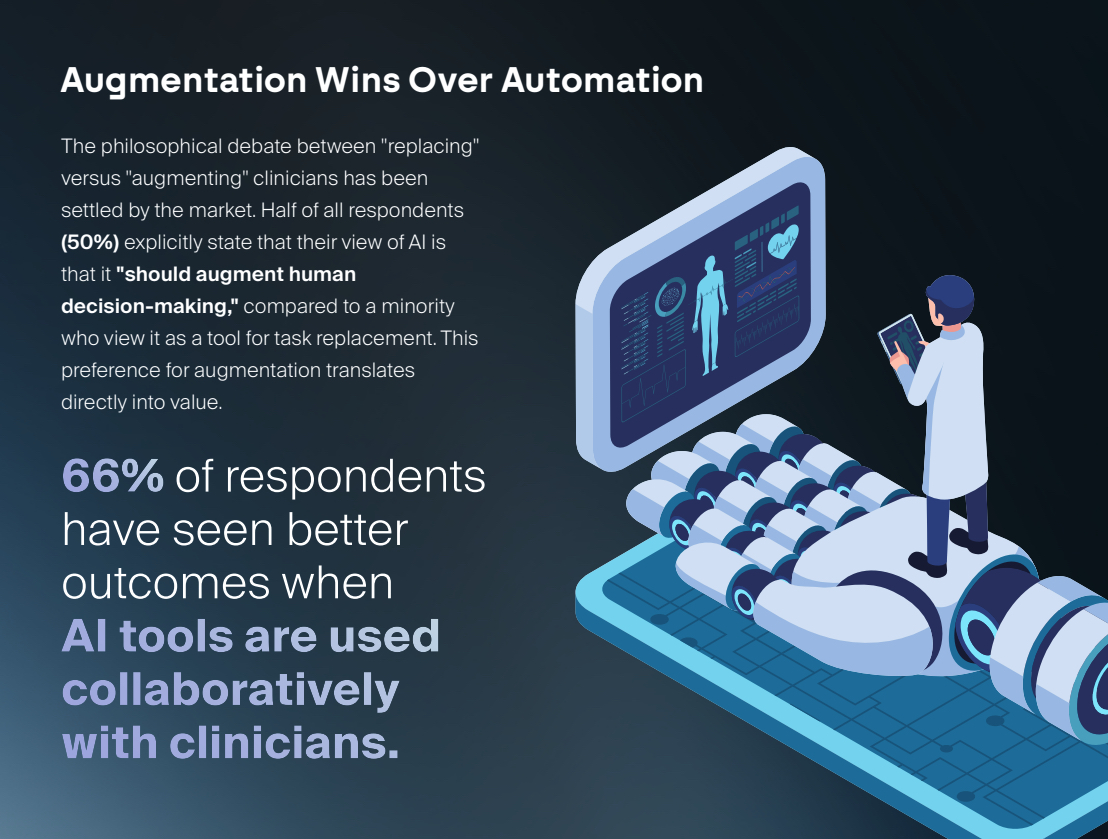
* augmentation, Not Replacement: 50% explicitly state that AI’s primary role is to “augment human decision-making,” rejecting the outdated “task replacement” narrative.
“Healthcare leaders aren’t looking for a magic switch to automate healthcare,” explains Brent Dover, CEO of Carta Healthcare.”They want a force multiplier-AI that respects clinical expertise, demands human validation, and integrates seamlessly into existing workflows.”
This aligns with the growing adoption of “Human-in-the-Loop” (HITL) workflows. Hospitals are increasingly seeking solutions that leverage AI to handle the time-consuming aspects of data abstraction and processing, while reserving the final, critical step – validation and informed decision-making – for experienced clinicians.
Why Hybrid Intelligence is the Winning Strategy for Healthcare
The preference for Hybrid Intelligence isn’t arbitrary; it’s rooted in the unique characteristics of healthcare data.Unlike the relatively structured data found in finance or retail, clinical records are often unstructured, messy, and brimming with nuance. “Black box” AI, which operates without openness and obscures its reasoning, is proving inadequate for navigating this complex landscape.
The hybrid model offers a crucial safety net.It harnesses the speed and scalability of technology to automate approximately 80% of routine work, while ensuring that the remaining 20% – the cases demanding critical judgment, complex reasoning, and ethical considerations – are carefully vetted by qualified professionals.
Here’s a breakdown of the benefits:
* Reduced Errors: Human oversight minimizes the risk of AI-driven errors and ensures patient safety.
* Improved Accuracy: Clinicians can
Worth a look