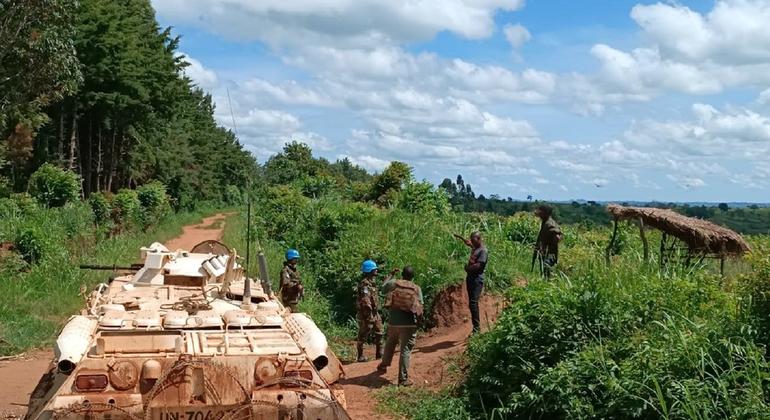
UN Security Council Renews MONUSCO Mandate Amidst Escalating Conflict in Eastern DRC, Condemns Rwandan Support for M23
The United Nations Security Council has voted to renew the mandate of the United Nations Institution Stabilization Mission in the Democratic Republic of Congo (MONUSCO) until December 31, 2024, but not without a stark warning regarding the escalating violence in the eastern DRC and direct accusations of Rwandan support for the M23 rebel group. Resolution 2808 (2024), adopted on March 29th, underscores the Council’s deep concern over the deteriorating security situation, particularly in North and South kivu provinces, and it’s commitment – albeit increasingly strained - to stabilizing the volatile region.
This renewal comes at a critical juncture.The M23, a resurgent armed group, has made significant territorial gains in recent months, culminating in the capture of Uvira, a strategically vital city on the shores of Lake Tanganyika. This seizure is viewed with grave concern by the international community, as it threatens to destabilize not only the DRC but the wider Great Lakes region.The resolution explicitly condemns the M23’s actions and,crucially,points to credible evidence of “support and participation of the Rwanda Defense Forces” in facilitating these advances. This direct accusation represents a significant escalation in international pressure on Rwanda.
MONUSCO’s Evolving Role: A Mandate Focused on Civilian Protection and Stabilization
For over two decades, MONUSCO has been tasked with bringing stability to the DRC, a nation plagued by decades of conflict, political instability, and humanitarian crises. The current mandate, as outlined in Resolution 2808, focuses on a multi-faceted approach, prioritizing the protection of civilians and supporting the Congolese government in its efforts to restore security. Key components of MONUSCO’s mission include:
* Civilian Protection: Protecting civilians under the threat of physical violence remains paramount. This involves proactive monitoring, early warning systems, community engagement, and local mediation efforts.
* Robust intervention: MONUSCO is authorized to use “all necessary measures” to prevent, deter, and stop attacks on civilians, particularly in displacement and refugee camps.
* Targeted Offensive Operations: The Force Intervention Brigade (FIB), a specialized component of MONUSCO, is empowered to neutralize armed groups through targeted offensive operations, often in collaboration with the Congolese armed forces (FARDC).
* Ceasefire Support: MONUSCO actively supports a permanent ceasefire,assisting in the implementation and monitoring of the Doha ceasefire oversight and verification mechanism,alongside regional verification efforts.
* Disarmament, Demobilization & Reintegration (DDR): The mission provides crucial support for DDR programs, aiming to reintegrate former combatants into civilian life.
* Security Sector Reform: MONUSCO contributes to strengthening the DRC’s security sector, promoting professionalism and accountability within the FARDC.
* Human Rights & Arms Embargo Monitoring: The mission diligently monitors and reports on human rights abuses and violations of international humanitarian law, while also observing and reporting on cross-border arms flows, adhering to the guidelines set forth by the UN Group of Experts established under resolution 1533. (Full resolution text available here).)
International Reactions: A divided Council Reflects Regional Complexity
The vote on resolution 2808 wasn’t unanimous in its tone. While all Council members supported the mandate renewal,diverging perspectives highlighted the complex geopolitical dynamics at play.
France,as the penholder on the DRC file,emphasized the urgency of the situation and called on all parties to uphold their commitments to lasting peace. Ambassador Jérôme Bonnafont stressed the need for a thorough solution encompassing both security and political dimensions.
The United States echoed these concerns, condemning the M23’s advances, which were “yet again disrupted” by Rwandan support. Ambassador Jennifer Locetta urged the M23 to promptly withdraw 75km from Uvira and fully comply with the Doha Framework Agreement. This strong statement underscores Washington’s growing frustration with the continued instability and its attribution of blame to Rwanda.
However, China and Russia, while supporting the renewal, cautioned against politicizing the mission and emphasized the importance of respecting the DRC’s sovereignty. Ambassador Sun Lei of China warned against external actors exploiting the situation for economic gain, advocating for a truly neutral approach to peacebuilding. Russia’s Ambassador Anna Evstigneeva echoed this sentiment, calling for detailed proposals on MONUSCO’s ceasefire monitoring role by March 1, 2
- Gyeonggi Province Declares Financial Emergency Amid Mounting Debt and Structural Reforms
- Ibrahim Salah: Moroccan Winger Set for New Club Transfer
- WTO: Global Trade Remains Resilient in Q1 2026 Despite Middle East Conflict (newsdirectory3.com)
- Qatar Reports Progress in Diplomatic Efforts to End US-Iran Conflict (archyworldys.com)