Beyond Throughput: Achieving Optimal LLM Performance with Disaggregated Inference and NVIDIA DGX B200
Large Language Models (LLMs) are rapidly transforming industries, but delivering a seamless user experience – fast responses and cost-effective operation – presents a significant challenge. simply maximizing teh number of tokens generated per second (throughput) isn’t enough. The key lies in optimizing for goodput: a metric that balances speed and quality, ensuring both low latency and efficient resource utilization.
This article dives into the innovative approach of disaggregated inference, pioneered by the DistServe team, and how cutting-edge hardware like the NVIDIA DGX B200 is making it a reality.We’ll explore why traditional performance metrics fall short and how a shift in focus to goodput unlocks the true potential of LLMs.
The Limitations of Throughput
For a long time, LLM performance was measured solely by throughput – the total number of tokens a system could generate per second. While higher throughput translates to lower costs per token,it doesn’t tell the whole story.
Imagine a system churning out tokens quickly, but with noticeable delays between each one. Users don’t experience a smooth, interactive conversation. They experience latency – the time it takes to receive a response. Often, maximizing throughput requires sacrificing latency, creating a frustrating user experience.
Introducing Goodput: A Holistic Metric
The DistServe team recognized this trade-off and introduced “goodput” – a more nuanced metric. Goodput measures throughput while meeting user-defined latency objectives, also known as Service Level Objectives (SLOs).
Think of it this way: throughput is what the system can do,while goodput is what the user experiences.Goodput prioritizes both cost-efficiency and service quality, leading to optimal performance and a superior user experience. It’s the metric that truly reflects the health of an LLM-serving system.
Prefill/Decode Disaggregation: The Key to goodput
So,how do you achieve optimal goodput? The DistServe research revealed a crucial insight: separating the two core stages of LLM processing – prefill and decode – onto diffrent GPUs substantially improves performance.
* Prefill: This initial stage processes the user’s input and generates the first token. It’s computationally intensive.
* Decode: This stage generates subsequent tokens,predicting each one based on the previous output. It’s more memory intensive.
Traditionally, both prefill and decode ran on the same GPU, leading to resource contention and slower response times. By dedicating seperate GPUs to each task – compute-intensive prefill on one set, and memory-intensive decode on another - interference is minimized, and both processes run faster. This is known as prefill/decode disaggregation.
“Previously, if you put these two jobs on a GPU, they would compete with each other for resources, which could make it slow from a user perspective,” explains Junda Chen, a doctoral candidate in computer science at UC San Diego. “Now, if I split the jobs onto two different sets of GPUs… we can fundamentally eliminate the interference between the two jobs, making both jobs run faster.”
NVIDIA DGX B200: Powering the Future of Disaggregated Inference
This disaggregated approach requires powerful and flexible hardware. That’s where the NVIDIA DGX B200 comes in. Its impressive specifications provide the foundation for running these complex workloads efficiently.
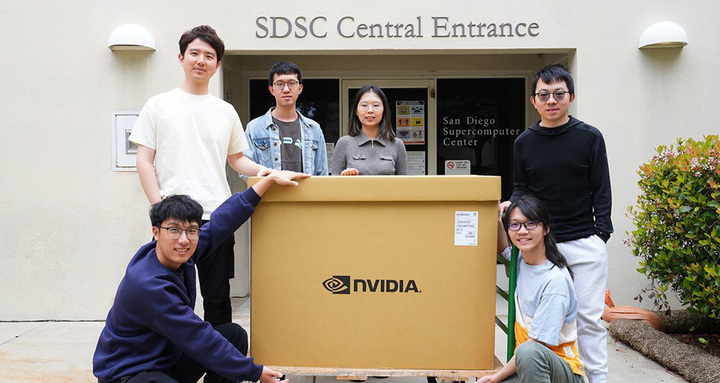
Researchers at UC San Diego are already leveraging the DGX B200 to explore the next generation of low-latency LLM serving. the system’s capabilities allow for continuous scaling of workloads without compromising on speed or quality.
Furthermore, NVIDIA Dynamo – an open-source framework – is designed to accelerate and scale generative AI models, specifically enabling disaggregated inference. It provides the tools needed to unlock the full potential of this approach.
Real-World Impact and Future Directions
The benefits of disaggregated inference extend beyond improved performance. It enables the continuous scaling of LLM applications, paving the way for more complex and refined AI solutions.
At UC San Diego,cross-departmental collaborations are already underway,applying these advancements to research in fields like healthcare and biology. Researchers are actively exploring how AI platforms can accelerate innovation across a wide range of disciplines.
**Learn more about the NVIDIA DGX B200 system [here](https://www.nvidia.com/en-us/data-center/dgx-
Keep reading