The Quiet Revolution in Healthcare Payments: Why XRP and Blockchain are Moving Beyond Speculation
Healthcare payments are facing a crisis. Rising costs, sluggish processing times, and outdated infrastructure are creating notable friction for pharmacies, providers, and patients alike. But beneath the surface of volatile cryptocurrency markets, a quiet revolution is underway. Leading healthcare organizations are no longer asking if blockchain technology can improve payments – they are actively evaluating and implementing XRP-based solutions to modernize their financial ecosystems. This isn’t about hype; it’s about operational necessity.
Are you a healthcare administrator, pharmacist, or provider grappling with the inefficiencies of current payment systems? Or perhaps a patient frustrated with delayed reimbursements and opaque billing? This article will delve into the challenges facing healthcare payments, the potential of XRP and blockchain technology, and the tangible progress being made towards a more efficient future.
The Pain Points of Traditional Healthcare Payments
For decades, healthcare payments have relied on a complex web of intermediaries and legacy systems. This system, while functional, is riddled with problems:
* High Transaction Fees: Each intermediary – from banks to clearinghouses to insurance companies – adds a layer of cost, eroding margins for providers and increasing expenses for patients. A recent report by CAQH estimates that administrative complexity costs the U.S. healthcare system over $265 billion annually, a significant portion attributable to payment inefficiencies. https://www.caqh.org/sites/default/files/2023-06/2023_CAQH_Index.pdf
* Slow Settlement Times: Reimbursements can take weeks, even months, to process, creating cash flow challenges for providers and delaying access to care for patients.This delay is particularly acute for smaller practices and pharmacies.
* Lack of Transparency: The opaque nature of the system makes it difficult to track payments, resolve disputes, and ensure accurate billing.
* Fragmented Infrastructure: Different providers, payers, and pharmacies often use incompatible systems, hindering interoperability and creating reconciliation nightmares.
* Increased risk of Fraud: The complexity of the system creates opportunities for fraudulent claims and billing errors.
These issues aren’t merely inconveniences; they directly impact the quality and accessibility of healthcare.
Why Blockchain – and XRP Specifically – Offers a Solution
Blockchain technology, with its inherent security, transparency, and efficiency, presents a compelling option to traditional healthcare payment rails. But not all blockchains are created equal. XRP, developed by Ripple Labs, stands out due to its specific design features:
* Speed: XRP transactions settle in approximately 3-5 seconds, a dramatic enhancement over the days or weeks required by traditional systems.
* Low Cost: Transaction fees are considerably lower than those associated with credit card processing or wire transfers. According to Ripple, XRP transactions typically cost less than $0.0001.https://ripple.com/solutions/xrp/
* Scalability: XRP is designed to handle a high volume of transactions, making it suitable for the demands of a large-scale healthcare system. It can process 1,500 transactions per second.
* Interoperability: XRP can bridge different currencies and payment networks, facilitating seamless cross-border payments and simplifying reconciliation.
* Security: Blockchain’s decentralized and immutable nature enhances security and reduces the risk of fraud.
These characteristics make XRP particularly well-suited for addressing the specific challenges of healthcare payments.
From Theory to Tangible evaluation: The Shift in Industry Outlook
The conversation surrounding blockchain in healthcare has evolved significantly. We’ve moved beyond theoretical discussions and pilot projects to serious, enterprise-level evaluations. Healthcare operators are now actively exploring how to integrate XRP-based infrastructure into their existing systems.
This shift is evidenced by:
* industry Partnerships: Ripple has been actively engaging with healthcare organizations to explore potential use cases for XRP.
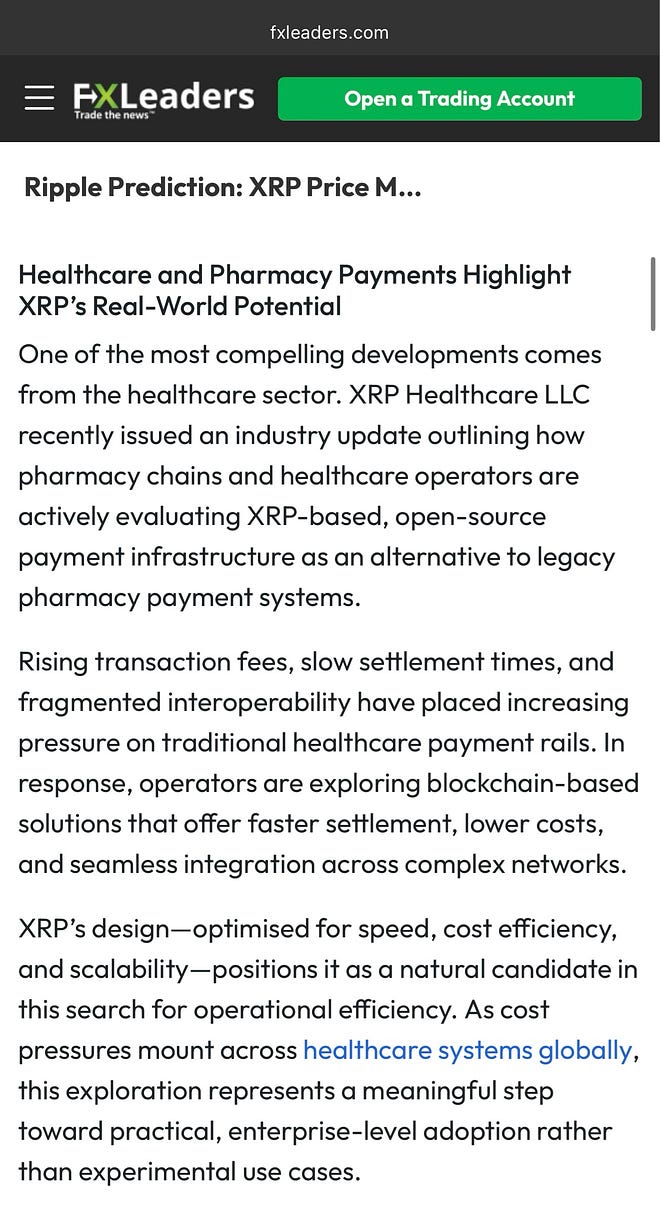
* Internal Evaluations: Pharmacy chains and healthcare operators are conducting internal assessments of XRP’s feasibility and benefits. as recently highlighted by FX Leaders, these evaluations are gaining momentum. http://fxleaders.com/news/2025/12/28/ripple-prediction-xrp-price-masks-progress-on-pharma-payments-regulation-adoption
* **Focus on Practical
Worth a look